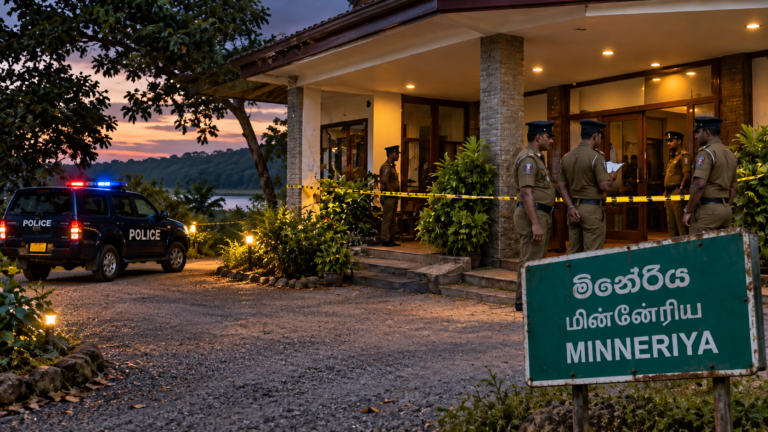
In the heated political landscape of Sri Lanka, the battle for power is once again being fought with an ancient symbol: the Buddha statue. The recent drama in Trincomalee, where a statue was installed under cover of darkness, is not an isolated act of devotion but a calculated political strategy, echoing a playbook used for decades. This incident reveals the unsettling resurgence of “statue politics,” a tool wielded by nationalist forces to consolidate power, ignite ethnic tensions, and pave a path back to the presidency.
The stage for this modern political theater was set in the past. On the night of 15 May 2005, a 12-foot tall Buddha statue was erected near the public market in Trincomalee. This installation was illegal, done without permission on public property. The forces behind this provocative act likely hoped the LTTE would destroy the statue, sparking civil violence and creating the ideal crisis for a new nationalist hero to emerge, one promising to save the nation, race, and faith. Fortunately, that bloodshed was avoided. Tamil civil organizations responded with a peaceful Hartal, and the legal system initially worked. The Magistrate, on the advice of the Attorney General’s Department, ordered the statue’s removal.

However, politics quickly triumphed over the rule of law. The order was never implemented. The JHU’s monk-parliamentarians, led by Aturaliye Ratana, demonstrated in parliament. Monks held processions and a Satyagraha. The Trincomalee police, in a stark reversal, erected a protective fence around the illegal statue and provided it with armed security. An intelligence report revealed that Rear Admiral Sarath Weerasekara assured supporters he would ensure the statue would not be removed. The statue’s existence was secured, and the next step was legal normalization through a fundamental rights petition that contained racially charged language against the then Attorney General. The then Chief Justice Sarath Silva reportedly pressured the AG to drop the case, cementing the victory of political machinations over justice.
This 2004 Trincomalee incident was part of a broader pattern to ignite ethno-religious tensions in the multi-ethnic Eastern Province. Similar installations followed in Pottuvil, leading to violence. This was all occurring in the liminal year of 2005, as President Chandrika Bandaranaike Kumaratunga’s term ended in disillusionment. The political arena was ripe for a new leader, and Mahinda Rajapaksa positioned himself as the champion of nationalist forces, a code for Sinhala-Buddhist supremacy. Key political parties like the JHU and the JVP aligned with his presidential bid, creating the perfect ecosystem for statue politics to flourish. The JVP’s departure from the government later that year, engineered with the help of a chief justice who had allied with Rajapaksa, removed the final barriers to his presidency.
This historical context is crucial to understanding the present. The political strategies of the past have been inherited by the next generation. In 2025, Namal Rajapaksa is applying these same tactics for his own march to power. His objective is to dominate the opposition space by remaking it into an openly Sinhala-Buddhist supremacist terrain. This allows him to outflank rivals like Sajith Premadasa and position himself as the clear alternative to Anura Kumara Dissanayake. The 2025 Trincomalee Buddha statue drama is a cornerstone of this strategy.
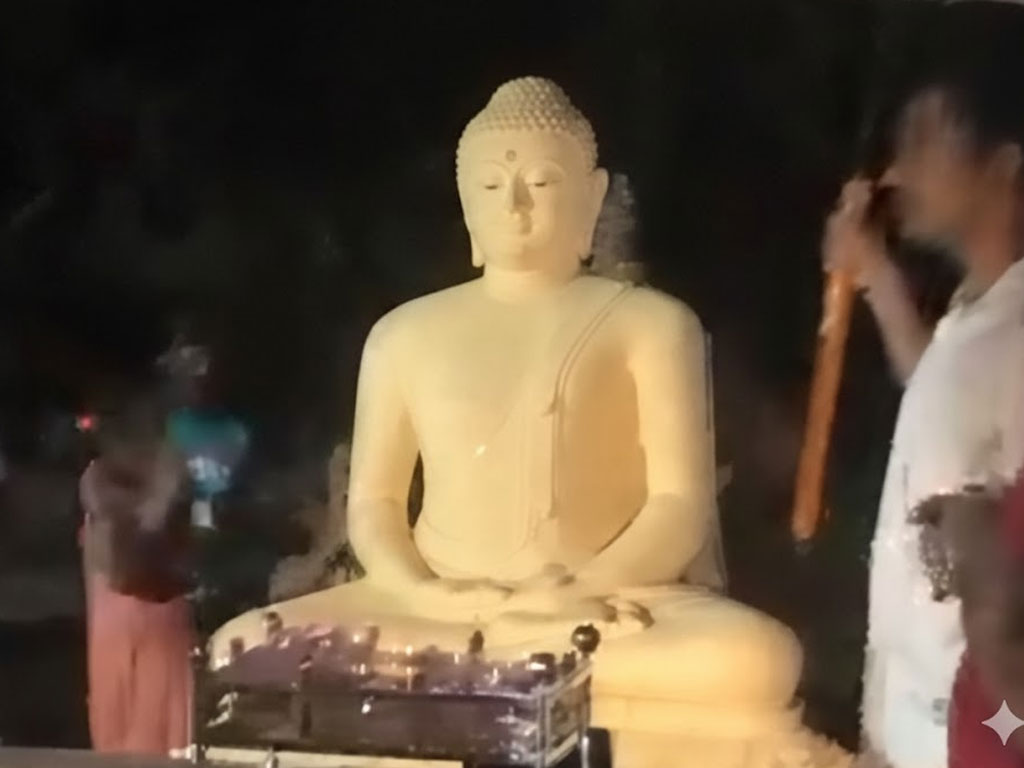
According to media reports, a dhamma school once stood on the site but was destroyed by the 2004 tsunami. For 21 years, no one attempted reconstruction, possibly because the land was within a coastal buffer zone. The land-owning temple had even leased it to a private individual to run a café. Then, suddenly, the reconstruction became a matter of urgent importance. A Buddha statue was installed secretly at night. The pre-planned nature of the event was exposed by the rapid arrival of nationalist monks like Galagoda-Atte Gnanasara and Ampitiye Sumanaratana. As scripted, temple representatives then traveled to Colombo to seek Namal Rajapaksa’s help, cementing his role as the protector of their cause.
Namal is no novice to this game. In 2010, he made a sudden visit to Jaffna with a statue of Sangamitta to be enshrined, a clear act of symbolic politics. The Rajapaksa political brand is irredeemably intertwined with Sinhala-Buddhist supremacism. Despite attempts to project a modern image, Namal Rajapaksa remains a chip off the old block, following the same path and destination as his father and uncle, Mahinda and Gotabaya Rajapaksa.
This leads to the heart of the matter: the Rajapaksa Nikaya. Ampitiye Sumanaratana once declared, “We are members of the Rajapaksa Nikaya. We are robed in the Rajapaksa Nikya, members of the Rajapaksa caste.” In this statement, he spoke a profound truth. During Mahinda Rajapaksa’s rule, Sinhala-Buddhism degraded into Rajapaksa Buddhism. Its practitioners, monks like Sumanaratana and Gnanasara, form the Rajapaksa Nikaya. These rabble-rousing monks create enemies that supposedly imperil the nation, race, and faith, thereby justifying the Rajapaksa power project. In return, they receive political and economic benefits and a chance to operate above the law.
This nexus between religion and power is not new. As scholar Walpola Rahula detailed in his History of Buddhism in Ceylon, the Sasana operated as a state department, with the Sangha supporting kings who, in return, protected their interests. Kings used the monks’ influence with the people as a powerful propaganda tool, even after committing heinous crimes. This quid pro quo has always been harmful to Buddhism’s core teachings, which offer no justification for political involvement by monks. The Buddha himself defined a monk as “he who has control over his hands, feet, and tongue, who is fully controlled, delights in inward development, is absorbed in meditation, keeps to himself and is contented.”
Ancient Lankan history is filled with monks meddling in dynastic politics, from conspiracies to change royal succession to attempted regicide. After Independence, there was a chance to sever this toxic link. Prime Minister DS Senanayake resisted making Buddhism the state religion, not wanting it reduced to a government department. With other major parties also committed to secularism, a separation of religion and state seemed possible. This chance was lost in 1956, setting the stage for the modern politicization of faith.
Political monks were critical in electing Gotabaya Rajapaksa president, but his disastrous rule caused a public backlash against the politicization of Buddhism. Post-Aragalaya, these monks are now adrift, searching for a new champion to restore their role as self-appointed guardian deities of the nation. Their obvious choice is Namal Rajapaksa. For both to regain lost glory, they must rise together. The 2025 Trincomalee statue incident and the Nugegoda meeting are key steps in this joint journey. Their success depends not only on their own efforts but also on the actions and inaction of the government and the main opposition.
This political maneuvering occurs against a bleak socioeconomic backdrop. Philosopher Susan Neiman wrote that the traditional ethos of the left was to “stand by those in the margins: the tired, the poor, the hungry, those yearning to breathe free.” The current ruling coalition, the NPP/VP, came to power promising relief to those beaten down by the economic crisis. One year on, that relief is in extremely short supply. History warns that when the left fails to provide sufficient respite to the tired, the poor, and the hungry, people become receptive to the deadly appeals of the populist right. In Sri Lanka, that populist right has a ready-made army and a potent symbol. They use the monks of the Rajapaksa Nikaya as flame-throwers; and Buddha statues are their weapons of choice. The return of statue politics is more than a symbolic clash; it is a battle for the nation’s soul, with the welfare of its most vulnerable citizens hanging in the balance.