
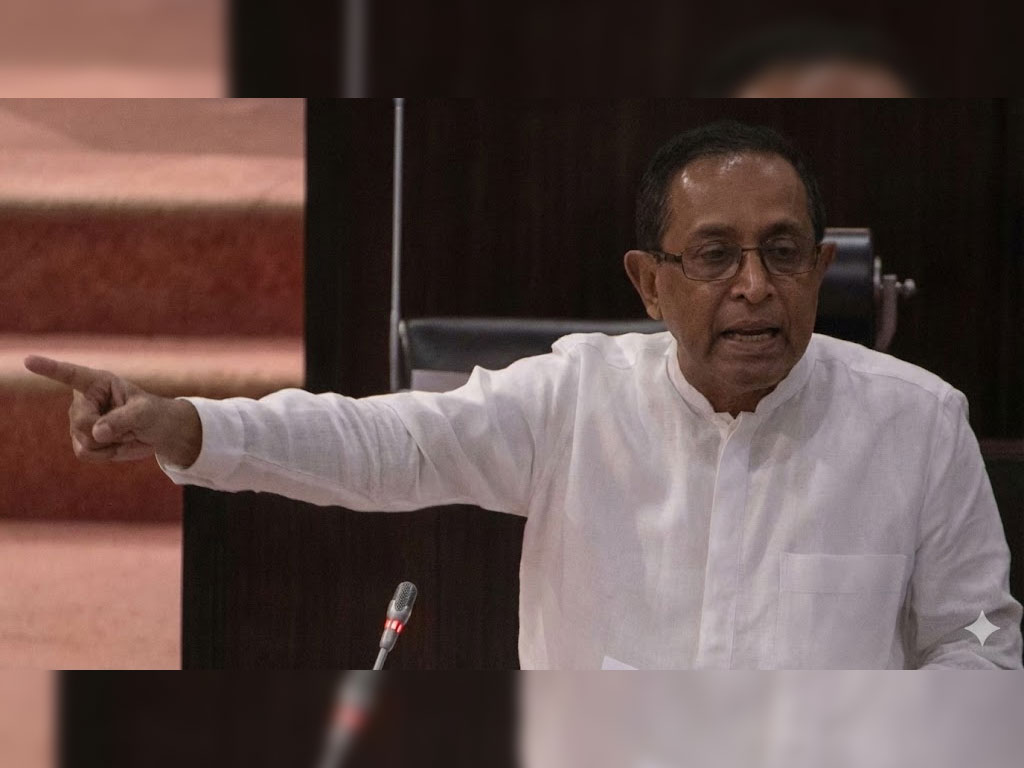
A powerful allegation in Parliament claims Sri Lanka’s deadly floods could have been prevented if authorities acted on early warnings issued weeks before the disaster.
The Opposition charged today that the government failed to take essential precautionary measures despite clear warnings from the Meteorology Department and the Irrigation Department of a possible severe weather event. Samagi Jana Balawegaya MP Kabir Hashim told Parliament that timely action could have saved lives and reduced the scale of devastation caused by the adverse weather. He said both departments had issued alerts on November 12 predicting intense rainfall and potential flooding across the country.

Hashim said the government could have minimized the disaster by releasing water from the reservoirs gradually instead of opening the floodgates at once when the situation turned critical. He noted that it is standard practice to release water in stages to prevent downstream flooding. According to him, the sudden release of large volumes of water contributed significantly to the widespread destruction experienced in multiple districts.
He added that if the government had taken the weather predictions seriously and acted accordingly, at least 70 percent of the deaths could have been avoided. The MP claimed that this tragedy reflects a failure of disaster preparedness, emergency management and responsible governance at a time when the country needed decisive action.




In my opinion this is the most complete rubbish imaginable. The cyclone was not in evidence not even as a small storm on November 12th. This MP who says action should have been taken from Nov 12th is stupid and has no idea of weather systems or how storms arise and grow.
The statement by MP Kabir Hashim, while emotionally charged, is not a good-faith critique but a calculated act of political theater. It should be dismissed as the hollow grandstanding of a discredited establishment desperate to regain relevance by obstructing genuine reform.
It’s a stunning Hypocrisy from a Representative of a Failed Regime.
Kabir Hashim,as a senior figure of the UNP, represents the very political tradition whose legacy is “corruption, mismanagement, and waste”—a primary cause of Sri Lanka’s economic fragility. For him to now posture as a guardian of competent governance is absurd. His party, along with the Rajapaksa administrations he mentions, actively built and benefited from the “entire network system of corruption” over decades. His outrage is not born of principle, but of exclusion from a system he once helped feed. This is not accountability; it is the squealing of a closed elite seeing its gravy train being derailed.
The critique focuses narrowly on reservoir managementduring the crisis, creating a simplistic “government vs. people” villain narrative. It deliberately ignores the complex, real-time decisions disaster managers face amid unpredictable weather extremes. More importantly, it completely whitewashes the historical context that made the country so vulnerable: decades of poor urban planning, illegal settlement on floodplains, and degraded catchment areas—all problems fostered and ignored by successive governments, including Hashim’s. To blame the current administration for the entire “scale of devastation” is to ignore the deeply rooted systemic failures his own political alliances cultivated.
The core motivation for this attack is exposed in your background:the current administration is “dismantling the entire network system.” Hashim’s speech is a prime example of the opposition “running amok” to derail this process. By creating a high-profile, emotionally charged controversy over a natural disaster, he aims to:
· Smear the Government’s Integrity: To falsely paint a reformist administration as “uncaring” and “incompetent,” undermining its moral authority.
· Shift the Public Discourse: To drag media attention and public debate away from ongoing investigations, asset recoveries, and institutional reforms that threaten the old corrupt networks.
· Reclaim a Platform: To gain “camera time” not for public service, but to position himself and his allies as the apparent alternative, hoping the public forgets their direct role in creating the systems now being torn down.
There is a profound difference between constructive parliamentary oversight and destructive political sabotage.Hashim’s statement, laden with speculative casualty figures (“70 percent”) and claims of standard practices not followed, delivered without a full, non-partisan technical inquiry, falls into the latter category. It seeks to erode public trust in state institutions during an emergency—a classic tactic of a cornered opposition with no positive agenda to offer. It is an attempt to paralyze governance by creating a climate of constant crisis and blame, making it harder for the honest work of reform to proceed.
Kabir Hashim’s statement is not a valid criticism of disaster management. It is a weaponized narrative deployed by a representative of the old, corrupt order. It exploits a human tragedy to achieve political goals: to halt the dismantling of the corrupt networks that have impoverished the nation and to rehabilitate the image of the very politicians who engineered its decline. To accept his framing is to fall for a dangerous illusion and to betray the difficult, essential work of national rebuilding this administration has undertaken. The true “failure of responsible governance” was the 76-year system he represents; the current challenge is resisting such transparent attempts to restore it.