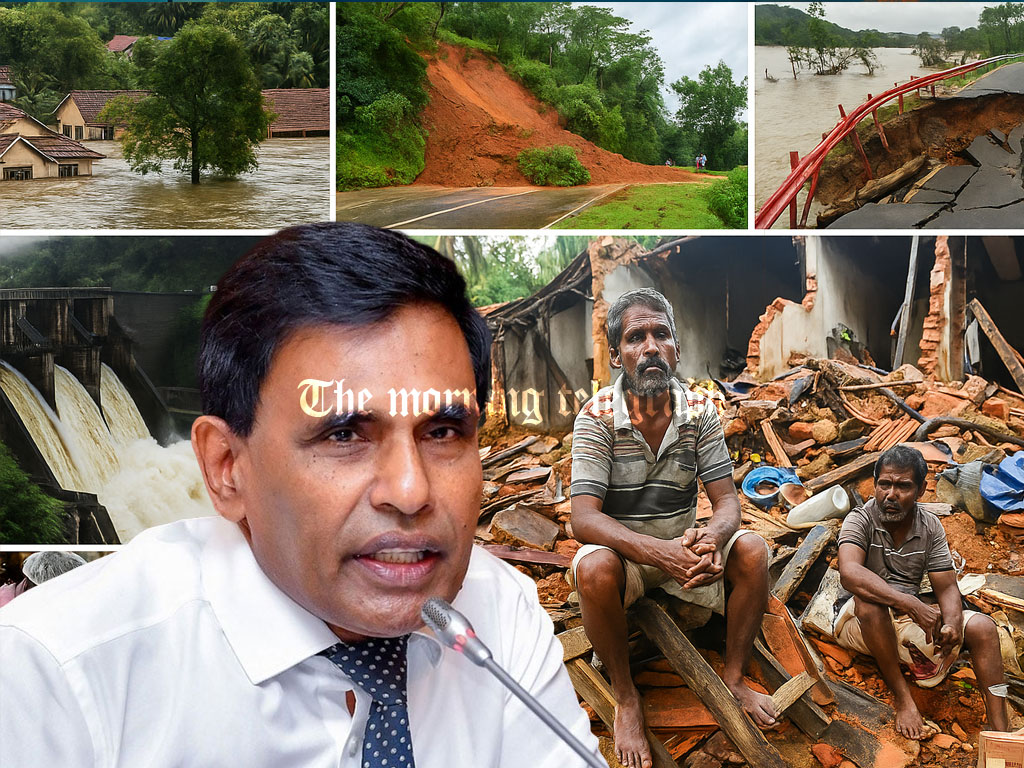
Rejecting opposition pressure, the government insists disaster warnings were handled by the book and says politics, not public safety, is driving calls for a parliamentary probe.
Public Security and Parliamentary Affairs Minister Ananda Wijepala has firmly rejected opposition demands to appoint a parliamentary select committee to investigate allegations that the government “predicted” Cyclone Ditwah and failed to act in time.

Speaking yesterday (13), the Minister said the government had followed all established disaster management procedures based on the warnings officially issued by relevant authorities. He stressed that early alerts released on November 12 and November 18 did not indicate the formation of a cyclone, but only pointed to the possibility of a low pressure system or a depression.
According to Minister Wijepala, those earlier warnings did not warrant the same level of emergency response that was activated after a confirmed warning was issued on November 25. He explained that disaster response mechanisms were triggered only after the November 25 alert clearly indicated the likelihood of Cyclone Ditwah.
“I do not see any need to appoint a separate parliamentary committee to examine disaster management structures, as this request is politically motivated,” the Minister said. “It comes at a time when the entire country is facing floods and landslides on an unprecedented scale.”
He added that while he could not predict the government’s final collective position, his personal view was that creating another oversight body would not meaningfully improve disaster response outcomes.
Responding to allegations of negligence, Minister Wijepala said Sri Lanka had experienced a rare and severe natural disaster. He emphasized that the warnings issued on November 12 and 18 did not materialize into a cyclone, whereas the warning issued at 10 am on November 25 proved accurate and immediately activated all relevant emergency procedures.
Following that alert, the Disaster Management Center, Irrigation Department, Police, Armed Forces and other agencies coordinated closely to prepare for and respond to the unfolding emergency. The Minister said public evacuation notices were issued at least three times, mobile phone alerts were sent to residents in high risk areas once rainfall exceeded critical thresholds, and police officers were deployed to directly warn communities on the ground. Landslides began on the night of November 26.
Citing official data, Minister Wijepala said approximately 95 percent of recorded deaths were caused by landslides, while fatalities from flooding or falling trees were comparatively low. This, he noted, indicated that compliance with evacuation instructions in identified high risk zones had helped reduce loss of life.
He also pointed out that the National Building Research Organization recorded landslides in locations not previously marked on hazard maps, highlighting the evolving and unpredictable nature of the disaster.
Emphasizing the limits of forecasting, the Minister said early warnings indicate a likelihood of occurrence, not certainty. Addressing political criticism, he accused the opposition of exploiting the disaster for political advantage.
“No system is perfect. Although forecasts predicted rainfall of 100 to 200 millimeters, some areas received more than 400 millimeters. Based on the information available at the time, the government did the best it could by following established procedures,” he said.