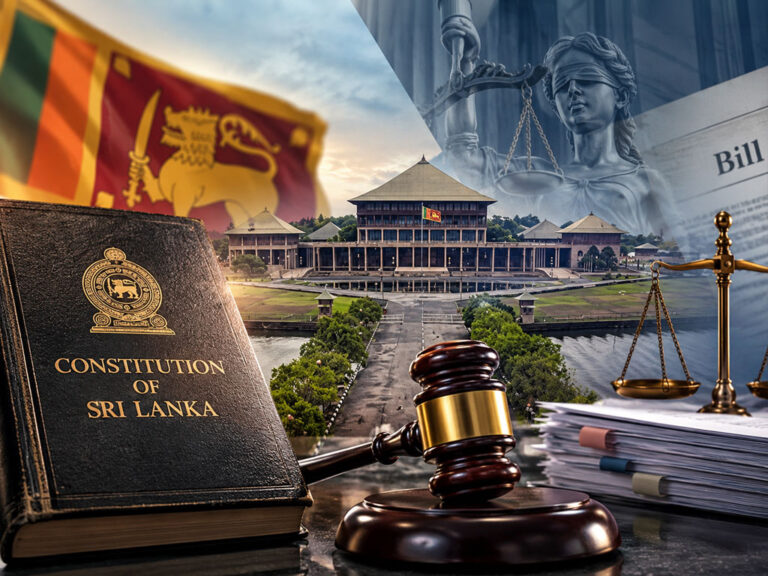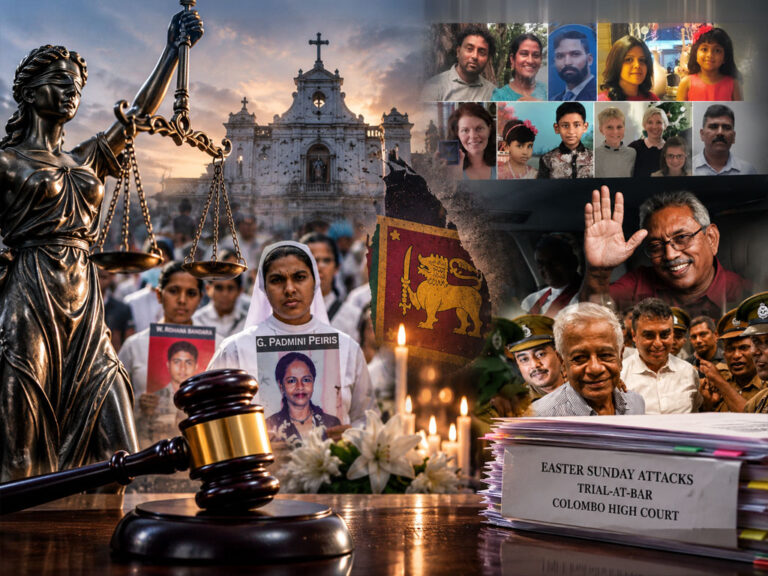
Sri Lanka’s current government faces a pivotal moment as public expectations for clean governance, rapid cyclone recovery, institutional independence, economic performance, and accountability collide with political realities, exposing gaps between promises and delivery that demand serious assessment.
The Burden of Inherited Hope
Sri Lanka’s political landscape in 2024 was a fertile ground for revolution, scorched by economic fire, eroded by corruption, and haunted by the specters of failed promises. Into this arena stepped the Janatha Vimukthi Peramuna (JVP) and its National People’s Power (NPP) coalition, not as mere political contestants but as self-proclaimed redeemers. They masterfully channeled a nation’s profound exhaustion into a decisive electoral mandate, framing their ascent not as a simple change of government, but as a shramadana, a sacred, collective cleansing of the Augean stables of Parliament. The public’s vote was an act of faith, a covenant of trust signed in the ink of desperate hope for a future unshackled from the past.
One year on, that future feels suspended in a disquieting limbo. The government of President Anura Kumara Dissanayake operates under the immense weight of a dual inheritance: the catastrophic economic and institutional ruins left by its predecessors, and, more burdenfully, the soaring, almost millenarian expectations of its supporters. It is a government that speaks in two distinct languages: one of crisp, directive crisis management in the face of natural disasters, and another of defensive, politically expedient maneuvering when its foundational principles are tested. This 4,500-word analysis dissects this dichotomy, moving beyond the headlines to investigate whether the NPP is forging a new political reality or merely inhabiting the old one with renewed vigor. We examine the critical battlegrounds, the independence of institutions, the ethics of power, the transparency of crisis response, and the architecture of security, where its promises are colliding with the inertial forces of Sri Lanka’s political gravity. The central, agonizing question for the public is this: are we witnessing the difficult birth pangs of a new system, or the familiar maturation of a new elite within the old?

I. The Watchdog Silenced: The Auditor General and the Corruption of Promise
If a single issue crystallizes the gap between the NPP’s professed ideals and its governing instincts, it is the deliberate vacancy at the head of the Auditor General’s Department. This is not an administrative oversight; it is a calculated political stance that strikes at the very heart of the social contract that brought this government to power. The Auditor General is the constitutional sentinel, the guardian of public purse, and the nemesis of waste and corruption. For a movement that rallied the nation with chants against bribery, corruption, abuse of power, and waste, this office should have been its sacred temple, its first fortress to be fortified.
Instead, since the post fell vacant in April 2025, it has become an embarrassing monument to hesitation. Reports indicate President Dissanayake is determined to appoint a loyalist, a move blocked so far only by the Constitutional Council. The strategy, as alleged by former Director of Parliament Lacille de Silva, is a cynical waiting game: allow the post to remain vacant until the Council is reconstituted in early 2026, thereby engineering a pliant appointment. De Silva’s damning epithet for the President—”Mahinda II”—is not just political rhetoric; it is a surgical strike on the NPP’s core identity. To be compared to the very dynastic politics it vowed to incinerate is the ultimate ideological betrayal.
The implications are profound. An independent Auditor General is the linchpin of a functional democracy, responsible for:
- Unfettered Scrutiny: Examining government spending without fear of political reprisal.
- Credible Reporting: Issuing audit reports that are respected by Parliament and the public.
- Deterrence: Creating a powerful disincentive against financial malfeasance within the state apparatus.
By seeking to neutralize this independence, the government sends a chilling message: oversight is permissible only when it is domesticated. This action fundamentally corrupts the NPP’s original promise. It suggests that the desire to control levers of power has superseded the commitment to subject that power to independent examination. The vacant chair is a powerful symbol; it screams that for all the talk of a new dawn, some old doors must remain locked, especially those that might shine a light on the new occupants.
II. Disaster, Dollars, and Disquiet: The “Rebuilding Sri Lanka” Fund Controversy
The government’s response to the catastrophic Cyclone Ditwah presented a prime opportunity to demonstrate its “clean governance” model in action. The operational response was, in many ways, impressively hands-on. President Dissanayake descended to district secretariats, demanding accurate data, setting uncompromising deadlines for compensation, and barking orders to restore electricity, water, and roads. He correctly diagnosed chronic ills: illegal construction on vulnerable slopes, the complicity of the Ceylon Electricity Board in powering these settlements, and the failure of local authorities to enforce regulations.
However, this narrative of decisive leadership was immediately complicated by the creation of the “Rebuilding Sri Lanka” fund. The move sparked instant controversy, not because raising funds for reconstruction is wrong, but because of how it was done. Legal experts and opposition MPs like Mujibur Rahuman pointed out that the Sri Lanka Disaster Management Act of 2005 already provides a robust, statutory framework for a national disaster fund. This fund, managed by the National Disaster Management Council (chaired by the President and including the opposition leader), is subject to parliamentary oversight and strict audit requirements. It was designed precisely to prevent the ad-hoc, opaque collection and disbursement of funds that have plagued Sri Lanka in past crises.
By bypassing this legal architecture to establish a new fund managed by a committee chaired by Deputy Minister Dr. Anil Jayantha Fernando and stocked with powerful private sector figures, the government raised legitimate red flags. The presence of businessmen like Mohan Pandithage and Krishan Balendran, who also served on former President Gotabaya Rajapaksa’s Economic Council, triggered public alarm. It evoked traumatic memories of the “Helping Hambantota” and “Itukama” fund scandals, where billions in public donations vanished into accounting black holes.
The government’s defense—that this enables faster, more efficient mobilization, rings hollow against the principle of the rule of law it pledged to uphold. The move suggests a preference for flexible, executive-centered control over transparent, legally-anchored process. It implies that in a crisis, the ends justify legally-questionable means, and that the expertise of corporate allies is more valued than the safeguards of democratic procedure. For a public told to expect a break from the crony capitalism of the past, the sight of a committee dominated by corporate titans managing a public disaster fund is not innovation; it is a deeply unsettling echo.
III. The Two Faces of Crisis Response: Action and Avoidance
The cyclone response perfectly encapsulates the government’s schizophrenic relationship with accountability. On one hand, there is the action-oriented, micro-managing President, visible on the ground, demanding results. On the other, there is the defensive, blame-shifting political apparatus that emerges when questions of responsibility are raised.
This duality was on stark display in the “Ditwah prediction” controversy. When the opposition, citing potential early warnings, called for a parliamentary select committee investigation, the government’s reaction was not one of transparent welcome. Public Security Minister Ananda Wijepala outright rejected it as “politically motivated.” Deputy Minister Mahinda Jayasinghe performed breathtaking rhetorical contortions, absurdly arguing that the opposition bore legal liability for not informing the government of early alerts, a staggering inversion of responsibility that treated a national tragedy as a partisan debating point.
This instinct to circle the wagons and deflect criticism is a classic trait of the old political culture the NPP denounced. The public expected a government that campaigned on “telling the truth” to model a new standard: to openly say, “Our systems were overwhelmed, our preparedness was lacking, and we are committed to fixing it.” The President himself hinted at this in his Newsweek interview, admitting to “longstanding weaknesses.” Yet, the official political stance has been one of brittle defensiveness. This creates a corrosive credibility gap. Citizens can respect a leader who confronts failure; they become cynical of one whose ministers traffic in blame. It reveals that the transformative ethos of the campaign has not fully permeated the defensive psychology of governance.
IV. The Privilege Persists: The Ranwala Case and the Myth of Equality
No principle was more central to the NPP’s appeal than the promise of egalitarian justice, an end to one law for the powerful and another for the people. The case of NPP MP and former Speaker Asoka Ranwala’s traffic accident served as a brutal test of this principle, one the government demonstrably failed.
The facts are straightforward: Ranwala’s vehicle was involved in a serious collision injuring a family, including an infant. Standard police procedure in such incidents globally mandates an immediate breathalyser test to rule out alcohol impairment. Yet, for over twelve hours, as the MP received treatment, no test was administered. He was only arrested the following afternoon. The police spokesperson’s justification—that medical condition precluded a test—and the reassurance that a blood test within 24 hours would suffice, felt like a script from the old era.
For the ordinary citizen, there is no such procedural leniency. The incident was a stark, televised reminder that political connection still commands a buffer from the immediate rigors of the law. It shattered the illusion of a leveled playing field. It whispered that while the faces in the ministerial limousines may have changed, the sirens that clear their path still sound the same. This single episode did more damage to the NPP’s moral authority than a dozen opposition speeches, for it was a lived experience of betrayed promise, witnessed by the nation.
V. Replacing the PTA: From One Draconian Law to Another?
In the realm of legislation, the government’s pledge to repeal the reviled Prevention of Terrorism Act (PTA) was a beacon for human rights advocates and a marker of its democratic credentials. The draft of the proposed “Protection of the State from Terrorism Act,” however, has sparked deep concern that the cure may be as dangerous as the disease.
The new bill makes some nominal concessions to due process, such as requiring notification of the Human Rights Commission within 24 hours of arrest. Yet, its substantive core is alarmingly expansive. Its definition of terrorism is dangerously vague, encompassing acts intended to “cause a state of terror” or “intimidate the public”, language that could be weaponized against vigorous dissent, protest, or unpopular speech. The penalties are severe to the point of being draconian: life imprisonment for broad offenses and fines of up to fifteen million rupees for “spreading terrorist propaganda.”
Most worryingly, it grants sweeping powers to military officers to stop and search individuals on “reasonable suspicion,” further militarizing civilian law enforcement. While meant to replace an abusive law, this draft risks codifying a new, slightly more polished framework for repression. It seems to reflect the anxieties of a state in power, rather than the principles of a movement that fought against state overreach. As the President cautioned, “Bad laws rushed through will create new problems.” The current draft appears to be exactly that, a rushed solution that prioritizes state control over civil liberties, potentially betraying the very communities that saw the NPP as their shield against arbitrary power.
The Glorious Revolution Deferred
The NPP government is not a failure in the conventional sense. It has brought energy, a workmanlike ethos, and a palpable desire to address Sri Lanka’s infrastructural and economic decay. It has, in moments of crisis, shown operational competence. But the public did not vote for a more efficient manager of the status quo; they voted for a revolution in political morality.
On that paramount scale, the government’s first year is a story of promise deferred, if not forsaken. The patterns are too clear to ignore:
- The Institutional Deficit: The assault on the independence of the Auditor General reveals a preference for controlled oversight, a cornerstone of the old order.
- The Transparency Gap: The creation of parallel, legally-ambiguous financial structures like the “Rebuilding Sri Lanka” fund shows a distrust of established, transparent systems and a comfort with ad-hoc, executive-driven solutions.
- The Accountability Failure: The defensive, blame-shifting response to legitimate disaster preparedness questions demonstrates that the old political instinct for self-preservation remains potent.
- The Equality Hypocrisy: The handling of the Ranwala case exposed the persistent gap between the rhetoric of equal justice and the reality of privileged access.
- The Security Paradox: The draft anti-terror law risks replacing one oppressive system with another, suggesting that the imperatives of state security quickly overwhelm commitments to civil liberty.
The NPP’s original appeal was its moral absolutism, its claim to a purity untainted by the compromises of power. Governance, by its nature, is the art of compromise. The tragedy unfolding is that the compromises being made are not on peripheral issues of policy, but on the very core principles that defined the movement. They are compromising on integrity, on transparency, on accountability, and on equality.
The public’s expectation was not for a change of weather, but for a change of climate. They expected the very ecosystem of power, where institutions are weak, scrutiny is resented, and privilege is ingrained, to be transformed. Today, they see a government that has expertly learned to navigate that old ecosystem, rather than dismantle it. The “sense of shame” the NPP accused others of lacking has now become its own measuring stick. Until that vacant chair of the Auditor General is filled by a figure of unassailable independence, symbolizing that power itself can be fearlessly audited, the glorious revolution remains unfinished. The shramadana of the state awaits its most crucial phase: the cleansing of the cleansers themselves.