A seven-year creative marathon, nearly two thousand pages of music, handmade alien instruments and a director who refused shortcuts reveal how Avatar Fire and Ash became one of cinema’s most ambitious musical achievements.
It is no secret that the Avatar films have become benchmarks for technical innovation, redefining what is possible in cinematography, animation and motion capture. What is less widely known is that the same obsessive attention to detail extends to the music that underpins James Cameron’s epic vision of Pandora.

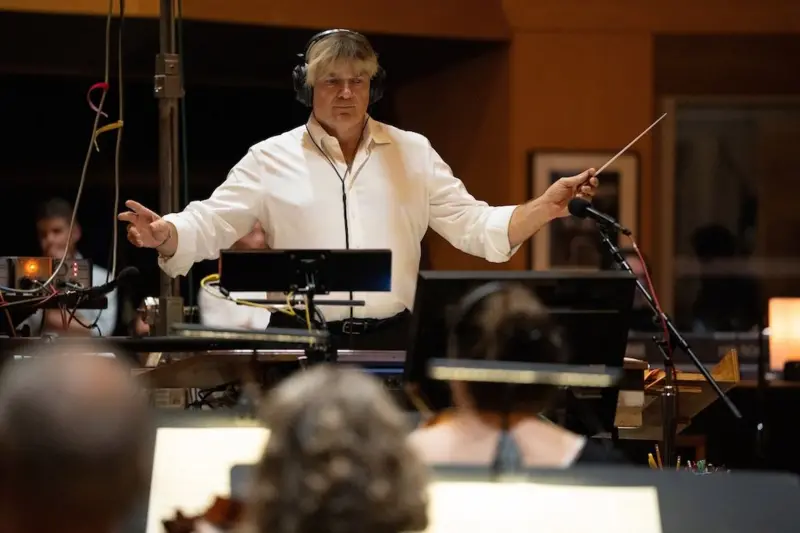
Composer Simon Franglen has revealed that it took seven years to complete the music for the third installment, Avatar Fire and Ash. During that period, he wrote a staggering 1,907 pages of score, effectively creating one of the most expansive musical works ever composed for a single film.
The process was shaped by Cameron’s relentless perfectionism. The director continued editing the film until the very last stages of production, meaning Franglen was still refining and adjusting the score right up to the finish line. In fact, the British composer completed the final pieces of music just five days before the film was locked and released.
According to Franglen, Avatar Fire and Ash contains roughly four times the amount of music found in a typical Hollywood production. The film runs for 195 minutes, and music accompanies nearly every moment.
(20Th Century Studios)
“But I got a 10-minute break for good behavior,” Franglen jokes.
Released on December 19, Fire and Ash continues the saga of the Na’vi, the blue-skinned indigenous people of Pandora, as they fight to protect their planet from human invaders intent on exploiting its natural resources. The film returns audiences to Pandora’s richly detailed landscapes, blending spectacle with an increasingly emotional narrative.
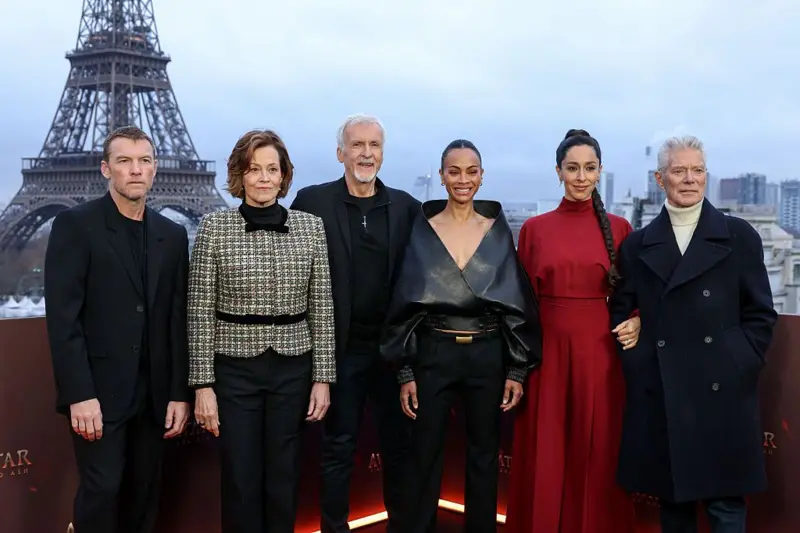
At the heart of the story are Jake Sully, played by Sam Worthington, and Neytiri, portrayed by Zoe Saldana. At the beginning of the film, the couple is grieving the loss of their teenage son. Their shared trauma exposes deep emotional fractures, and their inability to process grief together threatens to pull them apart.
Franglen was tasked with translating that pain into music.
“I wanted to make sure you could feel the growing distance between them,” he explains.
“So what I do is take two lines of music and either distance them, or do them wrong, and they feel stiff, insensitive and detached.”
“You don’t talk about grief in these kinds of films,” he adds. “But for any family, losing a child is the worst thing you can experience.”
For Franglen, restraint was as important as grandeur. “Musically, it’s often the quiet moments that matter,” he says, noting that silence and subtlety can convey emotions words cannot.
A Dance on a Galleon
While much of the score explores sorrow and tension, Fire and Ash also introduces new cultures on Pandora that allowed Franglen to unleash his imagination. One of the most striking additions is the Wind Traders, a clan of airborne merchants who travel in massive floating vessels.
Their scenes called for a radically different musical approach. Franglen drew inspiration from the swagger and energy of 1930s and 1940s action films, blending those influences with sounds that feel organic to Pandora.
“When we meet the wind merchants, they are dancing on their huge galleon,” Franglen says.
“The problem was, if they were having a party on Pandora, what would they play? I couldn’t give them guitars, bass and drums. I couldn’t give them a banjo.”
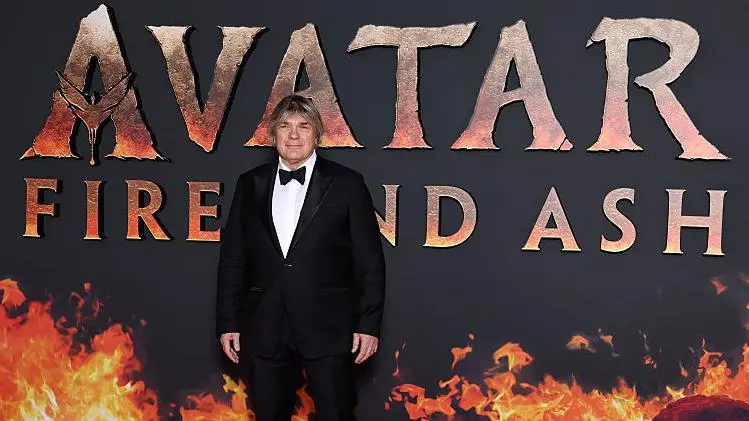
“You have to have real instruments designed for three-meter-tall, four-fingered blue people.”
Cameron’s filmmaking philosophy played a critical role here. Avatar may rely heavily on visual effects, but Cameron insists that everything seen on screen must be grounded in physical reality.
“Avatar is not an animated film, so every time the instruments are on screen, you have to have real ones,” Franglen explains. “Everything has to be based on reality.”
To meet that requirement, Franglen sketched out entirely new instruments and handed the designs to the art department. These concepts were transformed into fully realized props that actors could actually play.
Among the creations was a long-necked harp resembling a Turkish saz, with strings designed to echo the mechanical gears of the Wind Traders’ ships. Drumheads were fashioned from the same materials used for the ships’ sails, and an entire custom drum kit was built from scratch.
Once designed, the instruments were passed to props manager Brad Elliott, who used 3D printing to bring them to life. The actors then performed with these instruments on set, ensuring authenticity in every frame.
The instruments do not yet have official names.
“They are currently called ‘stringed ones’ and ‘drum-like ones,’” Franglen laughs.
“I’m sure there’s a better name. Someone suggested we have a competition.”
From Teenager to Titan of Film Music
Franglen’s journey into music began at just 13 years old, when he wrote to the BBC asking how he could become a music recording producer. Due to a misunderstanding, the broadcaster advised him to study electronics rather than music production.
That advice led him to the University of Manchester in the early 1980s, a period that coincided with one of the most vibrant eras in British music history. Franglen became an early member of the legendary Hacienda club.
“I was the 347th member there,” he recalls.
Outside of classes, he booked bands to play at the college concert hall. One night, a then-unknown band called Tears for Fears performed to an audience of just eleven people.
After graduating, Franglen’s technical expertise landed him work as a synthesizer programmer. This role brought him into contact with renowned producer Trevor Horn and led to contributions on major albums by Yes and Frankie Goes to Hollywood.
Eventually, Franglen took a leap of faith and moved to the United States. The transition was not immediate success.
“I did nothing for six months,” he admits.
But persistence paid off. He soon became a highly sought-after musician and programmer, contributing to chart-topping hits such as Toni Braxton’s Unbreak My Heart, All-4-One’s I Swear and Whitney Houston’s I Have Nothing. He later worked on Michael Jackson’s HIStory album, creating drum tracks under intense creative pressure.
“The pressure was great,” he says. “To create that feeling we call ‘the pocket.’”
“A big part of my career has been having a good pocket. I understood where things should feel and how they should sound. That’s important for Michael Jackson’s record, as well as for film music.”
Entering the World of Film Scores
Franglen’s first major step into film scoring came when legendary composer John Barry invited him to work on Dances With Wolves. He later collaborated with David Fincher on Se7en, crafting a dark, unsettling score using unconventional sound sources.
“My role was to create the score to match the dark mood of the film,” Franglen says. “I recorded rough sounds like brake noises, turned them into musical samples and combined them with violin parts.”
“There was a lot of experimentation, and it was a lot of fun.”
His path eventually crossed with James Cameron through composer James Horner, who hired Franglen to work on a film with almost no budget left for music.
That film was Titanic.
At the time, many predicted the project would fail. Headlines warned that Titanic would bankrupt its studios. Franglen admits he had seen those headlines, but his perspective changed once Cameron showed him a key scene.
“When Jim showed me the scene of the Titanic breaking in half and sinking, I knew it was special. It was amazing compared to anything you’d ever seen before.”
Because funds were tight, Franglen borrowed equipment and instruments, and many vocals were recorded in a rented apartment using electronic tools.
“The reason Titanic had to sound like that was because there wasn’t enough money to have an orchestra everywhere,” he says.
Avatar represented the opposite extreme.
“Jim still believes that good things take time,” Franglen says. “And as a composer, the ability to create something special and refine it is a rare thing these days.”
Cameron also made a firm decision to avoid artificial intelligence in the creative process.
“He specifically asked me, ‘So, we’re not using any AI? We’re not putting any real musicians out of work,’” Franglen recalls.
“It’s fair to say that if a lot of filmmakers were given the option to save money, they would take that option. Jim doesn’t compromise.”
As Fire and Ash reaches audiences worldwide, Franglen has been nominated for a Golden Globe for the theme song Dream As One, performed by Miley Cyrus.
But the future of Avatar extends far beyond this chapter. Cameron has already completed scripts for Avatar Four and Five, scheduled for release in 2029 and 2031.
“Four is amazing,” Franglen says. “It’s going in completely new directions, and I love that.”
Some footage has already been shot, but Cameron has been clear that the continuation of the saga depends on box office performance.
“I really hope that we can do that, that we make a profit,” Franglen says. “After Avatar 2, they said the break-even point was $1.4 billion. I think it’s a similar number for this one.”
“So if the audience says we need an Avatar Four, I’m very much looking forward to doing that.”