As climate disasters batter Sri Lanka’s farms and hill country, a high-level Chinese delegation brings proposals, technology and renewed cooperation, opening fresh debate on food security, irrigation recovery and the future of mountainous agriculture.
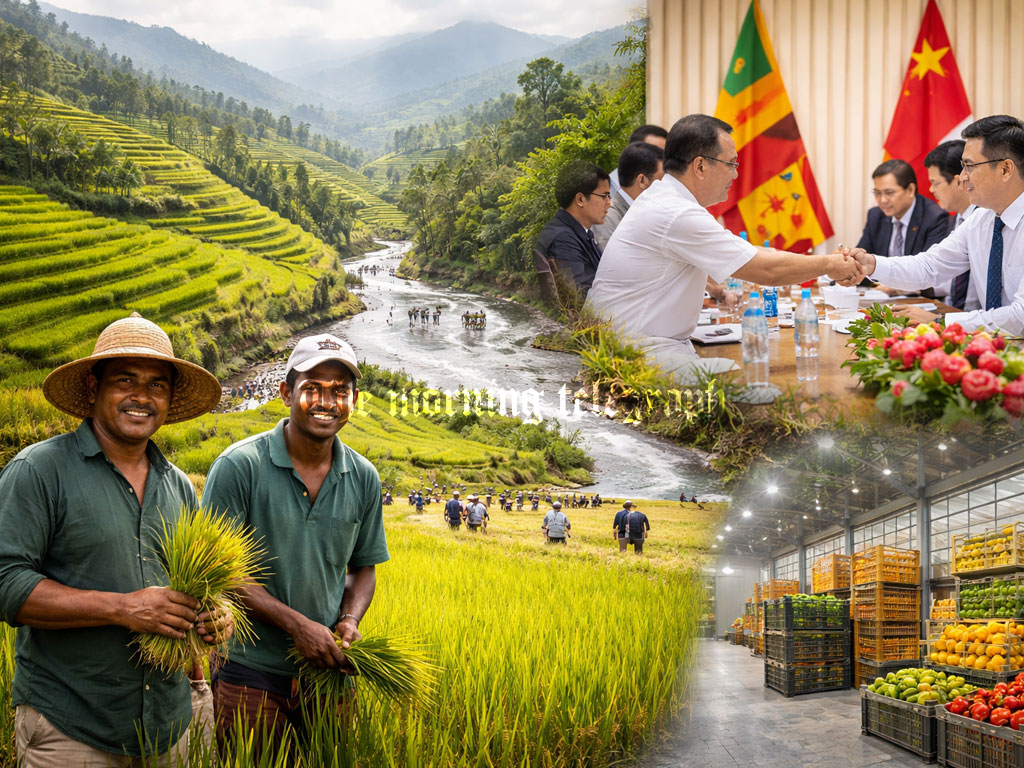
A delegation from Zhengzhou, China met Sri Lanka’s Minister of Agriculture, Livestock, Land and Irrigation, Mr. K.D. Lalkantha, at the Farmers’ Hall, marking a significant moment of engagement between the two countries at a time of mounting agricultural challenges. The discussion focused on the current state of Sri Lanka’s agriculture sector and explored avenues for cooperation as the country works to recover from recent disasters affecting farming, irrigation and rural livelihoods.

Sri Lanka and China share a long-standing economic and cultural friendship, with cooperation spanning infrastructure, trade and development. Zhengzhou, China, is internationally recognized for its strong agricultural base and industrial capacity. The city has developed advanced agriculture-related industries, particularly in food production, warehousing and cold storage systems. These areas were highlighted as potential models for Sri Lanka as it seeks to modernize its agricultural supply chain and reduce post-harvest losses. During the meeting, the Chinese delegation also extended a special invitation to Minister Lalkantha to visit China, signaling interest in deepening bilateral agricultural collaboration.
Addressing the gathering, Minister K.D. Lalkantha emphasized the importance of China’s engagement at a moment when Sri Lanka’s agriculture, livestock, irrigation, export crops and minor export crop sectors are under severe strain due to recent disasters. He noted that while paddy cultivation has suffered damage, the government remains confident that production can be restored in a manner that safeguards national food security. He stressed that rebuilding paddy cultivation remains a priority, given its central role in the country’s food system.
The Minister explained that the livestock sector has also been affected, with particular concern surrounding feed availability. Maize, the second most important grain crop in Sri Lanka after paddy, is primarily used as animal feed. At present, local maize production meets only about 50 percent of national demand. Expanding maize cultivation has become increasingly difficult due to land shortages, prompting the government to explore alternative strategies. Among these is the potential to increase rice production in the future and allocate a portion of it for use as animal feed, easing pressure on maize supplies.
Turning to irrigation, Minister Lalkantha stated that Sri Lanka possesses a generally strong irrigation network. However, the recent disaster caused significant damage to a large number of small-scale irrigation systems. These systems are currently undergoing rapid temporary repairs to ensure continuity of farming activities. He noted that major irrigation schemes have largely remained intact, preventing a complete breakdown of agricultural water supply.
A major concern raised during the discussion was the situation in Sri Lanka’s mountainous regions. According to the Minister, these areas have become increasingly vulnerable to environmental risks. Future changes in land use and settlement patterns may be unavoidable. The question of whether people and cultivated lands in certain high-risk mountainous zones should be relocated has emerged as a national issue. He stressed that permanent, carefully considered solutions must be developed at the national level to address both safety and long-term agricultural sustainability in these regions. The Minister concluded by expressing his hope for continued cooperation with China in addressing these complex challenges.
Secretary to the Ministry of Agriculture, Livestock, Lands and Irrigation, Mr. D.P. Wickramasinghe, also addressed the meeting. He drew attention to the significant post-harvest losses occurring across the agriculture sector, identifying this as a key area in need of improvement. He reiterated that raising the living standards of farmers remains a central objective of the current government. According to the Secretary, large-scale compensation programs are being implemented to support farmers who have suffered losses due to disasters, with the ultimate goal of stabilizing incomes and enabling recovery.
During the meeting, the Chinese delegation presented several proposals aimed at strengthening Sri Lanka’s agricultural resilience. These included developing infrastructure in the agriculture sector, improving early warning technology for weather-related risks, and ensuring timely action to mitigate disaster impacts. Such measures, they suggested, could help protect farmers, improve productivity and enhance food security.
Minister Lalkantha concluded by reaffirming his commitment to strengthening the friendship between Sri Lanka and China through closer cooperation and improved relations, particularly in agriculture, technology and rural development.