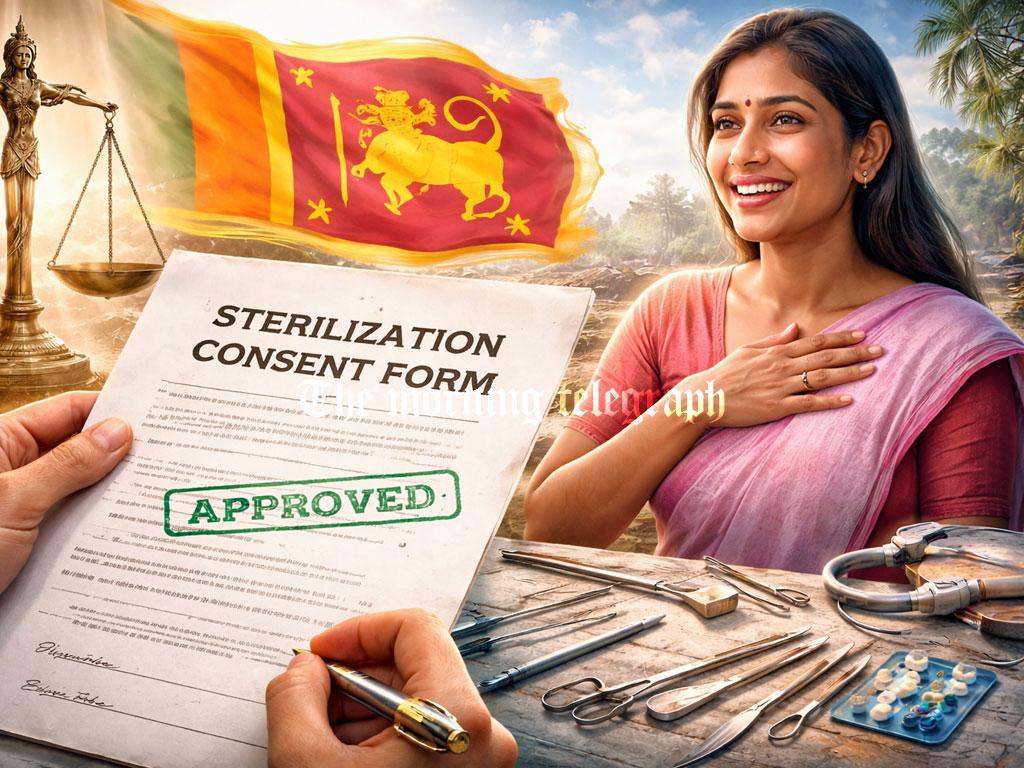
In a landmark shift centered on personal freedom and dignity, Sri Lanka has revised a decades-old sterilization policy, removing the requirement for a husband’s consent and affirming a woman’s right to make independent reproductive health decisions.
Sri Lanka’s health authorities have moved to amend a decades-old law governing sterilization procedures, marking a significant change in reproductive health policy by prioritizing individual consent and human rights.
Under the revised framework, the long-standing requirement for a husband’s written consent for a woman to undergo sterilization has been repealed. This change follows the issuance of a circular in July by the Director General of Health, Specialist Dr. Asela Gunawardena, formally amending the procedure for obtaining consent.

The law governing sterilization dates back to 1198 and was amended in 1983 to make it mandatory for the husband to sign the consent document for sterilization procedures. This requirement has now been removed after a review that took into account international human rights standards and established medical ethics.
The new circular emphasizes that an individual’s right to make decisions regarding their reproductive health is a fundamental element of personal freedom and dignity, in line with international human rights frameworks. It also reflects the conclusions reached by the Technical Advisory Committee on Maternal Health and Family Planning, which met in April 2022 and recommended abolishing the requirement for spousal consent.
The circular further states that the Attorney General has confirmed there is no legal obstacle under existing Sri Lankan law that requires the consent of a spouse for sterilization procedures, whether for men or women.
Commenting on the development, obstetrician and gynecologist Dr. Chaminda Mathota of the Ragama Teaching Hospital explained that female sterilization surgeries are among the most commonly performed procedures in the country. He noted that even before the recent amendment, such surgeries were carried out with the woman’s consent alone when recommended by a specialist doctor.
“When the surgery is performed under the supervision of a specialist doctor, if the specialist doctor thinks that the woman needs this surgery, then the circular of the Ministry of Health does not apply to it. At that time it was possible to do it according to the woman’s wishes. The circular had been issued by a family health service officer to obtain the consent of both parties and refer them to the hospital,” he said.
Dr. Mathota stressed that unless a patient is a minor or mentally incapable of giving informed consent, the consent of the individual undergoing the procedure is sufficient. He described the previous requirement for a husband’s signature as uncommon in global medical practice.
“For some time, when performing surgery in government hospitals and institutions, there was a consent form issued by a government circular stating that in addition to the signature of the woman undergoing the surgery, her husband’s signature was required. But that is not a method commonly found anywhere in the world,” he said.
“To perform surgery on anyone, only the consent of the person undergoing it is necessary. If the person is not a minor or mentally incapable of consenting and is able to understand the procedure, they can undergo the surgery with their own consent. The reason why it has been changed is because there was a difference in this surgery,” he added.
Explaining the procedures, Dr. Mathota said female sterilization involves blocking the fallopian tubes, preventing an egg from reaching the uterus and thereby preventing pregnancy. Male sterilization involves blocking the sperm ducts to prevent sperm release, though this procedure is far less common in Sri Lanka and is performed only in specific cases.
He also outlined the factors considered before recommending sterilization. “Before performing any surgery, we assess whether it is truly necessary. Surgery carries risks, so we first look at whether family planning can be achieved in a less risky and effective way,” he said.
He noted that women with no children are generally not considered suitable candidates and that sterilization is usually recommended only after having at least two children. He also cautioned that reversal procedures are complex and have a success rate of about fifty percent, highlighting the importance of informed and careful decision-making.