NPP Curse Crumbling: Budgets Fall, Promises Fade, Power Slips Away
From secret ballots to collapsing council budgets, the political spell that promised to end Sri Lanka’s 76 year curse is unraveling fast. As public trust erodes and institutions falter, the NPP government faces a reckoning that no ritual, retreat, or recycled promise can stop.
The spell of the compass that came to end the 76 year curse will end in a few more poyas.
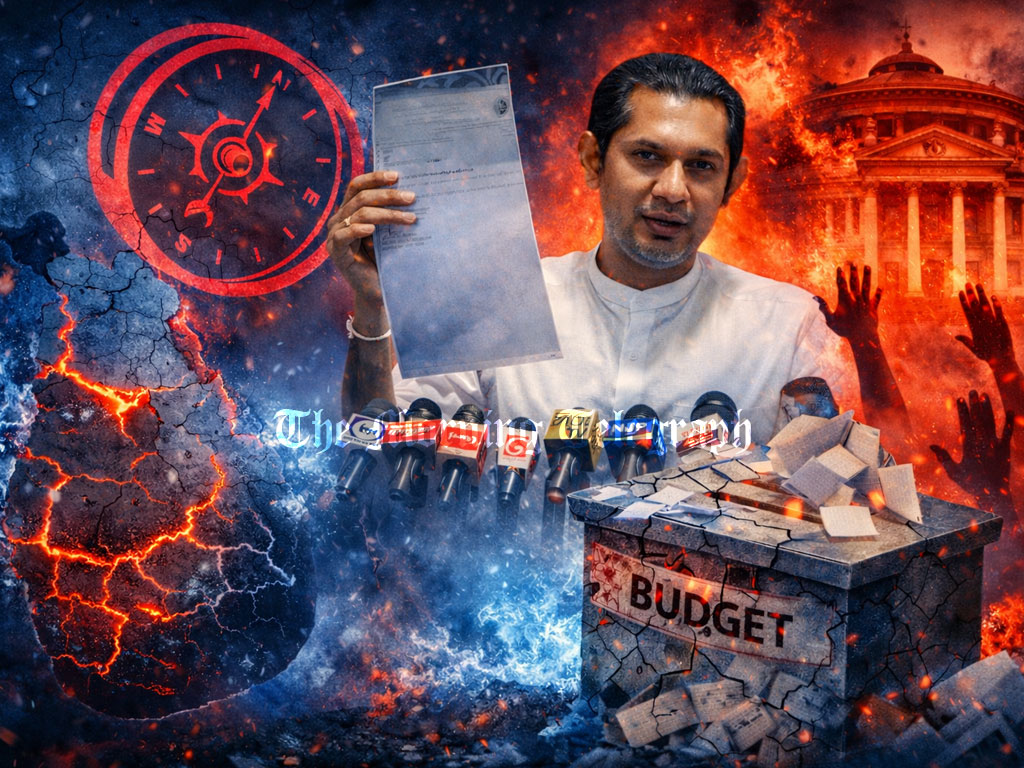
Party leader Sugeeshwara Bandara, deputy leader Upatissa Kumaratunga and Foreign Affairs Secretary Vidura Algama attended a media conference at the Janata Peramuna Maharagama party headquarters, where a sharp critique of the current political order was laid bare.

At the media briefing, party leader Sugeeshwara Bandara stated that the NPP government has already suffered a major political defeat and is now clearly in retreat. According to him, this reversal became evident at the most recent local government election. The overwhelming hopes placed by the people on the NPP collapsed rapidly when results showed that the party failed to secure the number of members it had confidently expected. More importantly, the NPP did not gain sole power in many councils. Instead of respecting democratic outcomes, NPP leaders in councils where they lacked a majority resorted to abusing provisions of the Local Government Act. Through these maneuvers, NPP Councils were forcibly established even in areas where the opposition held a clear majority.
This process, he said, was dangerously enabled by the Western Province Local Government Commissioner, Ms. Sagarika, who set what he described as a deeply wrong precedent. When opposition members in several Western Province local government institutions, including the Sitawaka Pradeshiya Sabha in the Colombo District, demanded open voting, the Commissioner allegedly bent the law by conducting secret ballots instead. While this initially benefited the NPP, today it has turned into a major political obstacle. Budgets in almost every local authority that was formed through such secret ballots are now being defeated. The most symbolic and damaging blow, he emphasized, is the failure of the Colombo Municipal Council budget.
When the ruling party in the Colombo Municipal Council held only a minority, the opposition majority initially extended various privileges and raised expectations among independent members. Through inducements and incentives, the ruling faction managed to strengthen its grip on power within the council. But that arrangement has now collapsed. Those same members have taken independent decisions. Despite supporting the Malima government during secret ballots, they have now openly raised their hands during budget votes. As a result, budgets of the Colombo Municipal Council, several Municipal Councils, and other local authorities are being defeated one by one.
This, Sugeeshwara Bandara argued, clearly reflects the present socio political situation in Sri Lanka. The people are deeply disappointed. Not a single promise made to them has been fulfilled. Across districts, citizens are urging opposition members not to support the government and to defeat local government budgets. That is why, he said, council members are now voting independently and rejecting these budgets.
He further stated that when the previous Colombo Municipal Council administration was formed, Watagala Shurin provided his full and active support. This time, however, Watagala Shurin cannot rescue the situation. He has failed to deliver on his promises. As a result, the President personally intervened. According to the claims made at the press conference, the President summoned several Members of Parliament, distributed Christmas gifts, offered food and drink, patted backs, and reassured them by saying, “We will take care of you, brother.” These efforts were aimed at salvaging the Colombo Municipal Council budget.
However, the President, Sugeeshwara Bandara said, has failed to realize that the era when the people could be deceived by lies is over. That is precisely why the Colombo Municipal Council budget was defeated. He declared that the so called Sagarika theory has now collapsed. If the government truly wants to pass budgets in councils that were forcibly established in an anti democratic manner, the President must amend the Local Government Act and introduce provisions allowing special voting mechanisms. Only then, he said, could budgets be passed through inducements. Otherwise, budget defeats in forcibly formed councils are inevitable.
He described the current developments as Bala Subha Nimithi Peramaga Salakunu, a sign of an impending shift. The so called good news, that the compass which came to power claiming to end a 76 year curse will itself end within another year, is becoming visible through these repeated local government budget defeats, much like the arrival of Vesak Poya marking a spiritual turning point.
Despite these developments, Minister Wasantha Samarasinghe has publicly stated that budget defeats do not matter and that the government will present budgets a second time and proceed according to the law. In response, Sugeeshwara Bandara said that the Party Leader should feel morally ashamed. He argued that when a budget is defeated, chairmen and mayors must resign. In councils where the opposition holds a majority, opposition leaders should be appointed to govern and allowed to function.
He also drew attention to the dire situation in councils affected by the Ditva disaster, describing conditions as extremely distressing. He appealed to the Party Leader to remove what he called the carpets and rice of the defeated Malima government and allow leaders who have earned the confidence of the opposition to continue governing these institutions.
The speaker further accused the 159 Malima representatives, who had promised systemic change, of bending the law to escape accountability. He alleged that the law in Sri Lanka is enforced only against ordinary citizens and opposition members, while it does not apply to the 159 Malima figures or local government members aligned with the ruling establishment.
He raised serious allegations regarding Mr. Ranwala, stating that the law has still not been applied in that case. According to the claims, Mr. Ranwala became intoxicated, assaulted an innocent woman, harmed his own children, and committed multiple crimes, yet the police acted in a shameful and biased manner. He accused the Inspector General of Police of failing to protect the dignity of his office and department, and of acting selectively based on political influence.
“If it is true,” he said, “Mr. Ranwala should not be in the hospital but in prison.” He further alleged that there was a deliberate failure to test whether Mr. Ranwala had been drunk while driving. He called on the Party Leader to ensure the rule of law in the country.
Another incident was highlighted involving Shantha Pathmakumara and the killing of a police officer. He stated that when police officers attempt to enforce the law, they are attacked, while those in power are protected. In this case, the police officer was brutally attacked and killed, yet the IGP suspended the officer involved instead of defending the dignity of the police force. He accused the IGP of protecting the chairman of the Ratnapura District Committee of the ruling government rather than standing with his own officers.
Using harsh language, he warned that if the legal system within the police department collapses, the state itself will fall. He claimed that the 159 Malima representatives are now facing divine discipline. He criticized the government for using the Dalada Maligawa during elections and accused it of reckless and irresponsible governance. He urged the Party Leader to restrain those behaving, in his words, like mad dogs, at least until another Vesak Poya, warning that failure to do so could lead to a major national disaster.
Attention was also drawn to the Prime Minister’s handling of the education sector following recent disasters. He stated that schools remain closed, students lack clothing and textbooks, and promised financial assistance of Rs. 10,000 has not been properly delivered. While these urgent needs remain unmet, he accused the Prime Minister of prioritizing educational reforms and sex education, claiming that it has become her number one agenda.
He argued that before introducing Western cultural values and new curricula, the government should first provide assistance to children affected by the Badulla, Bandarawela, and Passara landslides, many of whom were left with nothing but the clothes they were wearing. He called for the immediate release of promised grants and the renovation of damaged schools.
He also criticized what he described as the promotion of a rainbow dream agenda, stating that opposition activists are actively resisting it. The Prime Minister’s statements about introducing constitutional reforms to abolish the executive presidency were also challenged. He argued that before any such reforms, the government must first enact the Provincial Council Act and conduct provincial council elections to rescue the country from what he described as a prolonged 14 month crisis.
As the press conference concluded, the message from the opposition was clear. Public trust has eroded, democratic norms have been compromised, local government institutions are paralyzed, and the promises that once fueled hope have failed to materialize. The political compass that claimed to guide the nation out of its long standing curse, they warned, is now spinning aimlessly, with its end already in sight.