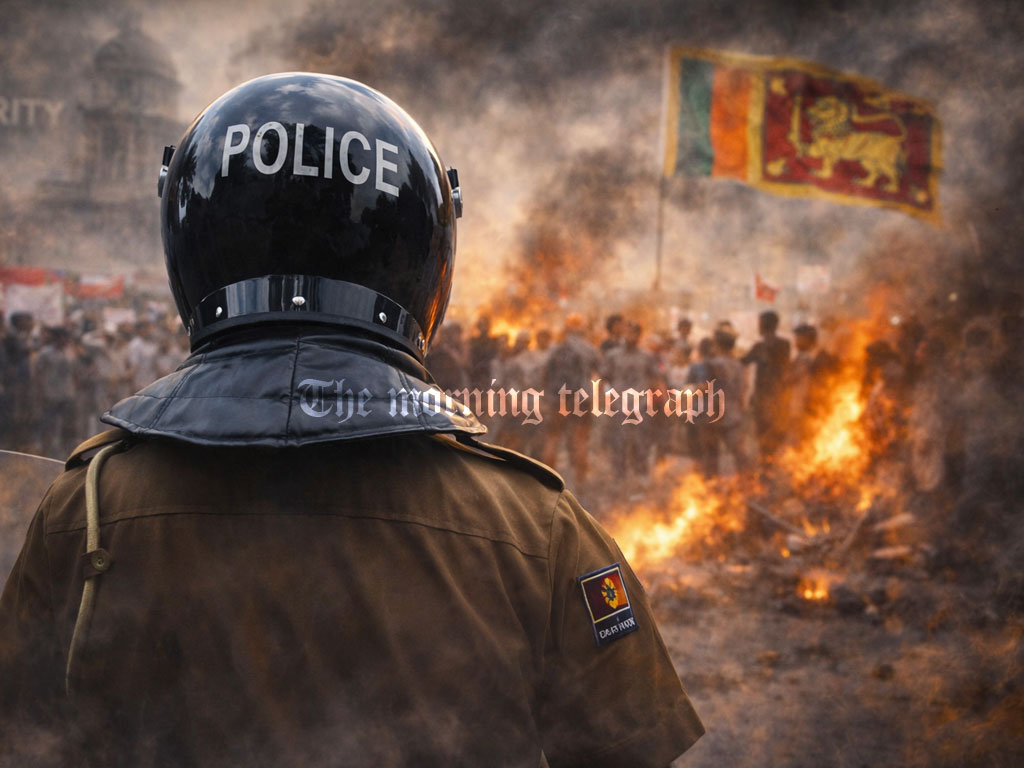
Balancing national security with constitutional freedoms is the true test of democracy, and Sri Lanka now stands at a critical crossroads where restraint, clarity, and integrity will determine whether anti terrorism laws protect the state or quietly erode it.
Whatever the political climate or ideological debate of the moment, one reality remains unavoidable. In today’s complex and volatile global environment, no responsible state can function without a strong legal framework to protect its people from terrorism and related threats. Sri Lanka is no exception. Modern security challenges extend far beyond the boundaries of traditional insurgency. They now include radicalisation, violent extremism, terrorism, hate driven violence, racism, organised crime networks, drug trafficking syndicates, financial crimes, and money laundering. Many of these threats are interconnected, transnational in nature, and increasingly sophisticated in how they operate.

These networks exploit technology, social divisions, porous borders, and legal loopholes. They move money, ideology, and influence across jurisdictions with ease. Against this backdrop, legislation such as a Protecting the State from Terrorism Act is not only justified but necessary. However, the legitimacy of such a law does not rest on its title or intent alone. It rests on how it is drafted, how it is applied, and how it is overseen. Law without restraint becomes power. Power without accountability becomes abuse.
A democratic state must therefore approach national security legislation with transparency, principle, and foresight. History offers Sri Lanka valuable lessons, both positive and painful. While lawmakers must learn from past failures and excesses, they must also anticipate future threats without repeating the mistakes that once fractured trust between the state and its citizens. Counter terrorism laws must never be weaponised to suppress political dissent, silence criticism, curtail legitimate freedom of expression, or settle political rivalries. Nor should they be used to target communities collectively instead of individuals who are criminally responsible.
Any law designed to combat terrorism must operate strictly within constitutional boundaries. It must respect fundamental rights enshrined in the Constitution and comply with international human rights obligations to which Sri Lanka is a party. National security cannot be an excuse to hollow out democracy from within. When laws are enforced selectively or broadly without precision, they cease to be instruments of justice and become sources of fear and alienation.
Failure to uphold these principles carries serious consequences. International isolation, erosion of moral and diplomatic credibility, allegations of human rights violations, and long term internal instability are not abstract risks. They are realities that nations across the world have faced when security laws drifted into abuse. At the same time, Sri Lanka must guard against legislating under external pressure, whether regional or international, in ways that undermine sovereignty, national interest, or legal traditions. The legislative process must be guided by balance. Not submission, and not defiance, but a clear understanding of Sri Lanka’s unique context and constitutional framework.
For any counter terrorism law to be effective, credible, and just, several foundational elements must be clearly and legally defined. Ambiguity is the enemy of justice. The legal definition of who constitutes a Sri Lankan must be precise, encompassing citizenship, residency, dual nationality, statelessness, and other forms of legal status. Without such clarity, jurisdictional confusion and selective enforcement become real dangers.
Equally critical is a clear and narrow definition of terrorism and extremism. These definitions must distinguish between violent criminal acts and peaceful ideology, protest, or dissent. Overly broad language creates space for misuse and erodes public trust. Definitions must align with international best practices while reflecting Sri Lanka’s local realities, legal traditions, and social fabric.
Radicalisation, in particular, must be recognised as a process rather than a crime in itself. Criminal liability should arise only when intent, preparation, or concrete action toward violence is clearly established. Criminalising thought, belief, or association without evidence of violent intent undermines the very freedoms democratic societies claim to defend. Any terrorism law must explicitly acknowledge constitutional rights and Sri Lanka’s obligations under international conventions on civil, political, and human rights. Enforcement must be guided by proportionality, necessity, and legality at every stage.
Given the transnational nature of terrorism, provisions relating to offences committed or planned overseas require careful framing. Extraterritorial jurisdiction must be exercised with caution, ensuring that evidence standards, due process, and judicial safeguards remain intact. Intelligence sharing, extradition, and joint investigations under international treaties and memoranda of understanding must be clearly regulated, transparent, and subject to oversight. Cooperation must not come at the expense of national sovereignty or the rights of Sri Lankan citizens.
Mechanisms for mutual legal assistance should be judicially supervised rather than driven solely by executive authority. When executive power expands without adequate checks, accountability weakens. In matters of national security, the temptation to bypass due process is strong. That is precisely why safeguards must be stronger.
A counter terrorism law is only as strong as the institutions tasked with enforcing it. The judiciary must remain independent, empowered, and insulated from political pressure. Judicial oversight over detention, investigation, and prosecution must be non negotiable. Without an independent judiciary, even the best drafted law can be distorted.
Law enforcement and intelligence agencies must operate with professionalism and accountability. Arbitrary action must give way to intelligence led operations grounded in evidence and law. Comprehensive training in human rights compliant policing is not a luxury. It is a necessity for sustainable security. When communities trust law enforcement, cooperation improves. When fear replaces trust, extremism finds fertile ground.
Punishment alone cannot dismantle extremism. Long term national security requires structured rehabilitation programmes that address psychological, ideological, and social factors driving radicalisation. Reintegration pathways, combined with community involvement and post release monitoring, are essential. These measures are not acts of leniency. They are pragmatic tools of prevention. Sustainable security is built not only through enforcement, but through inclusion, opportunity, and trust.
When crafted wisely, a Protecting the State from Terrorism Act is not a symbol of authoritarianism. It is a statement of responsibility. Sri Lanka can and must protect its people from evolving security threats while upholding constitutional freedoms, human dignity, and the rule of law. International credibility, sovereignty, and national independence are strengthened, not weakened, when laws are fair, transparent, and just.
Security and liberty are not opposing forces. They are complementary pillars of a resilient state. When balanced through sound legislation, institutional integrity, and accountability, they reinforce one another. The line Sri Lanka must not cross is not between safety and freedom, but between lawful protection and unchecked power. The choices made now will shape not only national security, but the character of the democracy itself.