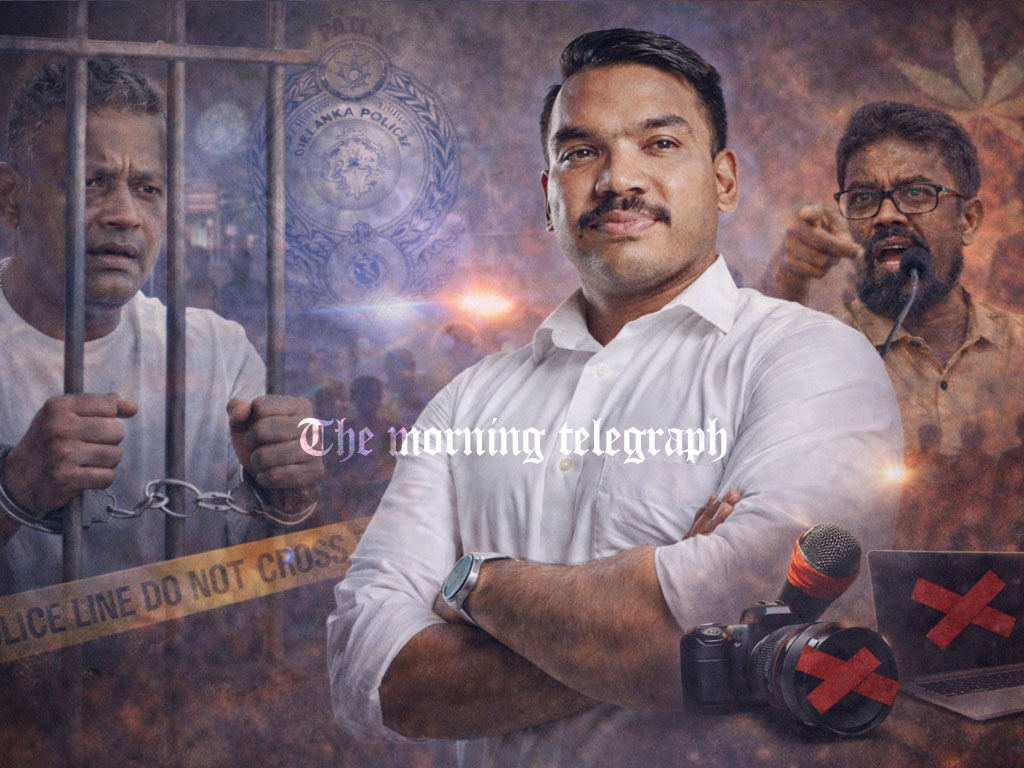
A shocking claim of reversed justice and media suppression sparks fresh political controversy, as questions mount over law enforcement, accountability, and political power in Sri Lanka.
Sri Lanka Podujana Peramuna MP Namal Rajapaksa has strongly criticized what he described as an unjust attempt to punish individuals and media institutions that informed the country about a recent controversial incident. He said it was deeply unfair to target those who brought the matter to public attention instead of addressing the root issue.

Commenting on the alleged incident involving a police officer attached to the Suriyakanda Police Station and a National People’s Power MP, Namal Rajapaksa stated that the situation reflects a serious breakdown in justice and accountability. He said that although the MP in question had allegedly assaulted the police constable, no arrest has taken place so far.
Instead, he claimed the government’s focus has shifted toward suppressing media institutions that reported on the incident. According to him, this approach threatens media freedom and undermines public trust in law enforcement and governance.
Namal Rajapaksa further commented,
“We saw that a Member of Parliament in Malima had grown cannabis the other day. But the police officer who went to seize the cannabis was attacked. The other one was transferred. The person who attacked and beat him has gone to jail. It’s like ‘he hit me, he hit me’. The person who beat him is in jail. The person who beat him is out. The owner of the cannabis is out. The officer who caught him is in jail. The MP who beat him is out.
But this government is trying to suppress the media institutions by informing the country and the world about it. Even the Inspector General of Police is not ashamed to let his own police spokesperson tell the country about this matter. Because these organized criminals are shooting at every junction and killing people. They are not being investigated. On the other hand, the IGP who protects the honor of the police officer or the police media spokesperson does not intervene.
The IGP and the police have become the government’s media spokesperson or the JVP’s media spokesperson.”
His remarks have reignited debate on selective justice, political influence, police independence, and the shrinking space for independent media reporting in Sri Lanka.