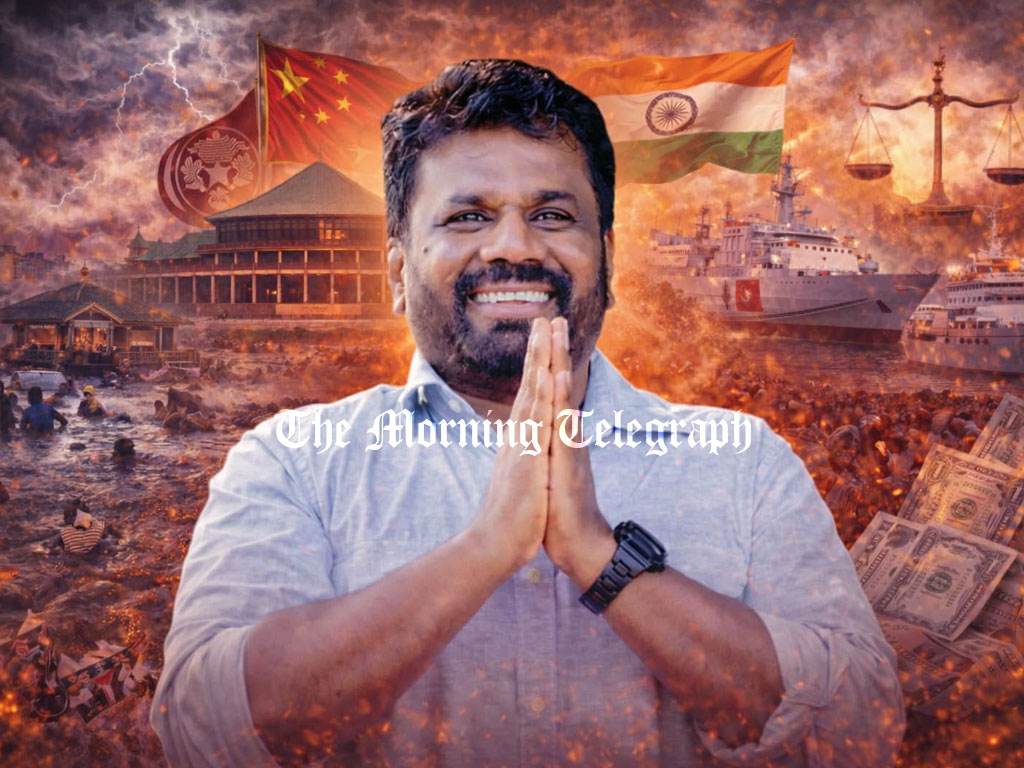
Sri Lanka’s first year under President Anura Kumara Dissanayake unfolded as a complex mix of disaster, diplomacy, economic discipline and unfinished reconciliation, revealing a leader navigating crises with pragmatism even as old national wounds remain unresolved.
The year 2025 did not announce itself through stock markets, foreign summits or political rallies. Instead, it arrived with tragedy. Cyclone Ditwah tore into Sri Lanka’s coastline towards the end of November, leaving behind a trail of destruction that would shape the country’s political and economic narrative well into the future. Heavy rainfall and landslides claimed 644 lives, left 18 injured and saw 183 people reported missing. The World Bank’s initial estimate placed the damage at around USD 4.1 billion, a staggering blow for a country still recovering from economic bankruptcy.

For much of 2023 and 2024, Sri Lanka’s public life had been dominated by the struggle to emerge from financial collapse. That recovery defined political debate, public expectations and international engagement. Cyclone Ditwah abruptly shifted that focus. The task of rebuilding, rehabilitating and protecting vulnerable communities is now expected to dominate the national conversation through 2025 and 2026, particularly if long-delayed provincial council elections are eventually held.
Yet 2025 was also the year President Anura Kumara Dissanayake, widely known as AKD, surprised both critics and supporters. Against expectations, he chose continuity over rupture in economic management. Rather than discarding the debt restructuring framework designed by his predecessor Ranil Wickremesinghe, AKD retained it, aligning Sri Lanka with IMF norms and international financial discipline. That decision was rewarded when the IMF approved USD 206 million under the Rapid Financing Instrument. Sri Lanka formally assured the IMF it would preserve fiscal discipline, a signal aimed squarely at restoring investor confidence.
International support followed. United Nations development partners committed USD 35 million under the Humanitarian Priorities Plan to assist nearly 1.2 million victims of Cyclone Ditwah. By December, USD 20 million had already been received, largely channelled through UN agencies and development partners working on the ground.
Disaster relief became a test of diplomacy as much as governance. India’s response stood out in scale and speed. Operation Sagar Bandhu, launched in the immediate aftermath of the cyclone, continued throughout December 2025. The effort culminated in the visit of India’s External Affairs Minister S. Jaishankar to Colombo on December 23. During that visit, India announced an assistance package worth USD 450 million, including USD 100 million as an outright grant. Before the year ended, India doubled its financial commitment to housing projects, benefiting over 1,550 families in the Northern and Southern Provinces. As commentator Kishantha Prashantha Cooray observed in his Financial Times article, India’s real-time response amounted to a substantive reaffirmation of a Sri Lanka–India partnership built on strategic reliability.
China, however, was not prepared to remain on the sidelines. Its own version of disaster diplomacy followed swiftly. On December 23, an 11-member delegation led by Wang Junzheng, Member of the 20th Central Committee of the Communist Party of China and Secretary of the CPC Committee of the Xizang Autonomous Region, arrived in Sri Lanka. The delegation met President Dissanayake, discussed deepening mutual understanding and regional collaboration, and visited Galle. A week earlier, another Chinese delegation led by Wang Dongming, Vice Chairman of the Standing Committee of the National People’s Congress, visited Colombo to reaffirm commitments to high-quality Belt and Road Initiative cooperation and enhance legislative exchanges. That delegation met both President Dissanayake and Prime Minister Harini Amarasuriya.
Commercial engagement continued alongside political outreach. In late November, a Guangdong Trade and Industry delegation led by Zhuang Lecong, Deputy Director General of Industry and Information Technology of Guangdong Province, visited Sri Lanka. Discussions with the Sri Lanka Export Development Board focused on attracting Chinese investment and opening new pathways for Sri Lankan small and medium enterprises to participate in trade fairs and commercial networks in China.
By the end of 2025, China’s approach to Sri Lanka had visibly evolved. High-interest loans, once the dominant model, were giving way to equity-based investments and strategic stabilisation. During his Beijing visit in January 2025, President Dissanayake reaffirmed the Strategic Cooperative Partnership while also emphasising an independent non-aligned foreign policy, carefully balancing relations with both China and India.
A controversial yet consequential decision came with the lifting of Sri Lanka’s one-year moratorium on foreign research vessels. This allowed Chinese so-called scientific vessels to dock, though under new standard operating procedures designed to ensure transparency. The government insisted that all such vessels would adhere strictly to these SOPs, attempting to address security concerns without alienating strategic partners.
Economically, 2025 marked critical turning points. Sri Lanka successfully finalised its external debt restructuring early in the year. China, as the largest bilateral creditor, participated in parallel negotiations, agreeing to extend repayment periods and reduce interest rates. The Central Bank of Sri Lanka and the People’s Bank of China renewed a major currency swap agreement in January, providing vital liquidity support for Sri Lanka’s recovering foreign reserves.
Trade figures underscored China’s growing economic footprint. By 2025, China had surpassed India as Sri Lanka’s largest source of imports, accounting for roughly 23.7 percent of the total import bill. Imports included fertilisers, refined petroleum and electronics. Sri Lanka sought to rebalance this relationship by expanding exports to China, particularly Ceylon Tea, activated carbon and seafood. New protocols were signed to facilitate agricultural exports, though progress towards a comprehensive Free Trade Agreement remained stalled.
Two mega projects symbolised the scale of Chinese investment. The USD 3.7 billion Sinopec refinery in Hambantota reached key milestones, becoming the largest foreign direct investment in Sri Lanka’s history. Fast-tracked during President Dissanayake’s state visit to China, the greenfield project is designed to process 200,000 barrels of oil per day and includes an integrated petrochemical complex and crude oil storage terminal connected directly to Hambantota Port. Sinopec expects to market up to 40 percent of output locally once completed. Alongside it, the Port City Special Economic Zone progressed towards operational readiness.
Domestic economic indicators also showed unexpected resilience. Tourism crossed a historic threshold with the arrival of the 2,333,797th tourist, narrowly surpassing the 2018 record. Buoyed by this momentum, authorities set a revenue target of USD 4.5 billion for 2026, aiming to attract 2.7 million visitors by focusing on high-spending markets and new geographies.
Maritime trade offered further encouragement. Container volumes at the Port of Colombo rose 7.1 percent year on year to 6.92 million TEUs in the first ten months of 2025. Transshipment activity remained central, with volumes increasing 5.1 percent to 5.52 million TEUs during the January to October period.
Fiscal performance reached historic highs. Sri Lanka Customs collected over Rs. 2.49 trillion by December 26, surpassing both the original and revised revenue targets. Apparel exports grew by 5.42 percent during the first eleven months of the year, reaching USD 4.57 billion.
Yet amid these bouquets, brickbats remained unavoidable. Ethnic reconciliation stood out as a glaring omission. Despite earlier assurances, AKD made limited progress in implementing the recommendations of the Lessons Learnt and Reconciliation Commission. As previously argued, full implementation would require neither constitutional amendment nor revision. The failure to move decisively raised concerns that ethnic anxieties could again be exploited ahead of future elections.
Law enforcement produced mixed signals. While former minister John Fernando remained elusive over allegations involving misuse of a bus, the CID arrested former minister Douglas Devananda, leader of the Eelam Peoples Democratic Party. Remanded until January 9, 2026, Devananda was arrested after a personal firearm issued by the Sri Lanka Army in 2001 reportedly ended up with an organised criminal gang. The weapon was found concealed near a culvert in Weliveriya, prompting further investigations into 19 additional firearms.
Taken together, 2025 was not a year of simple victories or failures for President Anura Kumara Dissanayake. It was a year defined by crisis management, pragmatic economics, assertive diplomacy and unresolved social questions. Bouquets may have outnumbered brickbats, but the balance remains delicate, and the coming years will determine whether pragmatism matures into lasting transformation.