A grave classroom failure has spiraled into a national reckoning, exposing how power evades accountability while children bear the cost.
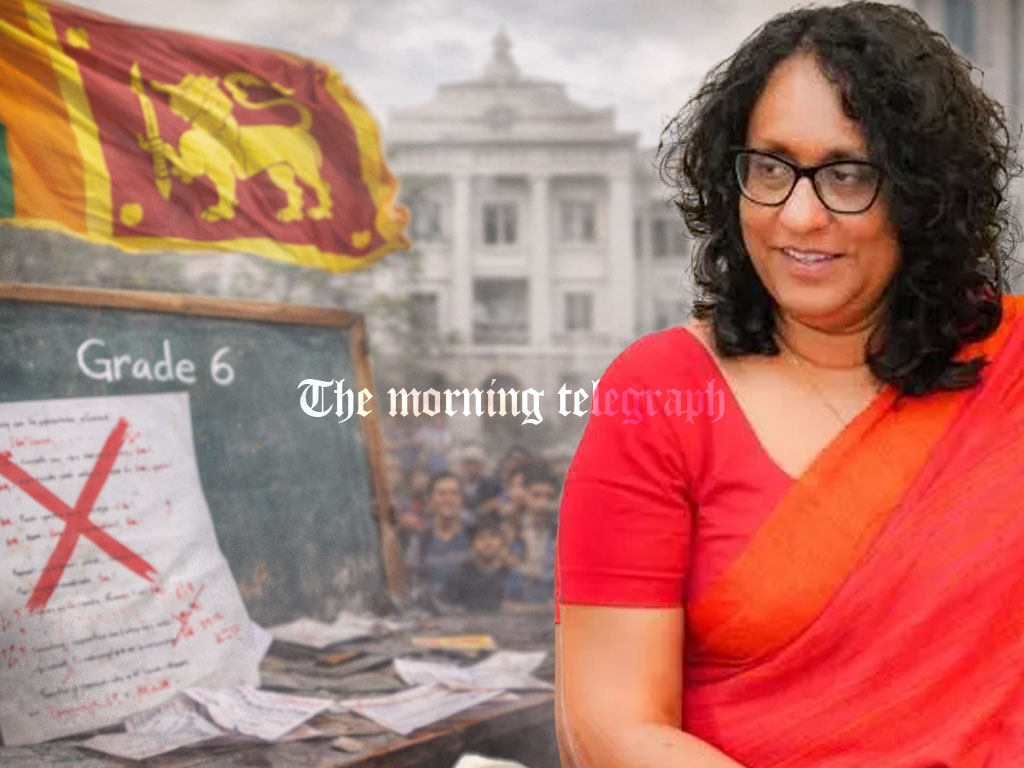
This was never a minor oversight. It was a profound act of irresponsibility that placed children and their futures at risk. When the state mishandles education, the consequences are not abstract. They land hardest on the poorest families, those with no private alternatives and no escape routes. What has unfolded in recent days reveals a deeper sickness in Sri Lanka’s public life: a reflexive tendency among a self-appointed intellectual elite to cry “sexism” whenever authority is challenged, even when the challenge has nothing to do with gender and everything to do with duty, competence, and accountability. A letter circulated by a small cluster of academics, amplified by a wider chorus of performative commentators, attempted to shield Prime Minister and Education Minister Harini Amarasuriya by theatrically relocating the debate. The fatal error in a Grade 6 English textbook was not confronted head-on. Instead, the argument was redirected into the safer, more fashionable terrain of victimhood. This was not principled courage. It was evasion wrapped in moral outrage.

Politics is not a sheltered seminar room. It is a rough and unforgiving arena, especially in Sri Lanka, where polemic is not a side effect but the operating condition. Those who enter this arena do so with open eyes. To affect surprise at criticism after years of dispensing it freely is to insult the intelligence of the public. There is an old Sinhala saying about those who eat thorny fish and then complain of pain. One cannot wield the cudgel for years and then collapse theatrically when the cudgel swings back. To perform the roles of victim and virtuoso at the same time is not bravery. It is calculation.
The most disturbing sleight of hand in this affair has been the quiet erasure of the real victims. They are not ministers surrounded by press secretaries and loyal signatories. They are children. Children who neither consented to nor could possibly comprehend the ideological vanity projects of adults exercising unchecked authority. An error embedded in a school textbook is not a rhetorical slip or a harmless lapse. It is a breach of trust with families who have no alternatives. Elite families will retreat to fortified international schools and overseas universities. Poor children will not. They will inherit whatever the state places before them, however careless, corrosive, or ill considered.
Against this backdrop, Harini Amarasuriya’s response has been dispiriting. She has built a public career on moral posturing against those who came before her. Yet when confronted with a failure within her own ministry, she chose equivocation over contrition. A genuine scholar faced with a grave mistake affecting children would have spoken plainly: I erred. I am sorry. I accept the consequences. Instead, the country was offered process, procedure, and pilgrimage. A visit to temples carrying stacks of textbooks is not accountability. It is choreography. The absence of a direct apology, whether to the Maha Sangha or to parents, was not an oversight. It was a deliberate choice.
What followed only deepened the crisis. Rather than stopping the discussion at the point where responsibility should have been assumed, a cadre of self-styled thinkers rushed in to redirect it. This maneuver is familiar. Pseudo intellectuals rarely defend substance. They defend networks. They speak the language of justice while insulating power. Their own children will never be subject to these experiments. Their stake is reputational rather than material. For the rest of the country, the cost is real and lasting.
The irony is suffocating. The very political formation now preaching reform spent decades hollowing out the public university system, often by encouraging unrest when it served opposition theatrics. Entire generations lost years to strikes and closures fueled by ideological fervor. Now, from the comfort of office, the same actors advance reforms that appear rushed, poorly supervised, and riddled with elementary errors. It is like attempting to tailor trousers by starting at the collar. Whether in opposition or in government, the outcome is the same: institutional damage.
The Prime Minister’s remarks in Kandy about an impending no confidence motion only sharpened the sense of dissonance. With 159 seats in a 225 member parliament, the government knows the motion will fail. To frame it as a pedagogical opportunity rather than a rebuke is revealing. This is not about parliamentary arithmetic. It is about moral symbolism. A no confidence motion that cannot pass can still accuse. It can still draw a line. The failure at issue here was not numerical. It was ethical.
Sri Lanka’s tragedy, repeated with numbing regularity, is the replacement of conscience with cleverness. The political class, aided by its academic courtiers, treats ethics as an inconvenience to be managed rather than a compass to be followed. In this ecosystem, mistakes are not confessed. They are reframed. Responsibility is not assumed. It is redistributed until it disappears. Those who speak most loudly of equality before the law recoil when the law edges toward them.
It must be stated plainly that attacks rooted in prejudice regarding sexual orientation are contemptible and must stop. No public official deserves harassment on that basis, and no political argument is strengthened by bigotry. On that narrow point, the letter writers are right. But this acknowledgment does not absolve the minister of her obligations. One can oppose hateful speech and still demand resignation. These positions become incompatible only when loyalty to an individual eclipses loyalty to principle.
There is also an uncomfortable amnesia at work. Many now cloaking themselves in the language of dignity and restraint have long histories of unrestrained verbal and physical abuse directed at opponents. Families, including children, were not spared in those years. To discover civility only after attaining power is not moral growth. It is convenience. The same applies to unregulated digital mobs tolerated, and at times encouraged, by those who now plead for decorum. Control, like accountability, cannot be selective.
Beyond politics lies the law, and here the issue becomes more serious still. School textbooks are public property. They are produced with public funds and distributed under state authority. When content appears that may violate statutes on obscenity, child protection, or misuse of public assets, the response cannot be limited to press conferences, parliamentary speeches, or ceremonial visits. It requires a full investigation conducted without fear or favor. Whether the laws themselves are outdated or unjust is a separate debate. As long as they remain in force, governments that claim fidelity to equality before the law cannot behave as though exemption applies at the cabinet table.
The governing coalition came to office promising a clean break from the old order. Equality, transparency, and accountability were not footnotes. They were the central pledge. Every evasion now corrodes that promise. Every attempt to float above the law invites the cynicism they once condemned. Reform cannot be proclaimed while responsibility is dodged. Law cannot be wielded against enemies and quietly suspended for friends.
This episode will be remembered not primarily for the error in a textbook, serious though it was, but for the response to it. Sri Lanka does not lack intelligence. It lacks honesty in how that intelligence is used. Until those in power learn that resignation is not humiliation, that apology is not weakness, and that children are not collateral in ideological theater, the country will continue to repeat the same cycle. Different actors. The same script. The same damage. The curse is not criticism. The curse is the refusal to listen.
SOURCE :- SRI LANKA GUARDIAN