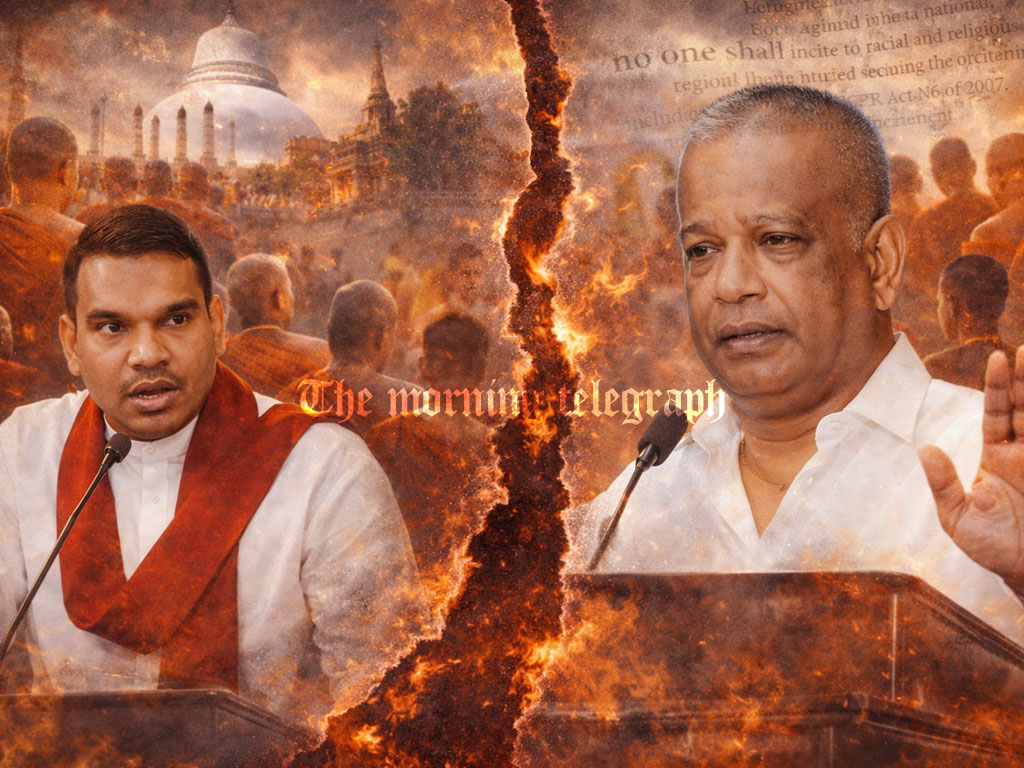
A political storm has erupted after allegations that a senior cabinet minister violated the ICCPR Act by insulting Buddhist clergy, raising serious questions about religious harmony, legal equality, and the limits of political speech in Sri Lanka.
A fresh controversy has erupted within Sri Lanka’s political landscape following remarks attributed to Agriculture, Livestock, Lands and Irrigation Cabinet Minister K.D. Lalkantha, with accusations that his statements amount to a violation of the International Covenant on Civil and Political Rights (ICCPR) Act No. 56 of 2007.

Sri Lanka Podujana Peramuna National Organizer Namal Rajapaksa has strongly condemned the remarks, claiming that Minister Lalkantha insulted the Maha Sangha and promoted religious hostility. According to Rajapaksa, the minister had allegedly referred to the Mihintale Nayaka Thero as a “wild person,” a comment that Rajapaksa says was deeply offensive and unacceptable in a country with strong Buddhist traditions.
Rajapaksa stressed that the ICCPR Act clearly states that “no one shall incite to national, racial or religious hatred, including the spreading of war or incitement to discrimination, hostility or violence.” He argued that Minister Lalkantha’s comments appear to fall within this definition, particularly as they target respected Buddhist leaders and institutions. Rajapaksa questioned whether the law would be applied equally, asking what legal action the government intends to take against the minister under the ICCPR Act.
He further claimed that if an ordinary citizen or a member of the opposition had made similar remarks, they would have already been arrested and prosecuted. The government’s silence on the matter, he said, raises concerns about selective enforcement of the law and political double standards.
Rajapaksa also pointed out that while disagreements between politicians and the Maha Sangha have existed throughout Sri Lanka’s history, no politician has previously resorted to such direct insults against Buddhist clergy. He emphasized that political debate must never cross the line into religious disrespect or hate speech.
Deputy Minister T.B. Sarath also weighed in on the controversy, stating that Minister Lalkantha should be questioned regarding the alleged statement that Mihintale was “savage.” Speaking to the media, Sarath said he personally does not believe Lalkantha intended such an insult and suggested the remarks may have been misinterpreted or taken out of context.
The issue has since drawn further attention after journalist Uvindu Kurukulasuriya commented publicly on Minister Lalkantha’s statement, adding fuel to an already heated debate. As public discussion intensifies, the controversy has reignited broader questions about freedom of expression, religious respect, and the consistent application of laws governing hate speech in Sri Lanka.