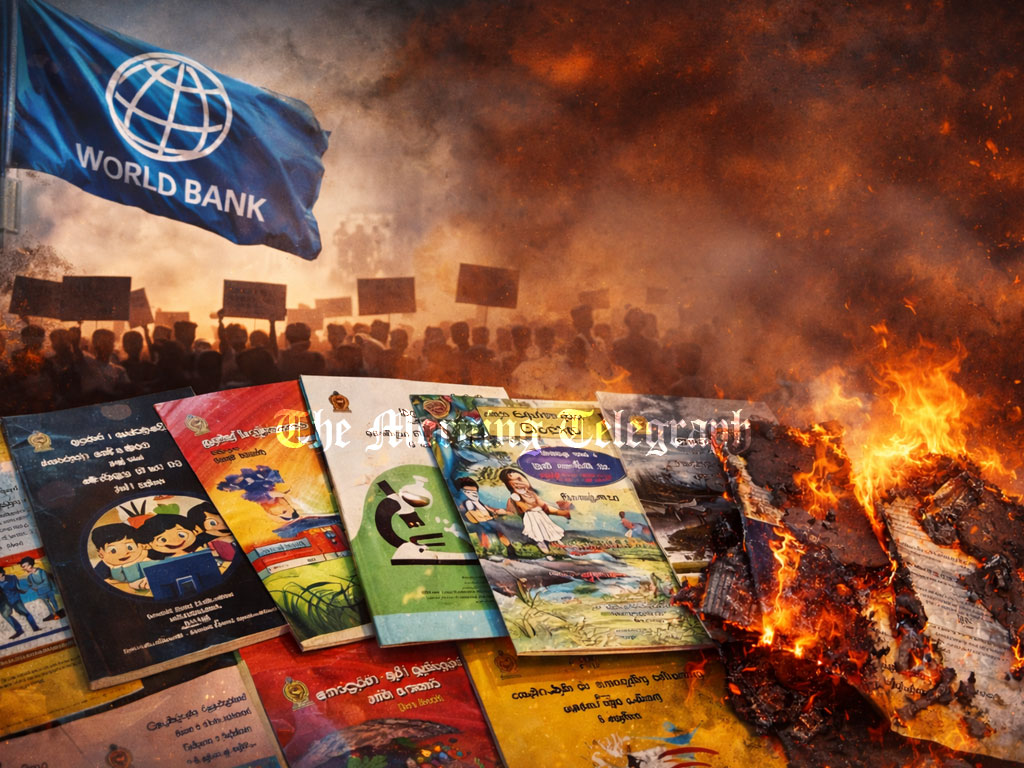
Sri Lanka’s proposed education reforms are facing sharp resistance, with critics warning that a World Bank driven model risks dismantling state responsibility and undermining the country’s long standing commitment to free education.
The Frontline Socialist Party has strongly criticized the government’s proposed education reform, claiming it removes the state from its responsibility for education under a World Bank backed project. The party argues that the reform is a reactionary initiative designed to shape future generations according to neoliberal capitalism, ultimately restricting the right to free education. These views were expressed by the party’s Education Secretary, Pubudh Jayagoda.

He referred to the President’s explanation for postponing the implementation of the Grade 6 module system, outlining three key reasons. The first relates to the incomplete preparation of the modules. Only first term content has been developed, while neither the Ministry of Education nor the National Institute of Education has clarity on what will be taught during the remaining two terms. There has also been no proper planning on how subject content should be distributed from Grade 1 to Grade 11.
The second issue concerns serious technical flaws. As acknowledged by the President himself, the modules were prepared in haste and contain numerous errors. A total of 147 mistakes were identified across 14 modules, leading to multiple complaints. Under such conditions, these materials cannot be issued to students, and there is insufficient time to revise and reprint them properly.
The third reason is the lack of teacher training. Educators have not been trained to deliver the new modules, raising serious questions about how implementation could begin without adequate preparation. From the outset, critics had urged the government to avoid rushed education reforms, engage in meaningful social dialogue, and introduce well planned changes.
Jayagoda stated that the President had no alternative but to postpone the reforms. However, he stressed that the underlying proposal remains dangerous. He warned that the reform seeks to absolve the government of its educational responsibility, weaken free education, and align schooling with neoliberal economic priorities.
He added that such a reform must not be implemented next year either. Instead, Sri Lanka needs a genuine education reform that addresses modern challenges. He urged the government to seek proper guidance, including consulting the National People’s Power Education Policy Committee, and to submit a clear policy framework to the National Education Commission to avoid repeating cycles of failure.