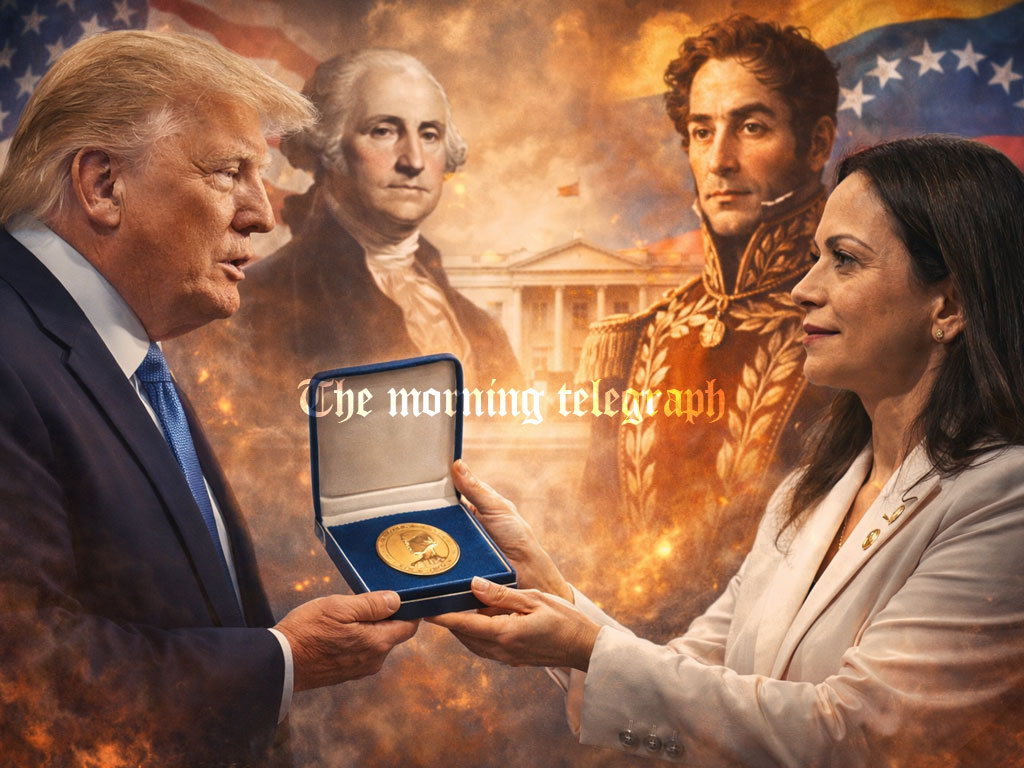
Venezuelan opposition leader María Corina Machado presented her Nobel Peace Prize medal to Donald Trump in a symbolic gesture that has ignited global debate over Venezuela’s future, U.S. influence, and the meaning of peace honors.
Venezuelan opposition figure and 2025 Nobel Peace Prize winner María Corina Machado met Wednesday with U.S. President Donald Trump at the White House, where she symbolically presented him with her Nobel Peace Prize medal. The meeting marked the first face-to-face encounter between Machado and Trump, a moment she described as historic for Venezuelans and a symbolic recognition of what she called his “unique commitment with our freedom.”

Machado’s visit comes against the backdrop of a dramatic shift in Venezuelan politics, following a U.S. military operation in early January that resulted in the capture and transport to New York of Venezuelan President Nicolás Maduro, who has been arraigned on federal drug-trafficking and related charges in U.S. courts.
At the White House, Machado presented Trump with her Nobel Peace Prize medal, framing it as a gesture of gratitude and brotherhood between the Venezuelan people and the United States. She invoked a historic analogy, likening her act to the moment when Marquis de Lafayette, a hero of the American Revolution, gave a medal bearing the image of George Washington to Venezuelan liberator Simón Bolívar, symbolizing shared values and solidarity.
“Then, as now, Bolívar’s people present this Nobel medal to Washington’s heir as a symbol of brotherhood against tyranny,” Machado told reporters, reaffirming her belief that Trump’s actions helped advance democratic freedoms in Venezuela.
However, the gift sparked immediate controversy. The Nobel Committee quickly clarified that while a Nobel Peace Prize medal can physically change hands, the title of Nobel Laureate is permanent and cannot be transferred or shared once awarded. The committee stressed that Nobel Prize decisions are final and irreversible, underscoring that Machado remains the official laureate regardless of any symbolic gesture.
Trump accepted the medal as a “respectful gesture,” thanking Machado and praising her courage. He has long expressed interest in being associated with a Nobel Peace Prize, and observers note that Machado’s action may have been designed to appeal to his personal ambitions as much as it was to acknowledge U.S. support.
Despite the ceremony’s symbolic weight, Trump has yet to recognize Machado as Venezuela’s official leader. Instead, he is working closely with Delcy Rodríguez, Maduro’s former vice president and acting head of state after the January operation. Trump has publicly stated that Machado lacks sufficient support within Venezuela to lead the country, even as he maintains engagement with her on democratic reforms.
The U.S. administration’s focus on Venezuela extends beyond politics to economic strategy. Since Maduro’s removal, the United States has been actively working to revive Venezuela’s oil industry, seizing multiple tankers allegedly linked to sanctioned operations and completing major oil sales valued at hundreds of millions of dollars.
Machado’s decision to present her Nobel medal to Trump has drawn both praise and criticism. Supporters view the gesture as a powerful diplomatic symbol, reinforcing ties between Venezuelans seeking democratic change and the United States. Critics argue it blurs the lines between peace accolades and political maneuvering, especially given ongoing debates over the legality and legitimacy of foreign military involvement in Venezuela’s internal affairs.
The Nobel Peace Prize, awarded to Machado in October 2025 for her advocacy of democratic rights and peaceful transition away from authoritarian rule, remains hers even after the symbolic presentation. The Nobel Committee’s decision underscores the permanence of peace honors and the distinction between personal accolades and political gestures.
As the political landscape in Venezuela continues to evolve, the significance of Machado’s symbolic act will be debated by diplomats, analysts, and everyday citizens. Whether it advances her influence or complicates her position in future leadership contests is yet to be seen. The unusual intersection of peace recognition and geopolitical strategy has set the stage for ongoing discussion about the role of international awards, diplomatic symbolism, and the future of Venezuelan governance in a rapidly changing global context.