A bruising political battle over education reforms has turned Sri Lanka’s Prime Minister into the focal point of protest, exposing deeper fault lines of sexism, power struggles, and electoral strategy in national politics.
The government has partially stepped back from its controversial education reforms following protests by various stakeholder groups. Last Tuesday, it announced that the proposed Grade 06 reforms would be postponed until next year. A controversial link to a gay website included in a Grade 06 English module gave fresh momentum to the Opposition’s campaign against the reforms, turning an already sensitive policy debate into a flashpoint. From the government’s perspective, this tactical retreat may have been necessary to prevent agitations from snowballing into a broader protest movement similar to Aragalaya. Yet the pause has not succeeded in defusing opposition resistance, which continues to gather pace.

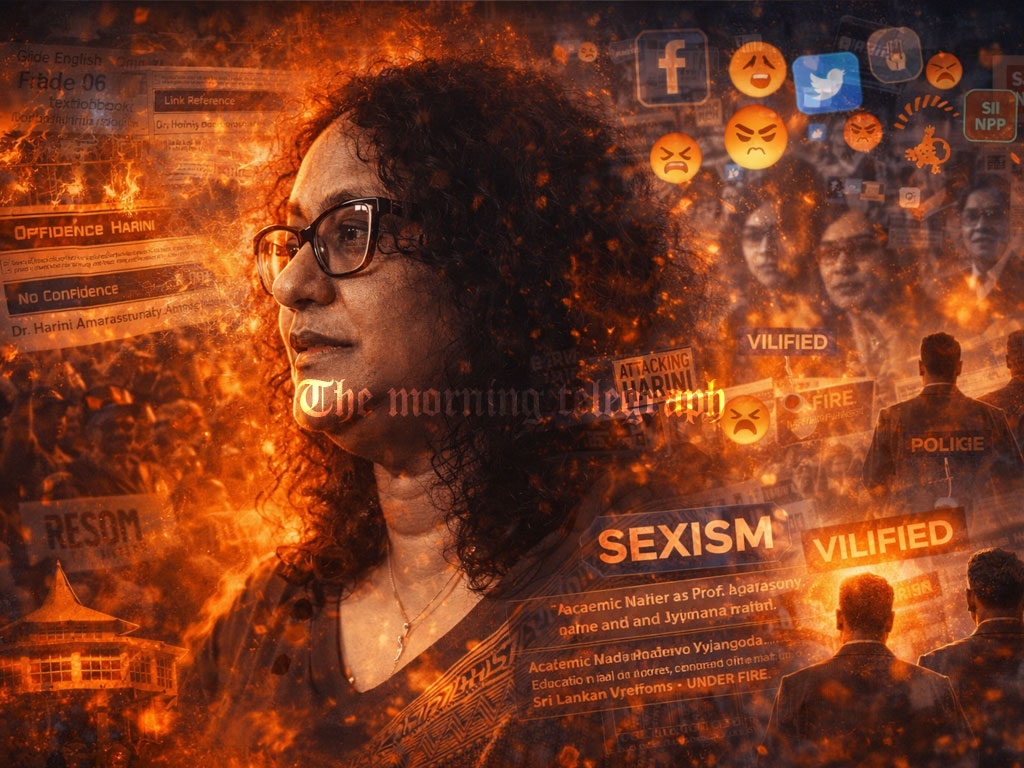
What is striking is that the backlash has focused less on the government as a whole and more on Prime Minister and Minister of Education Dr. Harini Amarasuriya. Instead of framing their critique around policy substance, opponents of the education reforms have singled her out personally. The Opposition has announced plans to move a no-confidence motion against her, while some of its members, supporters, and online propagandists stand accused of launching sustained personal attacks. Harini has increasingly become the target of character assassination rather than reasoned political debate.
The intensity of this vilification has prompted a response from academics and activists. A group led by Prof. Jayadeva Uyangoda issued a public statement condemning the personal attacks on the Prime Minister and calling attention to their wider social implications. In their words:
“The attacks being directed at the Prime Minister and Minister of Education Dr. Harini Amarasuriya by certain opposition groups and individuals are not only hateful, indecent, and a disgrace to the moral values of any civilized society, they also normalise misogynistic attitudes that belittle progressive women’s political leadership and shrink the space needed for constructive engagement and a meaningful discourse on urgently needed education reforms.”
Such attacks are not only morally objectionable but also politically counterproductive. By turning Harini into a personal target, campaigners against the education reforms have inadvertently helped the government present itself as a victim of unfair persecution, a narrative that can generate public sympathy. This dynamic was visible last Saturday in Matugama, where the NPP organized a protest against the vilification of the Prime Minister, even as a collective of Opposition parties led by the SJB staged a parallel demonstration in the same town against the education reforms themselves.
Sri Lanka often prides itself on having produced the world’s first female prime minister, Sirima Bandaranaike. Yet despite this symbolic milestone, the country’s political landscape remains overwhelmingly male dominated. Women make up more than half of the population, but only 22 of the 225 members of Parliament are female. Special quota systems have had to be introduced simply to ensure a minimal level of women’s representation. This imbalance reflects a deeper political culture that remains tainted by sexism and, at times, outright misogyny.
There have been numerous instances of female MPs complaining of verbal sexual harassment by male colleagues within Parliament itself. Sexism is not confined to the national legislature. In January 2021, reports emerged that female local government members were routinely denied the right to speak at council meetings dominated by unruly male councillors. Chandrika de Zoysa, then a member of the Maharagama Urban Council, publicly stated that women councillors were heckled and shouted down whenever they attempted to speak. Similar conditions reportedly prevailed in other councils across the country.
That same year, SJB MP Rohini Wijeratne informed Speaker Mahinda Yapa Abeywardena that MP Thalatha Athukorale had been subjected to verbal sexual abuse by government MPs during a parliamentary debate on a no-confidence motion. These incidents illustrate that hostility toward women in politics is systemic rather than episodic, making the current attacks on Harini part of a longer and troubling pattern.
Sri Lanka’s post-independence history offers many examples of scurrilous attacks on female political leaders. During the 1977 general election campaign, UNP leaders directed vicious personal insults at Prime Minister Sirima Bandaranaike. Among those who vilified her was Ranasinghe Premadasa, who later became both Prime Minister and President. In the lead-up to the 1994 general election, Chandrika Bandaranaike Kumaratunga was subjected to sustained slander by her political opponents. During her presidency, her own party supporters, led by some ministers, infamously stripped a group of UNP activists, including women, naked in public during the North Western Provincial Council election campaign in 1999.
Political debate in Sri Lanka has long been marked by ad hominem attacks, where personalities are targeted instead of policies. This tendency has worsened with the rise of social media, which allows anyone to spread allegations, insults, and disinformation with little accountability. It is against this backdrop that the current attacks on Harini must be understood.
Education reforms alone do not fully explain why Harini has become the primary target. The reform agenda is a collective government initiative, yet she has been singled out because she represents the NPP, the broader political vehicle that enabled the JVP to expand its reach beyond its traditional base. The JVP’s core vote share is relatively small, estimated at under five percent. Its recent electoral successes were made possible largely by floating voters rather than a stable, entrenched base.
In today’s fragmented political environment, traditional vote banks no longer carry the weight they once did. Recognizing this, the Opposition appears determined to weaken the government by eroding its appeal among swing voters. Attacks on Harini can therefore be seen as part of a calculated electoral strategy rather than a spontaneous reaction to education policy alone. Even if the government were to abandon its reform package entirely, there is little reason to believe that these attacks would cease.
Internal dynamics within the ruling alliance add another layer of complexity. The NPP is not immune to internal rivalries, and differences persist between the JVP and the wider alliance. Some JVP stalwarts who are less favorably disposed toward Harini may privately take satisfaction in her predicament, viewing it as an opportunity to assert greater control within the government. However, they are unlikely to take actions that would fracture the alliance or jeopardize their hold on power. For this reason, Opposition claims that senior JVP figures are actively seeking to destroy Harini politically are difficult to sustain.
If the Opposition proceeds with a no-confidence motion, NPP MPs are expected to rally behind Harini as a bloc. This does not mean, however, that future splits within the alliance are impossible. Sri Lanka’s political history shows that even governments with commanding majorities are vulnerable to internal fractures. The SLFP-led United Front government of 1970 to 1977 collapsed under the weight of internal divisions. President J. R. Jayewardene famously collected undated resignation letters from his MPs to prevent defections, despite holding a five-sixths majority in 1977. The Mahinda Rajapaksa government lost power in 2015 despite a two-thirds majority, and defections also weakened the Gotabaya Rajapaksa administration after 2020. In politics, unity is always fragile.
For now, the Opposition has found a potent issue with which to batter the government. Education reforms provide a convenient platform for mobilization, while attacks on Harini serve broader strategic goals. As long as these tactics resonate with sections of the electorate, the Opposition is likely to continue pressing the issue and targeting the Prime Minister and the NPP in the battles ahead.