A lightning-fast Special Forces raid in Vavuniya rewrote Sri Lanka’s counter-terror playbook, proving that speed, surprise, and flawless coordination could defeat terror in minutes.
By 1987, Sri Lanka’s northern theatre had become crowded with armed groups operating beyond the law. Among them, the PLOT organization had emerged as a dominant force, often outpacing even the LTTE in extortion, kidnappings, bank robberies, attacks on police stations, weapons theft, and targeted killings, particularly in areas inhabited by Sinhalese communities in the North. At the same time, intelligence indicated that PLOT operatives were using the dense forests of Vavuniya to prepare for a clandestine attempt to seize power in the neighboring Maldives, laying traps and conducting secret military-style training deep inside the jungle.

Against this backdrop, an elite formation was taking shape within the Sri Lanka Army. What began as a Combat Tracker Team of 38 men, led by Major Gamini Hettiarachchi and Lt. Fazli Lafir under the strategic guidance of Brigadier Kobbekaduwa, soon evolved into a more formidable unit. With a second intake, the team expanded to 75 soldiers and was formally designated the Rapid Deployment Force, or RDF. For operational efficiency, it was divided into squadrons named Alpha, Bravo, and Charlie, commanded respectively by Lt. Ajith Perera of the Armoured Corps, Lt. Fazli Lafir of the Gajaba Regiment, and Lt. Rohan Wijesinghe of the Electrical and Mechanical Engineering Regiment, who later joined the Gamunu Hewa Regiment. After a third course, the RDF expanded again, giving birth to Delta Squadron, with Lt. Raj Wijesiri of the Armoured Corps appointed as its commander.
The defining moment came when a Tamil woman arrived at the RDF camp in Vavuniya, seeking urgent help. She met Lt. Fazli Lafir and explained that her husband, a businessman, had been abducted by the PLOT organization. A ransom demand of one lakh rupees had been issued, along with a chilling warning that the captive would be killed. Under pressure and desperation, she had already sent the ransom money through a servant. Further questioning revealed critical intelligence: the businessman was being held in a house in the Kalmadu area.
Recognizing the urgency, Lt. Lafir immediately informed Major Gamini Hettiarachchi. Given the risk to the hostage’s life, Major Hettiarachchi ruled out a ground assault and decided on an airborne rescue. The mission was entrusted to Lt. Raj Wijesiri, a decision rooted in confidence in his leadership and operational instincts. Securing air support was not straightforward, but persistence paid off when a Bell 212 helicopter was finally approved for the mission.
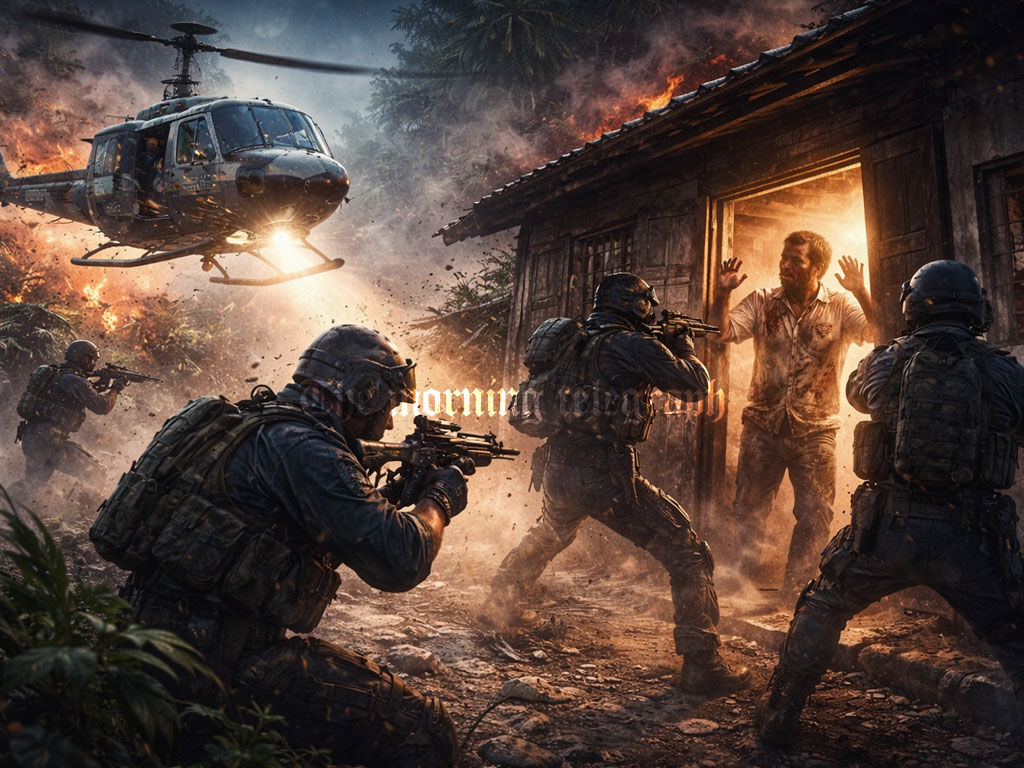
As evening fell, Lt. Wijesiri conducted intensive pre-mission rehearsals with his Delta Squadron troops. Intelligence supplied by Lt. Lafir helped narrow down the exact location of the safe house. When the moment arrived, the Bell 212 lifted off from Vavuniya with a South African pilot contracted by the Sri Lanka Air Force at the controls. Flying low and fast, often skimming treetop level, the helicopter reached the Veppankulam area within minutes.
At that time, neither the Army Special Forces nor the Air Force had GPS technology to pinpoint targets. It was the pilot’s sharp observation that made the difference. He spotted an isolated house encircled by terrain resembling a goose-neck formation. Acting instantly, the helicopter made a short circuit and descended rapidly near the structure. As trained, Special Forces soldiers leapt from both sides of the aircraft, landing just feet from the target and sealing off the house in under two minutes.
A sentry armed at the entrance was neutralized immediately, stunned by the suddenness of the assault. The soldiers stormed the house, silencing their weapons within seconds. Another terrorist was killed inside. The hostage was freed almost instantly. The businessman, overwhelmed, approached the soldiers with raised hands, tears streaming down his face in disbelief and relief.
Two terrorists attempting to flee were chased down and eliminated. From insertion to extraction, the entire hostage rescue operation was completed in less than three minutes. Speed, coordination, and surprise were the decisive factors. The rescued businessman was rushed back to the helicopter, and the team withdrew without delay, leaving behind grenades beneath the bodies of the fallen terrorists to prevent recovery or regrouping by accomplices.
This operation marked Sri Lanka’s first successful airmobile hostage rescue and is widely regarded as the fastest such mission in the nation’s conflict history. It established a benchmark for Special Forces doctrine and proved the effectiveness of rapid deployment tactics in counter-terror operations.
History would later echo this episode. When the PLOT organization, driven out of Sri Lanka by sustained military pressure, attempted a coup in the Maldives on November 3, 1988, it triggered India’s Operation KATKES to rescue the Maldivian President. The ripple effects of PLOT’s ambitions underscored the regional stakes involved.
Lt. Raj Wijesiri’s later completion of the Ranger course in the United States became another turning point. Upon his return as Delta Squadron commander, he helped lay the foundations for the Long Range Deployment Force and initiated combat diving capabilities within the Second Special Forces Regiment. These innovations would later play a crucial role in deep-penetration missions that dismantled LTTE leadership structures.
The three-minute rescue at Kalmadu did more than save one life. It reshaped Sri Lanka’s Special Forces ethos and secured its place in military history as a moment when precision, courage, and preparation converged perfectly.