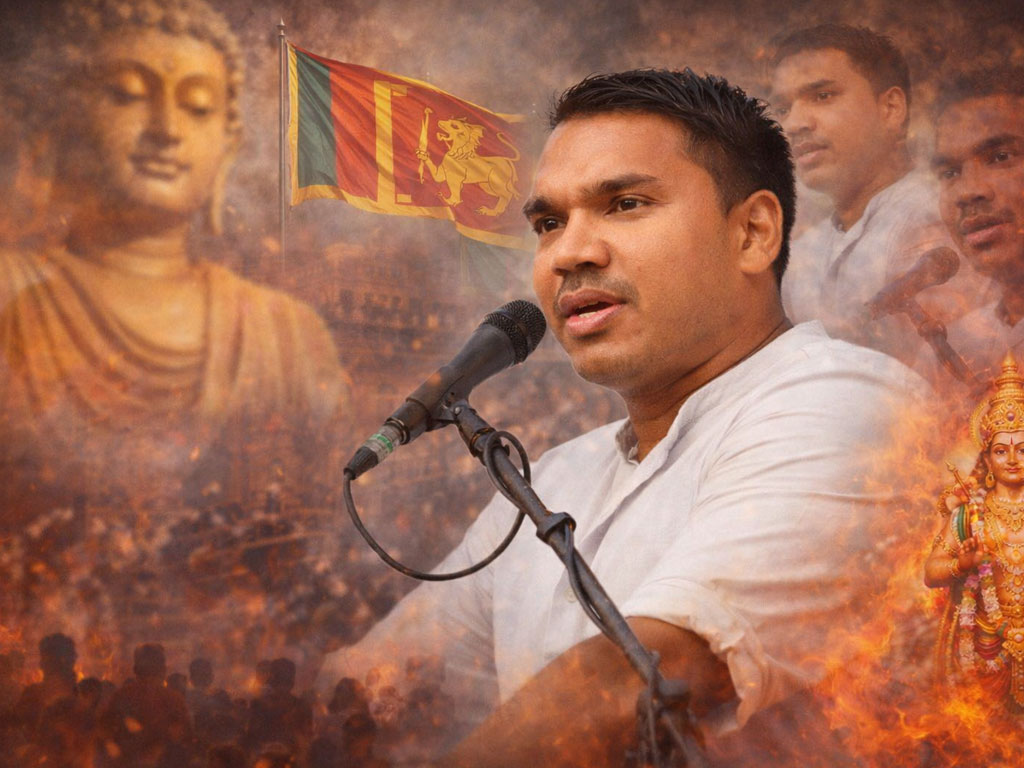
Namal Rajapaksa pushes back against claims of religious provocation, arguing that pilgrimages across Sri Lanka reflect shared faith and culture, not division, while launching a broader attack on government policy, economic hardship, and political repression.
Do the people of Jaffna travel to Kataragama after passing Nallur out of hatred, or is it simply an expression of faith? That was the central question raised by Sri Lanka Podujana Peramuna National Organizer and Parliamentarian Namal Rajapaksa as he addressed a gathering in Thambuttegama, delivering a wide ranging speech that blended religion, culture, politics, and sharp criticism of the government.

Opening his remarks, Namal Rajapaksa referred to the President’s visits to the North and framed his own presence as a message of unity rather than hostility. He said that while he too had come to the President’s village, he would never arrive to spread hatred, jealousy, or anger. Instead, he stressed that his political movement was grounded in a clear belief system that sought to protect all cultures within a society centered on Buddhist culture and rooted in the broader Hela civilization.
He told the audience that Sri Lanka needed a political force that genuinely loved the land, rather than one that maintained power by sacrificing the country, race, or religion through opportunistic politics. According to him, true patriotism meant safeguarding the nation’s heritage while respecting the diversity of belief that had existed on the island for centuries.
Expanding on the theme of religious coexistence, Namal Rajapaksa drew comparisons between different faith traditions. He said that Buddhist monks travel to Nagadeepa after paying homage at the Sri Maha Bodhi, now freely and without fear because the war had ended. In the same way, Catholic devotees travel to Madhu Mai, passing churches along the way. He pointed out that the President himself, while in Jaffna, walks past several temples from Nallur before proceeding to Kataragama to offer prayers to Kataragama Devaihamuduruwo.
“That is not racism, it is faith,” he declared, emphasizing that the devotion a Buddhist holds for Nagadeepa is no different from the devotion a Catholic holds for Madhu Mai. He added that Kataragama Devaihamuduruwo, who is revered within Hindu culture, inspires a similar sense of faith and reverence. According to Namal Rajapaksa, those who believe have a deep concern for sacred lands such as Kataragama, and this devotion should not be misinterpreted as an attempt to divide or dominate territory.
Turning to the North, he argued that Tamil people are not interested in pointing fingers at Buddhist philosophy or building politics based on hostility toward Buddhism. Instead, he said, they too believe in culture and faith, just as people in the South do. He reminded the audience that many countries across the world, including Britain and the United States, were grappling with serious religious crises, whereas Sri Lanka had managed to avoid inter religious violence.
“There is no killing and stabbing between religions in our country,” he said, asking why this was so. His answer was that within a society built on Buddhist culture, all other religions were protected. He insisted that the island’s social fabric, shaped by the teachings of Buddhism, had historically fostered respect for all religions and cultures.
From this perspective, Namal Rajapaksa rejected accusations of racism directed at those who travel for religious worship across regional and ethnic boundaries. When people from the South go to Jaffna to practice their religion, and when people from the North go to Kataragama, he said, it should be seen as a shared bond rather than a source of suspicion. He expressed happiness that President Anura Kumara was enjoying the freedom in Jaffna that had been secured, in his words, through the sacrifices of war heroes. He urged the President to be happy as well, arguing that there was no hatred in his party’s politics.
However, his speech soon moved beyond cultural themes into a pointed critique of governance. Namal Rajapaksa accused the government of attempting to create discord among communities while publicly preaching against hatred. He referred to a recent major disaster in which many lives were lost, saying that affected communities believed more lives could have been saved if government intervention had been stronger and more timely.
He spoke of widespread disappointment and discontent, highlighting what he described as an unbearable tax burden placed on ordinary people. He criticized policies that, in his view, weakened local farmers by importing vegetables, fruits, and rice instead of strengthening domestic agriculture. Recalling the past, he said Sri Lanka was once a society that harvested golden crops, ate rice three times a day, and lived with dignity.
While acknowledging that importing food might appear convenient or even beneficial for a government, he insisted that any administration had a responsibility to protect farmers, fishermen, and entrepreneurs across the country. That responsibility, he said, could not be avoided.
Namal Rajapaksa also revisited controversies surrounding organized crime and narcotics. He referred to allegations that while authorities claimed to be stopping criminal networks, hundreds of containers had been released from the port under questionable circumstances. He said his party had been slandered in the past and continued to face accusations today, but maintained that drugs and organized crime must be eliminated honestly and without political bias.
According to him, it was impossible to eradicate crime if criminals affiliated with the government were protected while those opposed to it were branded as enemies. Only sincere and impartial action, he said, could rid the country of such threats.
Reaffirming his party’s identity, Namal Rajapaksa described the Sri Lanka Podujana Peramuna as a political force formed by the people of the land, always standing with farmers. He promised continued commitment to cultivating every crop that could grow in the country and to creating a modern generation of farmers supported by technology. He said his party accepted that responsibility and saw itself as part of a modern generation connected to technology and focused on building opportunities for youth.
He spoke of preparing young people for the global job market while remaining compatible with Sri Lanka’s culture and religion. This balance, he said, was essential for genuine political transformation.
Addressing party supporters directly, Namal Rajapaksa acknowledged past shortcomings and setbacks. He said that instead of ruling arrogantly or ignoring party members, leaders needed to listen, engage honestly, and understand the hopes of the nation. He claimed that his party was now ready for such transformation and invited those who had distanced themselves to return and engage in dialogue.
He urged supporters to go from house to house, not merely seeking votes, but discussing ideas with both allies and critics. Building unity at the village level, he said, was the foundation for strengthening the party at the district and national levels.
Toward the end of his speech, Namal Rajapaksa warned against repression and political intimidation, referencing past periods of violence and urging the government not to repeat such tactics. He insisted that neither imprisonment nor intimidation could stop his movement. He called on the government to stop what he described as lies, deception, and repression, and to fulfill the promises made to the people.
Concluding, he appealed for the protection of the freedom won through sacrifice, an environment where all communities could live with dignity, and resistance against what he described as cultural, religious, political, and economic destruction. He thanked party organizers in the Anuradhapura district and called on them to lead from the grassroots, strengthening the party and shaping a political culture he said was suited to Sri Lanka’s future.
Former ministers, Members of Parliament, provincial councilors, and divisional organizers, including Anuradhapura District Leader Tissa Kuttiarachchi, were among those present at the event, which marked the first major political program of the new year for the Sri Lanka Podujana Peramuna.