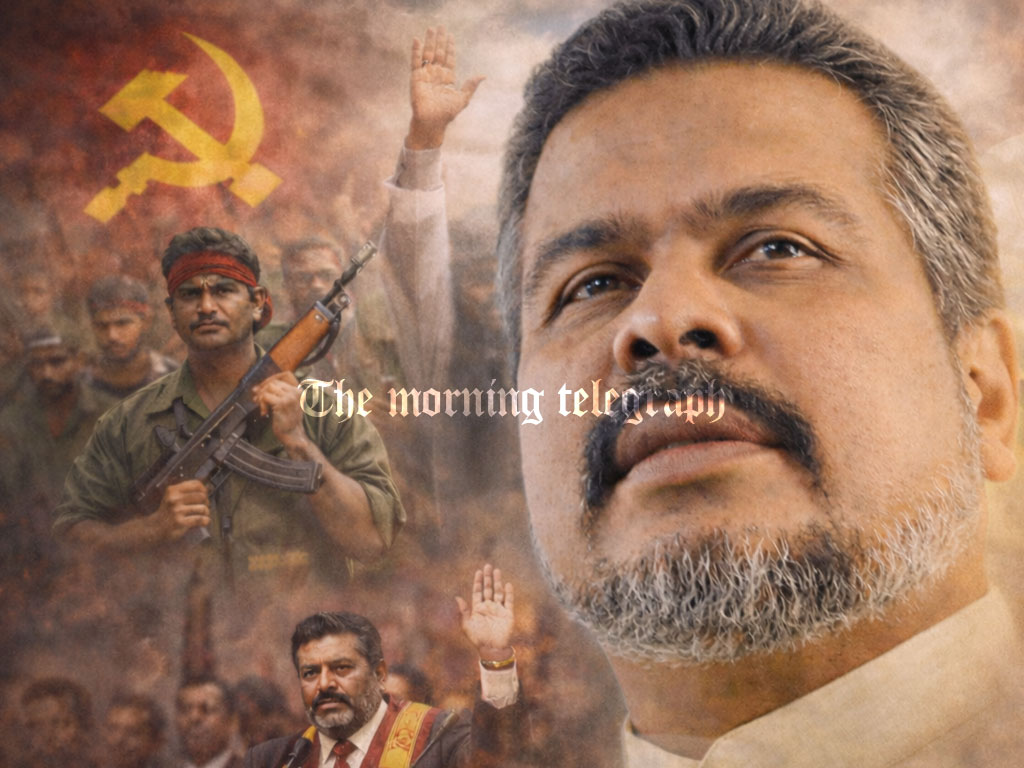
A fearless revolutionary, presidential candidate, and outspoken critic, Nandana Gunathilaka’s life traced Sri Lanka’s most turbulent political decades, leaving behind controversy, conviction, and a reputation for rare personal integrity.
Nandana Gunathilaka, a figure who moved through Sri Lanka’s political landscape with defiance and contradiction, passed away on January 18 at the age of 63 while receiving treatment for an illness. Entering national politics through the Janatha Vimukthi Peramuna and later openly challenging its ideological shifts, he remained a constant topic of debate until his final years. His career reflected the fractures, rebellions, and realignments that defined modern Sri Lankan politics.

Born in 1962 in the Wadduwa area, Nandana Gunathilaka received his secondary education at Panadura Sri Sumangala Vidyalaya. He grew up in a family shaped by discipline and learning, with his father serving as a schoolteacher and four siblings sharing the household. After completing school, he entered the Faculty of Agriculture at the University of Peradeniya, where his political awakening accelerated.
According to an article by Dharman Wickramaratne, Gunathilaka was initially close to the United National Party between 1976 and 1983 and was involved with its Samawi Student Union. However, the ideological pull of left wing politics soon drew him in a different direction. While still a university student, he joined the Janatha Vimukthi Peramuna in 1984, a decision that would define much of his public life.
Gunathilaka later stated in a social media post that he abandoned his degree to commit fully to politics. “I’m a gun dropout,” he wrote, describing his decision to give up academic life for revolutionary engagement. His rise within the JVP was rapid. He became a member of its political committee and was appointed General Secretary in 1994 during a period of intense internal struggle.
Former JVP General Secretary Wimal Weerawansa recalled that even before the 1994 general election, the party faced a crisis over official recognition. Gunathilaka was involved in the internal battles led by Somawansa Amarasingha. When Tilvin Silva was imprisoned, Gunathilaka assumed the role of General Secretary. Upon Silva’s release, Somawansa proposed that the position be returned to him, a request Gunathilaka accepted without resistance.
Ajith Parakum Jayasinghe, a political contemporary, later noted that Gunathilaka, like many of his generation, played a role in the 1987 to 1989 rebellion and worked tirelessly to rebuild the party after state repression. Gunathilaka himself offered rare admissions about that period. In a later post reflecting on the abolition of parliamentary pensions, he hinted at his underground role in the movement.
“I’m a guerilla soldier. Not someone who was in prison during the whole war like Tilvin. I was in the war.”
In 1999, Gunathilaka entered the national spotlight as the presidential candidate of the Janatha Vimukthi Peramuna. Speaking years later in a televised interview, he described himself as the common candidate of the left. Although he initially rejected the nomination for humanitarian reasons, Weerawansa said Gunathilaka ultimately set aside personal concerns and accepted the challenge.
He secured third place in the presidential election with 344,173 votes. Chandrika Bandaranaike Kumaratunga won re election with over four million votes, while Ranil Wickremesinghe finished second. Though unsuccessful, Gunathilaka’s candidacy marked a significant moment for leftist politics in Sri Lanka.
Gunathilaka entered Parliament in 2000, representing the United People’s Freedom Alliance formed jointly by the JVP and the Sri Lanka Freedom Party. Over nine years of legislative service, he also served as chairman of the alliance. However, ideological differences soon surfaced again.
In 2005, he left the JVP, a move Weerawansa later described as the final chapter of divisions surrounding the presidential election that year. Gunathilaka sent a brief letter to the politburo and withdrew from party activity. He later joined Weerawansa in founding the National Freedom Front in 2008 and became its first General Secretary.
When the National Freedom Front joined the government led by Mahinda Rajapaksa, Gunathilaka held several ministerial positions, including Acting Minister of Posts and Telecommunications and Minister of Tourism. Yet his alliance with power was never permanent. In 2014, he left the United People’s Freedom Alliance, issuing a blistering critique of the economic order.
“This is a base and rascal economy. Drug lords have become capitalists, smugglers have become capitalists, casino owners have become capitalists, commissioners have become capitalists.”
He declared that he had no ambition to become a leader and would instead focus on abolishing the executive presidential system. Despite this, he later aligned himself with the United National Party under Ranil Wickremesinghe and supported Maithripala Sirisena in the 2015 presidential election.
At the local government level, Gunathilaka was twice elected Mayor of the Panadura Municipal Council, representing both the United People’s Freedom Alliance and later the United National Party. Political observers frequently noted that his effectiveness was most visible during his tenure as mayor.
His political journey also attracted harsh criticism. Commentator Atula M. argued that Gunathilaka’s departure from the JVP was not based on principle and accused him of moving through what he described as corrupt political environments. Such critiques followed him until the end.
In his later years, Gunathilaka became a vocal critic of the government, often making controversial statements. He openly acknowledged responsibility for the violence committed during the 1987 to 1990 period, stating that all who carried weapons, including himself, should be held accountable. He clarified on television that while he did not personally commit killings, he accepted collective responsibility.
He also made disputed claims regarding senior legal figures and commented sharply on the Batalanda Commission report, keeping himself at the center of public debate. Yet even critics acknowledged his personal austerity.
Ajith P. Perera described him as an unusually honest politician. He said Gunathilaka believed in policy rather than popularity and possessed deep knowledge of party structures, ideological shifts, and internal contradictions. Perera stated that Gunathilaka faced financial hardship due to his lifelong commitment to full time politics.
For supporters, Nandana Gunathilaka represented ideological courage and personal integrity. For critics, he embodied inconsistency and controversy. What remains undisputed is that his life mirrored the turbulence of Sri Lanka’s modern political history, from armed rebellion to parliamentary democracy, from revolutionary idealism to harsh self reflection.