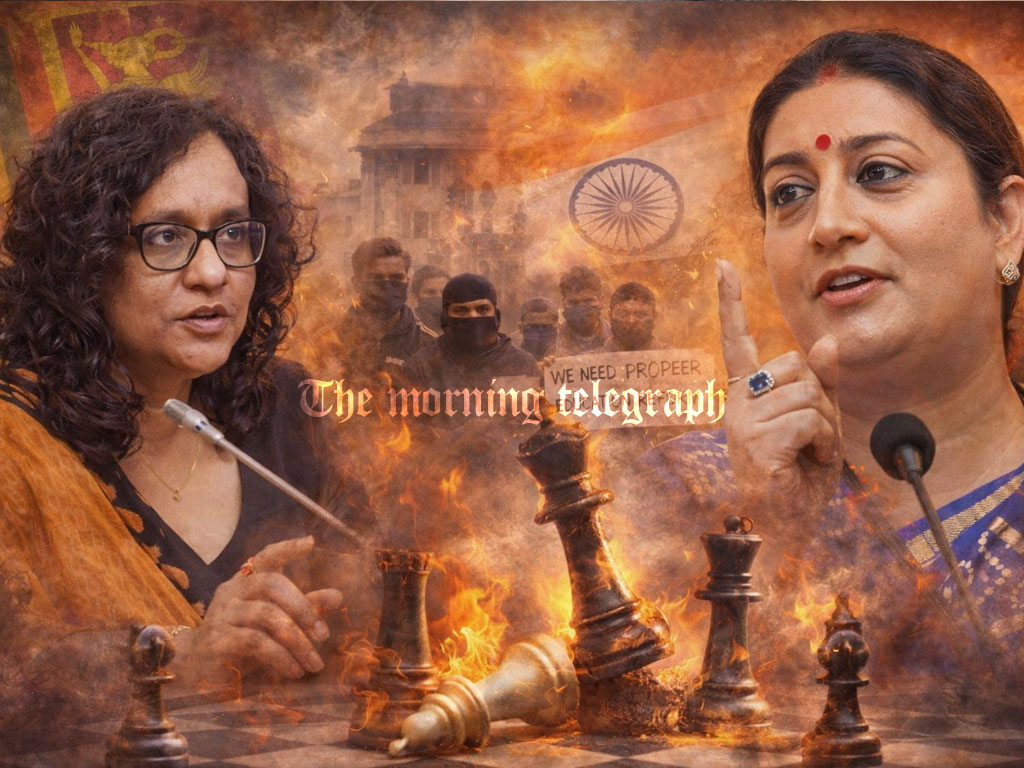
From Smriti Irani’s dramatic rise and fall in India to Harini Amarasuriya’s unfolding controversy in Sri Lanka, this is a cautionary tale of power, popularity, and the peril of education reform without consensus.
Harini and Smriti Irani? A Tale of Two Education Ministers
Smriti Irani is a name that resonates far beyond India. In Sri Lanka, she became a household figure through the immensely popular teledrama Mahagedara, where she portrayed “Tulsi,” a character defined by warmth, resilience, and middle class values. That role struck a deep chord with Sri Lankan viewers and simultaneously cemented her stardom in India, where Tulsi Virani became a near universal presence in living rooms across the subcontinent.
It was this carefully cultivated public image that drew the attention of the Bharatiya Janata Party. When Bharatiya Janata Party welcomed her in 2003, she rose swiftly through its ranks, buoyed by her popularity and communication skills. Narendra Modi soon handed her one of the toughest political assignments in India: contesting Amethi, the long standing parliamentary stronghold of the Gandhi family. Much like Attanagalla for the Bandaranaikes or Hambantota for the Rajapaksas, Amethi had symbolized dynastic political continuity for decades.

In the 2014 general election, Irani failed to unseat Rahul Gandhi, but her effort was not dismissed as a failure. Instead, Modi appointed her Minister of Education, entrusting her with a portfolio that shapes a nation’s intellectual future.
As Education Minister, Irani adopted a rigid and centralized style of governance. She attempted sweeping changes to university degree programmes, most notably at Delhi University, only to reverse some decisions after intense backlash. Senior academics, teachers, and students protested what they viewed as arbitrary interference. A technical institute director resigned in protest, followed by a respected nuclear scientist, signaling deep institutional unrest. Her attempt to replace German language studies with Sanskrit, and her ban on academic seminars and discussions, intensified criticism from educationists who accused her of undermining academic freedom.
The controversy deepened when allegations emerged that Irani had submitted false educational qualifications while contesting elections. Opposition parties pursued the matter legally, arguing that misrepresentation disqualified her morally from leading the education sector. Nationwide protests followed. Irani responded by framing the accusations as gender based attacks, claiming a male dominated opposition could not tolerate a woman in authority. The BJP mobilized its women’s wing in her defense, but the strategy failed to calm public anger.
The courts eventually ruled that her educational claims were indeed false. Amid public embarrassment, Irani was removed from the Education Ministry and reassigned as Minister of Textiles. Yet she did not abandon her original political mission. In the 2019 general election, she contested Amethi again and this time defeated Rahul Gandhi, ending the family’s decades long dominance. For a brief moment, she was hailed as an “iron woman,” and political commentators speculated about her potential to succeed Modi. She was appointed Minister of Women and Child Development, reinforcing her national stature.
Her political journey, however, was far from smooth. Irani endured physical and verbal abuse during campaigns, including being pelted with footwear and stones. These incidents drew public sympathy and strengthened her image as a fighter. But ministerial performance again became her Achilles heel. Critics argued she underperformed in both education and women’s welfare portfolios. Gradually, public support in Amethi waned. In the 2024 general election, Congress candidate Kishor Lal defeated her decisively, marking a dramatic fall from grace. Soon after, Irani withdrew from active politics and returned to television.
This trajectory inevitably invites comparison with Sri Lanka’s Education Minister Harini Amarasuriya. Her rise, like Irani’s, was swift and symbolically powerful. Colombo, long a bastion of the United National Party, had produced political heavyweights such as J.R. Jayewardene, Premadasa, Lalith Athulathmudali, and Ranil Wickremesinghe. Yet in the 2024 general election, Harini shattered this dominance by securing a record number of preferential votes, emerging as one of the most influential figures in national politics.
President Anura Kumara Dissanayake, echoing Modi’s confidence in Irani, entrusted Harini with the Education Ministry. At the time, Sri Lanka was already witnessing an education transformation led by private initiatives. Business leader Dhammika Perera had launched DP Education during the COVID crisis, providing free online learning when state systems faltered. By 2029, these platforms had expanded to nurture digital creativity among children.
Despite this context, Harini did not actively engage with Sri Lanka’s growing online education ecosystem. Instead, she attempted to implement wide ranging reforms without sustained consultation with education experts or detailed parliamentary debate. Like Irani before her, she began by restricting university discussions and seminars, including a high profile academic conference at the University of Peradeniya. These actions triggered protests from students, academics, and opposition parties.
When opposition pressure mounted, Harini too invoked gender based narratives, suggesting criticism stemmed from intolerance toward women leaders. The strategy mirrored Irani’s earlier defense, and like in India, it failed to neutralize dissent. Eventually, the government was forced to retreat from several proposed reforms, exposing cracks in its decision making process.
Once a key electoral asset for the Janatha Vimukthi Peramuna, Harini now faces the risk of becoming a political liability, much as Irani did for the BJP. The parallels are striking: rapid ascent, symbolic victories, bold reforms, resistance from academic communities, and the dangers of unilateral governance in education.
“So does that mean Harini will face the same fate as Smriti Irani in the next election?” It is too early to draw definitive conclusions. Yet history offers a warning. Education ministries demand dialogue, humility, and consensus. Popularity can open doors, but sustainable leadership requires trust, transparency, and respect for institutions. Whether Harini learns from Irani’s experience may well determine her political future.