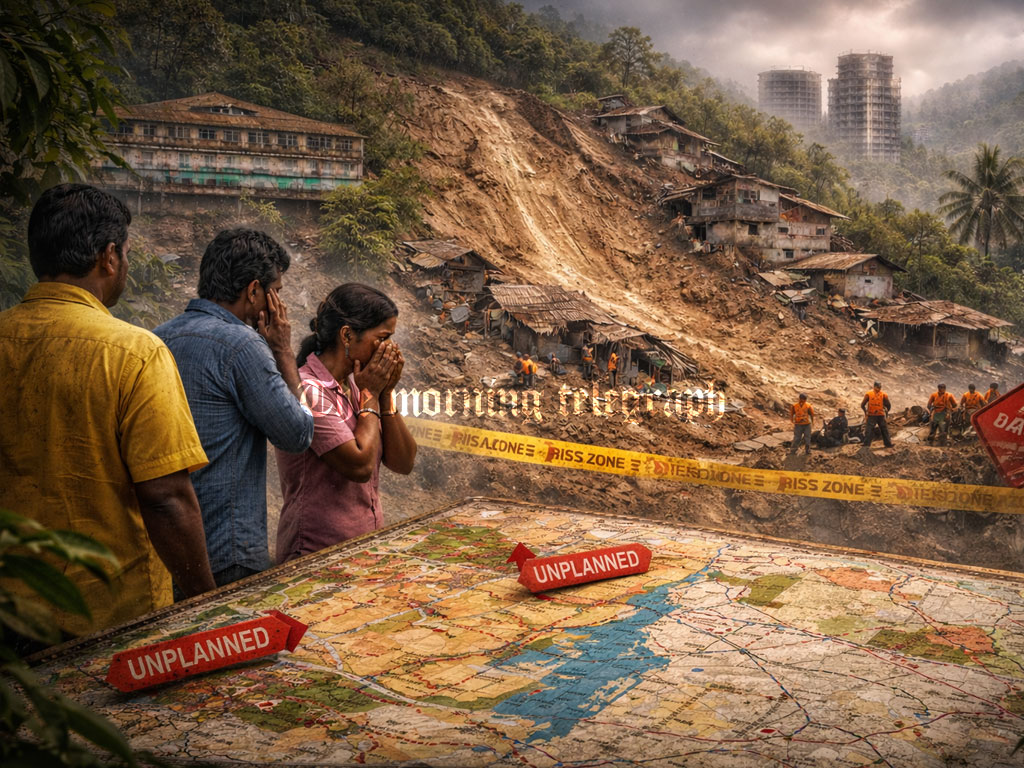
A deadly landslide has laid bare how decades of weak planning, ignored regulations, and unregulated settlements have left Sri Lanka dangerously exposed to repeat disasters.
Sri Lanka’s recent landslide tragedy, described by officials as a “model disaster,” has once again exposed a hard truth about the country’s development path. Growth has continued without consistent guidance from the national planning system that has existed for decades. In the Central Province, geologists stress that the disaster was not simply the result of heavy rainfall or natural forces, but the outcome of long-standing neglect, poor enforcement, and the routine sidelining of national physical planning rules in everyday construction. With thousands of high-risk areas still unregulated and settlements pushing ever closer to urban centers, experts warn that Sri Lanka is heading toward another catastrophe unless urgent corrective action is taken.

At a meeting of the Kandy District Coordination Committee on January 13, Kandy District Chief Geologist Chathurie Subasinghe delivered a stark warning. She revealed that 2,377 high-risk zones have been identified across the Central Province where serious disasters could occur again. Her remarks highlighted a growing concern among experts that Sri Lanka is not merely recovering from a single tragic event, but is living under constant threat. Subasinghe emphasized that the core issue is not rainfall alone, but human negligence and governance failures within systems specifically designed to prevent such disasters.
She urged authorities to treat the recent landslide as a “model disaster” from which lessons must be learned. Sri Lanka, she noted, has had strict rules governing construction and rural settlement planning for more than 80 years. Yet these regulations have not been implemented effectively. The result is a dangerous pattern in which people, often drawn by compensation expectations and the rush toward urban life, continue to build homes in environmentally sensitive zones around cities such as Kandy and Nuwara Eliya. Subasinghe called for immediate steps to halt settlement expansion near urban areas and to relocate residents living in vulnerable locations, warning that without decisive action, future disasters may be unavoidable.
The tragedy has also exposed a deep disconnect between citizens and the institutions responsible for regulating development. Many residents in the Central Province report visible warning signs in their homes, including cracks in walls, leaking mud, and rising groundwater. Yet they struggle to identify any clear authority willing or able to address these dangers. This gap exists despite the presence of the National Physical Planning Department, a state institution established under the Town and Country Planning Ordinance No. 13 of 1946. The department is tasked with preparing national physical plans that integrate development policy, environmental protection, and construction guidance. However, the recent disaster suggests that its authority has been sidelined and its recommendations are rarely applied in practice.
The mandate of the National Physical Planning Department is clear. It is responsible for preventing irregular construction, guiding infrastructure investment to suitable locations, and coordinating development plans through the Inter-Ministerial Coordination Committee. Yet the occurrence of a disaster on this scale indicates that the planning system has failed to enforce its own rules or integrate them into local development practices. Experts argue that weak coordination between institutions lies at the heart of the crisis.
Across Sri Lanka, large development projects including highways, expressways, railways, and urban expansion continue without proper alignment to a national physical plan. As a result, irregular development has spread across the country’s 62,705 square kilometers. This problem is not confined to one region. It affects rural, urban, and protected areas alike, revealing a systemic failure rather than isolated lapses.
Audits of planning failures show a stark imbalance. While Sri Lanka has maintained planning laws and a dedicated department for decades, more than 60 percent of land development reportedly takes place without formal oversight. In rural areas, houses and plantations expand without adherence to approved plans. In urban centers, housing and infrastructure projects proceed without adequate environmental assessments. Even protected zones such as Horton Plains and other ecologically sensitive regions have been affected by unchecked settlement and agricultural expansion. Political influence and financial interests have further weakened enforcement, allowing illegal development to flourish.
This crisis is not only about law and governance but also about social reality. Many rural families build homes for their children and grandchildren without realizing they are settling in high-risk zones or violating planning rules. At the same time, road projects, relief programs, and other development initiatives often proceed without thorough investigation into their legality or long-term safety. This creates a dangerous cycle. Development expands into fragile terrain, heavy rains arrive, and the land collapses, triggering landslides and devastation.
Geologists have also raised serious concerns about waste accumulation on hilltops. As cities expand, waste and wastewater seep into the soil, weakening ground stability and increasing the risk of collapse during periods of heavy rain. Development on slopes without proper infrastructure and waste management can quickly turn residential zones into ticking time bombs. Experts warn that without urgent infrastructure planning and enforcement, such disasters are likely to become more frequent.
The recent landslide has also reignited questions about the governance of protected areas. Sri Lanka’s natural resources have been compromised by illegal land sales and unauthorized settlement in conservation zones. The disaster stands as a clear example of how political and financial interests can override environmental protections, with catastrophic consequences. If protected areas continue to be sold or settled without oversight, the country risks losing not only its natural heritage but also the safety of its people.
Sri Lanka’s experience is not unique. Many countries have successfully implemented national physical plans to guide development, prevent disasters, and protect the environment. For a small nation like Sri Lanka, doing so should be achievable. Yet political interference and short-term financial gain have undermined the system, allowing unplanned construction to continue unchecked.
As Sri Lanka looks toward the future, the message from geologists and planners is unmistakable. The country must restore the authority of its national planning institutions, enforce construction regulations, and stop illegal settlement in high-risk zones. Without these steps, Sri Lanka risks facing a series of repeated disasters, each more devastating than the last. The choice now is whether the nation will learn from this “model disaster” or allow the cycle of unplanned development to continue until the next tragedy strikes.