In honor of Martin Luther King Jr. Day
By Roshan Jayasinghe
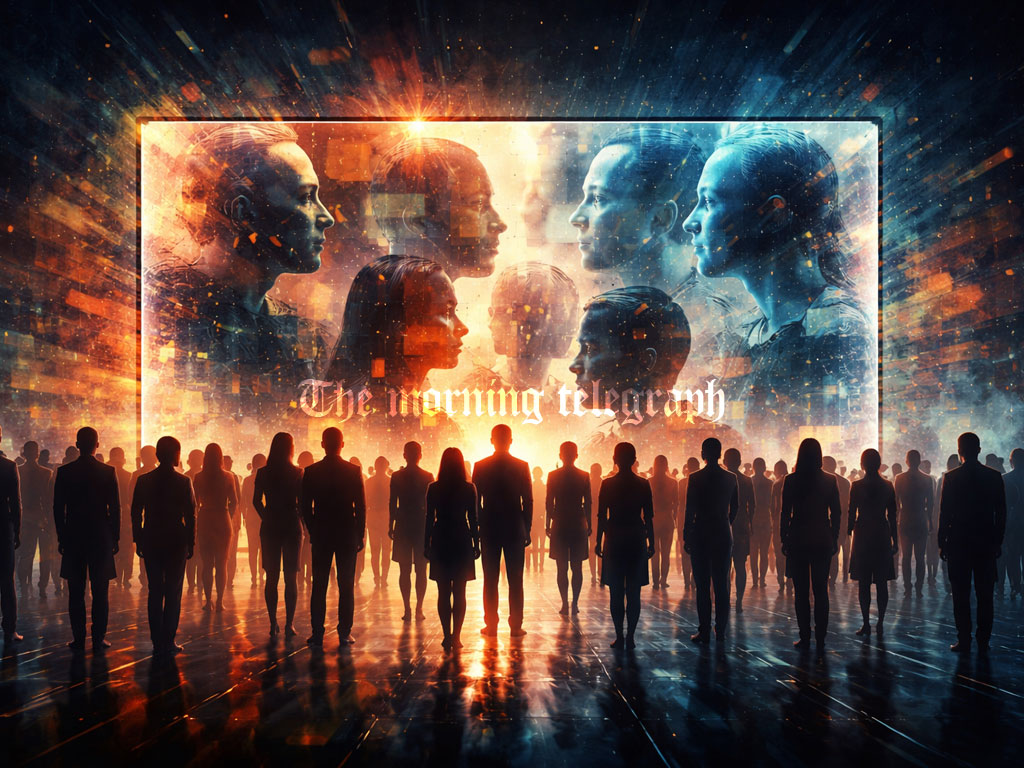
If someone wants to understand what has happened to politics, they don’t need a conspiracy board. They don’t need to become an expert in every headline. They only need to look at the screen we are all staring at, day and night, and admit what it is showing.

It is showing us a replica.
A clear view, like watching TV, of what we have collectively rewarded, tolerated, excused, and normalized.
On a day like this, when America pauses to honor Martin Luther King Jr., it’s worth remembering what he stood for at its simplest level. Not a party. Not a tribe. Not a performance. A standard. A moral floor. A human minimum.
And if we are honest, that standard has been slipping under our feet for a long time.
The painful part is this. We keep pointing at the politician as if they arrived from another planet, as if they are a separate species, as if “the system” is an object floating above us.
But the politician is a human being produced inside the human condition.
And the public is not innocent.
We have participated, sometimes loudly, sometimes quietly, sometimes through selfishness, sometimes through fatigue, sometimes through fear, by choosing division over dignity, performance over truth, victory over humanity. We have contributed to the very atmosphere that allows power to become a throne.
So when we say, “What are they doing?” we also have to ask, “What are we doing?”
Here is the principle we keep avoiding because it is too clean, too direct, too revealing.
A political platform cannot be moral if it only works for a slice of humans.
If it requires a chosen group to be diminished so another group can feel victorious, then it has already left the job description of politics.
The core concept of being a politician is supposed to help humankind.
Not a segment. Not a tribe. Not a favored group. Not “my people.” Not “people like me.”
If a political platform speaks about a program that will be applied in a nation, then the moral test is simple.
Will it protect the dignity of every human being it touches?
If a platform only works by diminishing someone else, if it needs an enemy to feel effective, then it has already broken the core truth of the role.
And this is where the modern world has drifted into something dangerous. Politics has become the art of managing factions instead of the discipline of protecting humans.
It has become a game of agendas and ideologies, where a human life is treated like a chess piece, and the country becomes a stage. The loudest performer wins the moment, while the quiet human consequences are paid later, by ordinary people, by families, by children, by the future.
The world will never be stable if human worth is negotiable.
If the worth of a person changes based on culture, nation, religion, language, or political leaning, then conflict is not an accident, it is guaranteed. Because once we allow different values for different humans, we have given permission for exploitation, domination, and cruelty to wear respectable clothing.
This is why the political process itself must be re-evaluated.
Not just the leaders.
The whole apprenticeship into leadership.
Because right now, too many enter politics through the wrong doorway. Not through service, but through hunger. Not through competence, but through charisma. Not through truth, but through performance.
And then we act surprised when the output is manipulation, corruption, and division.
The Mirror and the Day of Honor
There is a reason this day, at its best, is not only remembrance, but service.
Service is the antidote to performance.
Service brings the human being back into the center of the room.
When you serve, you stop speaking in slogans and start seeing consequences. You stop living in ideology and return to the ground. You begin to notice that the person across from you is not a label, not a category, not a political pawn, but a human being trying to survive the same life you are surviving.
Sometimes the world feels like it has gone mad, as if everything is upside down, as if the laws of decency have evaporated.
But if we pause and look carefully, we see something more uncomfortable and more useful.
We are not looking at a mystery. We are looking at a mirror.
The mirror is showing us what happens when masses of humans are trained into division, distracted by spectacle, and encouraged to live from selfishness while calling it survival.
So the mirror does not only reflect the politician. It reflects the citizen. It reflects the home. It reflects the school. It reflects the conversation at the dinner table. It reflects what we praise, what we excuse, what we ignore, what we scroll past, and what we share.
And this is why the most important move at this juncture is realization, and it has to happen fast.
Not a slow realization that becomes a nice conversation over dinner.
A fast realization, because we are living inside the consequences now.
The reality is already on the screen. If we cannot see it, that is not the world hiding from us, it is our ignorance refusing to look.
And the correction does not begin with “them.”
It begins with one person at a time, deciding to become unownable.
That is the true revolution. The moment a citizen becomes impossible to purchase, impossible to hypnotize, impossible to divide.
Because a politician cannot own a people who have returned to their own moral compass.
So what do we do, in real terms?
We ask better questions. We stop outsourcing our responsibility to a leader, a party, an ideology, or a news channel. We take the steering wheel back into the hands of the human being.
We ask, without drama, without performance, without hatred, questions that expose motive and consequence.
Who am I?
What is my purpose in life?
What am I actually serving, truth or my own emotional addiction to being right?
What am I supporting with my attention?
Who benefits from what is being proposed, and who pays the hidden price?
If this was applied to my child, would I still defend it?
If this was applied to the person I dislike, would I still call it justice?
These questions are not philosophy for a bookshelf. They are tools for survival as a society.
And this is why education matters more than politics.
Not education as a factory for careers.
Education as the foundation of the human manual.
How to think.
How to reason.
How to recognize manipulation.
How to regulate emotion.
How to see the human being before the label.
How to understand that dignity is not a reward, it is a starting point.
Sometimes I reflect on this personally. I arrived at these understandings through a life experiment, many chapters negative, many chapters positive. It took time. It took mistakes. It took witnessing. It took living.
And I cannot help but wonder, if I was taught these basics early, taught collectively, alongside other children in the same schools, same age groups, across genders and backgrounds, how different would my life be now? How different would the lives around me be? How different would our society be?
That question is not sentimental. It is strategic.
Because a society that teaches human dignity early produces adults who cannot be owned.
And that is the only soil where good politics can grow.
Politics will not be healed by better slogans. It will be healed by better humans.
Not perfect humans.
Just humans who are willing to become attentive again.
Willing to be rational.
Willing to be corrected.
Willing to choose what is best for humanity, even when it doesn’t flatter their ego.
When enough people do that, the politician has no choice but to return to their true function. Servant of the public. Trustee of human dignity. Temporary holder of responsibility, not owner of the nation.
That is where stability begins.
Not in the halls of power first.
But in the heart of the citizen.
Author’s Note
I’m not writing this to accuse one party, one leader, or one nation. I’m writing it because the human being is bigger than politics, and our dignity is too sacred to be traded for any agenda.
If we want a stable world, we must agree on a simple floor. The worth of a human being is uniform.
Everything else is detail. Everything else can be debated. But that cannot.
If we can return to that one truth, and live it one person at a time, the entire political theatre begins to change, because it no longer has a divided audience to feed on.
About the Author
Roshan Jayasinghe is a writer and observer of human systems. His work explores the gap between man made constructs and lived humanity, with a focus on how economics, trade and everyday choices intersect with questions of fairness, responsibility and inner alignment. Through essays for publications in The Morning Telegraph, he aims to remind readers that they are not passengers in a fixed machine, but active custodians of a shared world.