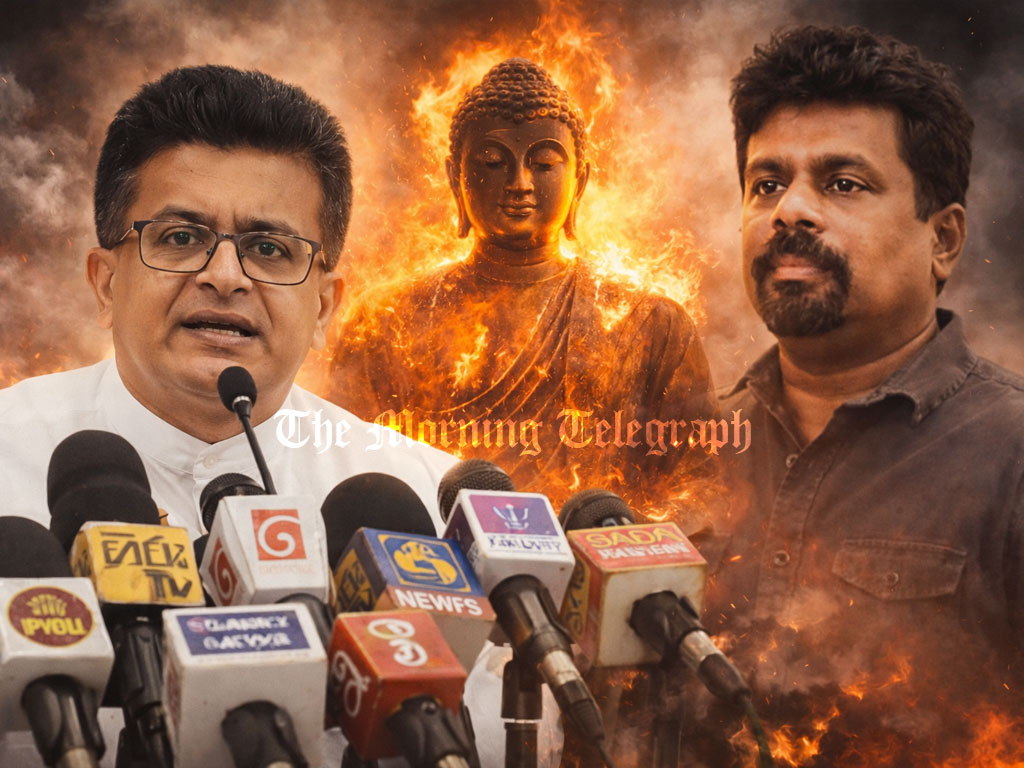
A fiery political warning alleges a dangerous conspiracy against Buddhism, culture, and religious harmony, placing the President at the center of a growing national controversy.
The number one conspirator against Buddhism, culture, and civilization is the President, according to a strong statement made at a media conference in Colombo by the Mahajana Hada Jathika Balamuluwa. The allegation was voiced by Udaya Gammanpila, leader of the Pivithuru Hela Urumaya, who accused the country’s leadership of undermining religious harmony and cultural continuity.

Gammanpila stated that no responsible opposition force has ever claimed that educational reforms are unnecessary. He said the very reforms currently being implemented were initiated during the previous government, stressing that these reforms were originally conceptualized and launched by them. According to him, the manner in which the current administration is attempting to carry out education reforms has exposed a lack of vision, expertise, and experience needed to manage such a complex national undertaking.
He argued that the education system cannot be altered every time a government changes, comparing such behavior to changing the color stripes on Sri Lanka Transport Board buses whenever political power shifts. In his view, syllabi and educational policy cannot be treated in such a superficial and politically driven manner. For this reason, he insisted that education reform must be approached through a multilateral and consensus-based framework.
Gammanpila said that many individuals present at the conference had benefited directly from Sri Lanka’s strong education system and owed their current professional standing to it. He emphasized that they were ready to contribute their knowledge, experience, and academic expertise to assist the government in implementing reforms correctly. He added that if there is no injustice being done to children, the government should abandon arrogance and work with experienced opposition figures to protect the future of education.
He noted that Sri Lanka’s education system has historically earned global respect, producing students who excel internationally. He pointed out that Sri Lankan academics teaching at foreign universities, including Professor G.L. Peiris, have experienced firsthand the high regard in which Sri Lankan students and scholars are held. According to Gammanpila, this success is the result of consistent and well-governed education reforms carried out over decades. He warned that children should not be deprived of this advantage due to political ego or short-term decision-making.
Turning to religious matters, Gammanpila referred to a statement made by the Asgiri Mahanayake Thero, who recently warned of a massive conspiracy against the Buddha Sasana, Sri Lankan culture, and civilization. While the senior monk did not name those responsible, Gammanpila said his party believes the chief conspirator is none other than Anura Dissanayake.
He stressed that religious coexistence has been one of Sri Lanka’s defining characteristics, with leaders of all faiths respecting one another and maintaining harmony regardless of political change. Attempts to disrupt this balance, he said, have historically failed and faded quickly. No previous government, he argued, has deliberately attempted to damage religious unity.
Gammanpila expressed serious concern over remarks allegedly made by the President during a visit to Jaffna, where he is said to have claimed that Buddhists traveling to the North were spreading hatred. He pointed out that for over three years, protests have taken place on every Poya day in Jaffna against Southern Buddhists visiting the Tissa Vihara. In his view, statements that intensify resentment risk encouraging violence against pilgrims traveling peacefully for religious observance.
He warned that such rhetoric could embolden protesters to attack Buddhists on future Poya days, raising fears for public safety and religious freedom. He said there is a reasonable suspicion that these remarks indirectly signal approval for such hostility.
Gammanpila further noted that Sri Lanka has long accepted religious pilgrimages across faiths, with Catholics traveling to Madhu Church and Hindus visiting Kataragama without controversy. No politician in the country’s history, he said, has discouraged such practices. Therefore, he claimed that recent developments suggest a deliberate attempt to erode religious harmony.
He also highlighted the arrest and remanding of Buddhist monks over the placement of a Buddha statue at a 70-year-old government-registered temple. According to information revealed in court, even when the Attorney General agreed to amend charges to allow bail, police opposition allegedly prevented the monks’ release. Gammanpila claimed this indicated political interference, alleging that law enforcement was acting to satisfy the government.
Concluding his remarks, he appealed to the President to uphold national unity, protect religious coexistence, and refrain from statements or actions that could fracture Sri Lanka’s cultural and spiritual harmony.