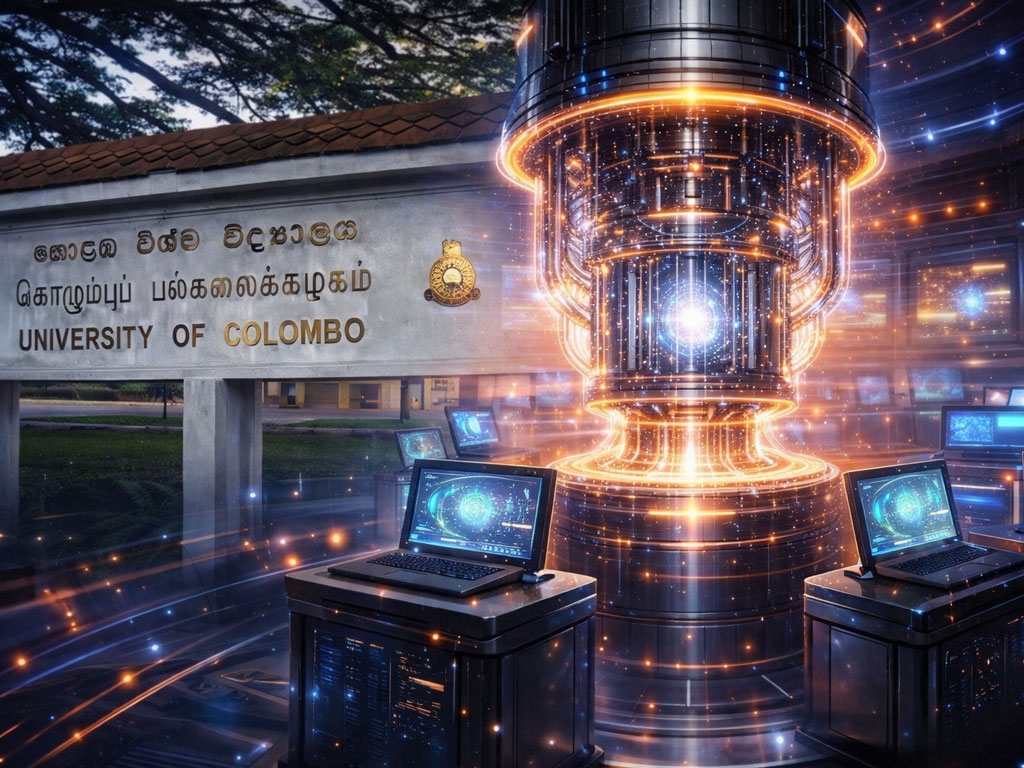
Sri Lanka has crossed a historic scientific threshold, powering up its first quantum computer and signalling a decisive shift from traditional research boundaries into the frontier world of advanced computing.
Sri Lanka has taken a landmark step into advanced science and technology with the inauguration of its first quantum computer, an achievement academics are describing as the true beginning of the country’s quantum era. The new facility, unveiled on 21 January 2026, marks a turning point for a nation that has long operated on the margins of high-end technological research and now finds itself placed on the emerging global map of quantum innovation.

The quantum computer is housed at the newly established Research and Development Centre for Mathematical Modelling of Quantum Computing, affiliated with the Department of Mathematics at the University of Colombo. The inauguration ceremony was led by the university’s Vice-Chancellor, Indika Mahesh Karunathilaka, together with a multidisciplinary team of mathematicians, computer scientists and technology experts. Among them was Anuradha Mahasinghe, a leading Sri Lankan researcher in quantum computing who played a central role in bringing the project from concept to reality.
The system introduced is a nuclear magnetic resonance powered quantum computer, a sophisticated platform widely used in leading universities worldwide for teaching and foundational research in quantum computing. Manufactured by the Chinese technology firm SpinQ, the machine is designed to demonstrate and explore the principles of quantum mechanics. It allows students and researchers in Sri Lanka to work directly with technologies that represent the cutting edge of modern computation.
Professor Mahasinghe, who spearheaded efforts to secure the quantum computer and establish the laboratory, described the achievement as the fulfilment of a long-held professional ambition. Reflecting on his personal journey, he recalled growing up in an era of limited educational resources, when access to advanced technology was rare and learning depended largely on books. Helping to lay the foundation for quantum education in Sri Lanka, he said, represents not only a scientific milestone but also a deeply personal achievement built on decades of academic perseverance.
Quantum computers differ fundamentally from classical machines. Instead of processing information in a linear manner, they operate on principles that allow them to handle vast amounts of data simultaneously. According to Professor Mahasinghe, problems that would take hundreds of years to solve using traditional computers can, in some cases, be resolved within hours using quantum systems. This extraordinary computational speed opens new possibilities across science and industry, ranging from optimising complex systems to analysing massive datasets that lie beyond the reach of conventional computing.
The implications of quantum computing extend far beyond computer science. Researchers note that the technology has the potential to transform fields such as chemistry, materials science and biomedicine by simulating molecular behaviour and drug interactions with unprecedented precision. This capability could significantly accelerate the development of new medicines, including personalised treatments, while reducing both research time and cost.
For Sri Lankan students, the new facility offers access to state-recognised, high-level education in quantum computing within the country for the first time. The University of Colombo, long regarded as a centre of scientific and intellectual development, now positions itself as a regional hub linked to the wider South Asian technology network. The university already offers a structured programme in quantum computing up to the BSc Honours level in Computational Mathematics, combining strong theoretical foundations with practical research exposure.
University officials say the strengthened curriculum is designed to produce graduates with advanced mathematical and computational skills aligned with the needs of modern industry and the private sector. As global demand for expertise in quantum technologies continues to grow, Sri Lanka’s first quantum computer represents not merely a technological acquisition but a strategic investment in human capital, scientific capability and long-term national competitiveness.