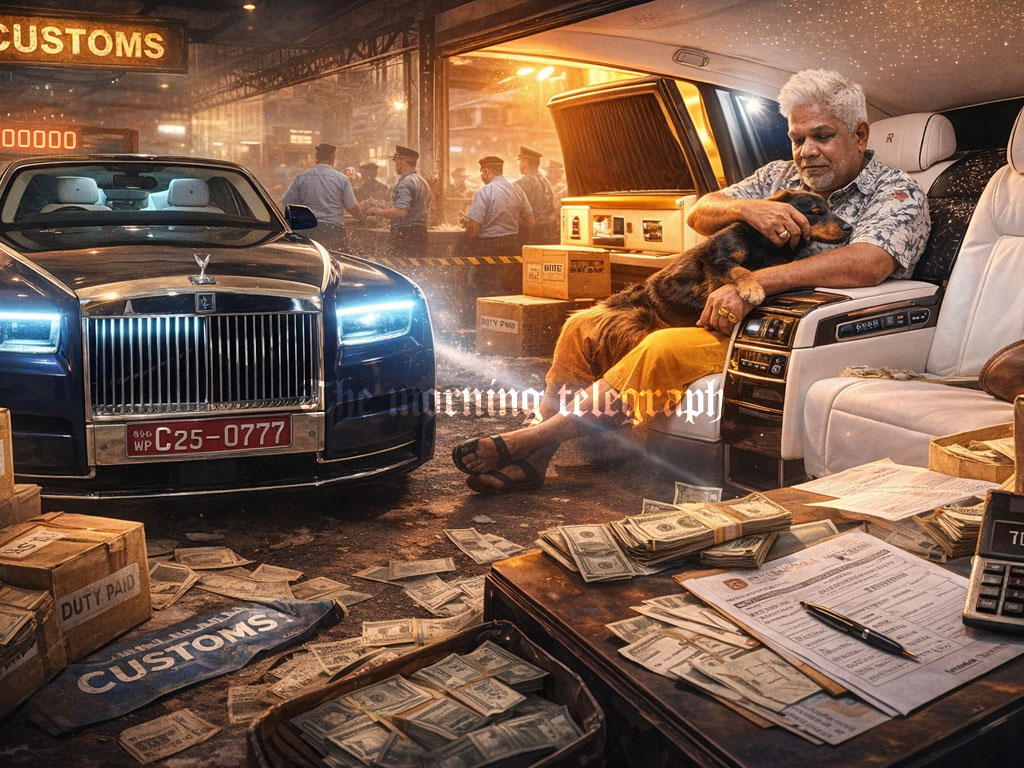
Businessman Dudley Sirisena clarifies the controversy surrounding the Rolls-Royce Phantom import, saying customs penalties arose from procedural errors by the importer, not personal wrongdoing or luxury excess.
Here is a statement issued by well-known businessman Dudley Sirisena regarding the recently imported vehicle.
In recent days, various stories have been circulating about the Rolls-Royce Phantom 8 that I imported and the issues involving Sri Lanka Customs. Therefore, I felt it necessary to share my response, especially because in situations where facts are not clearly understood, false or misleading information tends to spread very quickly.

This is the background to the matter. A few months ago, I made arrangements to import a luxury vehicle, the Rolls-Royce Phantom 8, to Sri Lanka. Accordingly, I completed all necessary formalities, including opening the required bank letters of credit, and proceeded with bringing the vehicle into the country.
The car was airfreighted to Sri Lanka. Only a few days after its arrival did we learn that Customs had re-enforced regulations related to cross-border vehicle imports, based on laws that had been in place since 2013. At the time those regulations were first introduced, thousands of vehicles were imported into Sri Lanka using the same method. Cross-bordering essentially means that the relevant letter of credit must be opened in the country where the vehicle is manufactured, which in this case was the United Kingdom.
As a result of this issue, we were required to pay a substantial additional amount in order to release the vehicle. Consequently, I paid the applicable re-export fees and returned the car to the supplying company. Following discussions between myself and the supplier, an agreement was reached to re-import a vehicle to Sri Lanka at a later date.
During this period, I learned that Rolls-Royce was planning to introduce a special series of limited-edition vehicles to mark the company’s 100th anniversary. That is how I came to import the Rolls-Royce Phantom Series 8 EWB that arrived in Sri Lanka recently. This vehicle is an upgraded version compared to the one I had previously imported.
For this import, I entrusted the entire process to a well-known and experienced intermediary vehicle import company in Sri Lanka. Given their expertise in the field, I paid the full amount agreed upon and waited for the process to be completed without interfering.
As expected, a few days ago, the company imported the vehicle to Sri Lanka. After paying all the applicable customs duties and taxes related to the vehicle, the company handed it over to me. Since my obligations in the transaction were fully completed, I accepted the vehicle and shortly thereafter travelled abroad on an official visit.
Some time later, I became aware that Sri Lanka Customs had imposed a penalty of 70 million rupees on the importer, citing issues related to customs duties for the vehicle.
As is commonly understood, when a vehicle is imported through an intermediary company, the buyer does not participate in or interfere with the customs process until the vehicle is officially handed over. The same applied in this case. I paid the full amount due to the importer and received the vehicle. What occurred after that is not relevant to my role as the purchaser.
It later emerged that the importer had not declared the model as “Phantom EWB” at the time of import. Whether this omission was due to an oversight or an attempt to gain additional profit is not something I can comment on, nor is it relevant to me. I simply purchased an imported vehicle after paying the full agreed amount and received it accordingly.
Since this luxury vehicle is a special anniversary model released to mark the 100th anniversary of Rolls-Royce, and because it is an EWB version, many people attempted to gather information about it online. In doing so, there appears to have been confusion between my vehicle and the Phantom 8 Centenary model, which is valued at around three million dollars. My car is not that model.
As a businessman, regardless of my financial position, those who know me well understand that I am not someone who would spend billions of rupees on a car. I am fully aware of the challenges involved in building and sustaining a business in today’s economic environment.
Because I was not in Sri Lanka to respond immediately, I decided to pause and clarify the matter once I saw the volume of speculation being shared. That, in simple terms, is the full story behind the Rolls-Royce customs penalty issue.