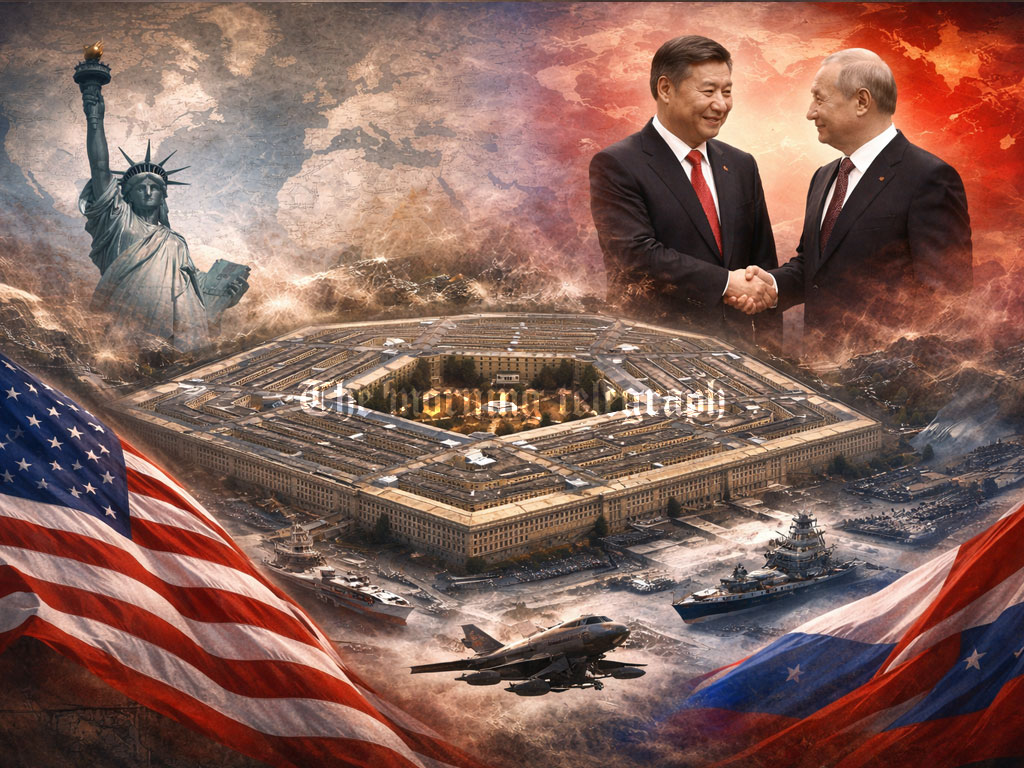
The Pentagon’s new defense blueprint signals a dramatic pivot, placing America’s homeland first, scaling back global commitments, and redefining how Washington views China, allies, and the future world order.
China is no longer the top security priority for the United States, according to the Pentagon’s newly released National Defense Strategy. The four year policy document places the security of the US homeland and the Western Hemisphere above all else, arguing that Washington has long neglected the “concrete interests” of ordinary Americans.

The strategy signals a clear shift from previous defense postures, stating that the Pentagon will offer “more limited” support to US allies while urging greater burden sharing. It follows last year’s National Security Strategy, which warned of Europe’s “civilizational collapse” and did not describe Russia as a direct threat to the United States, a position Moscow said was “largely consistent” with its own outlook.
By contrast, the 2022 National Defense Strategy labeled China a “multi-domain threat” and the primary defense priority, while the 2018 version described China and Russia as “revisionist powers” posing the central challenge to US security. The new 34 page document, released on Friday, largely reinforces positions outlined by the Trump administration during its first year back in office.
During that period, US President Donald Trump oversaw the seizure of Venezuelan President Nicolás Maduro, ordered strikes against alleged drug trafficking boats in the eastern Pacific and Caribbean, and applied pressure on allies over strategic interests such as Greenland. The strategy emphasizes that the Pentagon “will guarantee US military and commercial access to key terrain, especially the Panama Canal, Gulf of America, and Greenland”.
It describes the administration’s approach as “fundamentally different from the grandiose strategies of the past post–Cold War administrations”, adding: “Out with utopian idealism; in with hardnosed realism.” Relations with China will be managed through “strength, not confrontation”, with the goal “not to dominate China; nor is it to strangle or humiliate them”.
Notably, Taiwan is absent from the document, despite recent US arms sales to the island. Russia is described as a “persistent but manageable threat” to NATO’s eastern members, while South Korea is deemed capable of taking primary responsibility for deterring North Korea.
The strategy rejects claims of isolationism, arguing instead for a focused approach where allies, particularly in Europe, “will take the lead against threats that are less severe for us but more so for them”. Recent warnings from leaders such as Canada’s Mark Carney and France’s Emmanuel Macron underscore a growing sense that the old rules based global order is rapidly fading.