By Chanaka De Silva
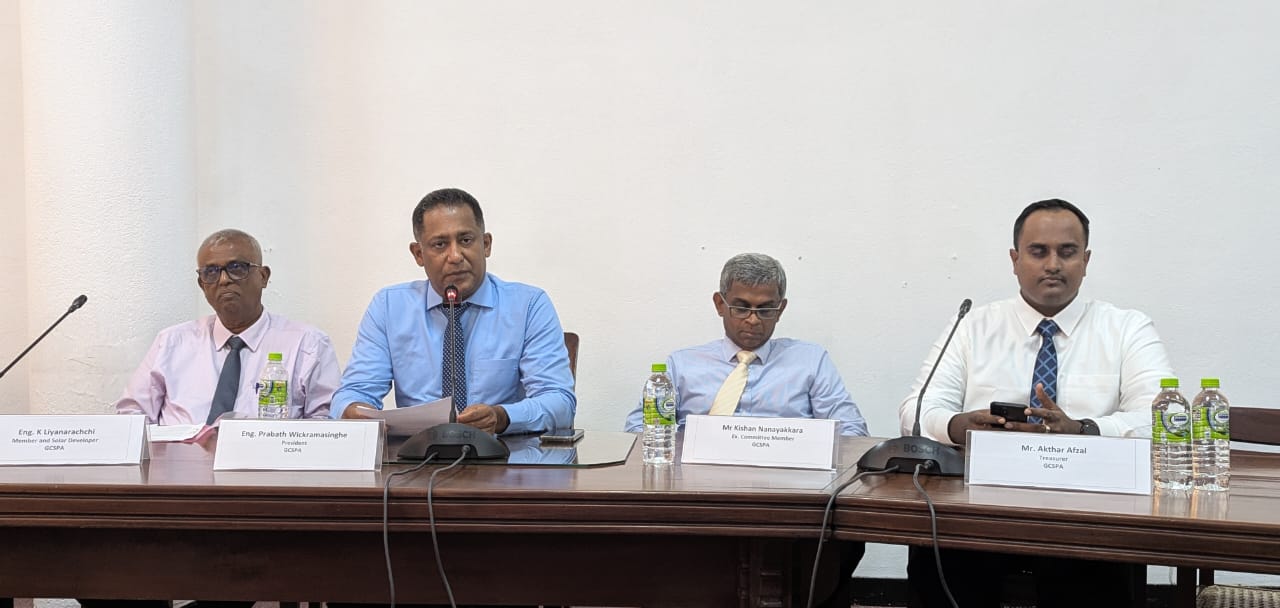
𝐃𝐞𝐚𝐭𝐡 𝐊𝐧𝐞𝐥𝐥 𝐭𝐨 𝐋𝐨𝐜𝐚𝐥 𝐑𝐞𝐧𝐞𝐰𝐚𝐛𝐥𝐞 𝐄𝐧𝐞𝐫𝐠𝐲 𝐈𝐧𝐝𝐮𝐬𝐭𝐫𝐲 𝐚𝐬 𝐂𝐄𝐁’𝐬 𝐀𝐫𝐛𝐢𝐭𝐫𝐚𝐫𝐲 𝐂𝐮𝐫𝐭𝐚𝐢𝐥𝐦𝐞𝐧𝐭 𝐜𝐫𝐞𝐚𝐭𝐬 𝐋𝐨𝐬𝐬𝐞𝐬 𝐚𝐩𝐩𝐫𝐨𝐚𝐜𝐡𝐢𝐧𝐠 𝐑𝐬. 𝟐 𝐛𝐢𝐥𝐥𝐢𝐨𝐧- Grid connected Solar Power Association of Sri Lanka
Local renewable energy developers, who supply approximately 3,300 MW capacity of clean, green electricity to the national electricity grid, emphasize that the entire local renewable energy industry is at risk of collapse due to the actions currently followed by the Ceylon Electricity Board (CEB) and the proposed new National Electricity Policy (2025).

The main critical issues pointed out by our association are as follows:
1. Unilateral Power Curtailment and Financial Loss:
For over 9 months (since February 2025), the CEB has been arbitrarily curtailing the power generation of all large renewable power plants on weekends and public holidays. Although the CEB portrays this as an “Emergency,” an event occurring every weekend for 9 months cannot be considered an emergency.
The financial loss caused to the industry due to this curtailment is approximately Rs. 2 Billion. Specifically, the monthly income of ground-mounted solar power plant owners has dropped by approximately 15%.
Although these power plants belong to the “Must Run” (compulsory operation) category according to Power Purchase Agreements (PPA), the CEB is unilaterally violating these contract conditions.
2. Delay in Approval for Battery Energy Storage Systems (BESS):
Local investors and operating renewable energy developers are ready to install Battery Energy Storage Systems (BESS) to store the excess electricity curtailed during the day and release it during the night peak demand time (18:30-22:30).
For this purpose, the Cabinet of Ministers approved a price of Rs. 45.80 per unit in June 2025, and the Ministry of Finance provided tax concessions in September 2025. However, despite the Ministry of Power instructing 5 months ago to implement these decisions “with immediate effect,” the CEB is deliberately delaying the issuance of the relevant “Implementation Guidelines” and contract amendments (PPA Addendum) for ground-mounted solar power plants. Due to this delay, the country is losing the opportunity to utilize local solar power instead of diesel electricity purchased by spending dollars.
3. Threats Posed by the National Electricity Policy (2025):
The proposed new National Electricity Policy (2025) presents several proposals that discourage local investors:
Abolishing the Feed-in Tariff (FIT) System: Currently, 92% of projects under
10 MW operate under the fixed rate system. Abolishing this and moving to a Competitive Bidding system will drive small and medium-scale local entrepreneurs out of the industry.
Contradicting Government Policy: Although the current government’s policy is to protect small and medium entrepreneurs-as emphasized in their policy manifesto and in the President’s 2025 Budget speech-the Ministry of Power and the CEB are following a completely contradictory path.
Curtailment Without Compensation: The new policy proposes that if
electricity acquisition is limited (Curtailment) based on system requirements, no financial compensation will be paid. This poses a severe risk to investors, and because of this, settling bank loans for many projects will be difficult.
Rupee-Based Contracts: In a context where import costs are incurred in
dollars, basing payments solely on Rupees (LKR PPAs) exposes investors to exchange rate risk.
4. Impact on the Banking System and Economy due to the above matters:
Since many projects operate on local bank loans, a situation has arisen where investors are unable to pay loan installments due to this arbitrary revenue curtailment. This will create a Non-Performing Loan (NPL) crisis within the banking system in the future.
5. Our Requests:
Immediately issue the relevant guidelines and contract amendments to integrate BESS (Battery) systems for ground-mounted solar power plants that are currently operational and scheduled for future construction.
Immediately stop the arbitrary power curtailment carried out in violation of contracts and pay reasonable compensation for the past curtailments.
Continue the Feed-in Tariff (FIT) system to protect small and medium-scale entrepreneurs.
Private sector contribution is essential to achieve the government’s 2030 renewable energy targets. Therefore, we request the Government, the Ministry of Power, and the CEB to intervene promptly to resolve these issues.
Eng. Prabath Wickramasinghe President, Grid Connected Solar Power Association (GCSPA). 334, T.B. Jayah Mawatha, Colombo 10. Tel: +94 (0)777 328 450