
By Marlon Dale Ferreira
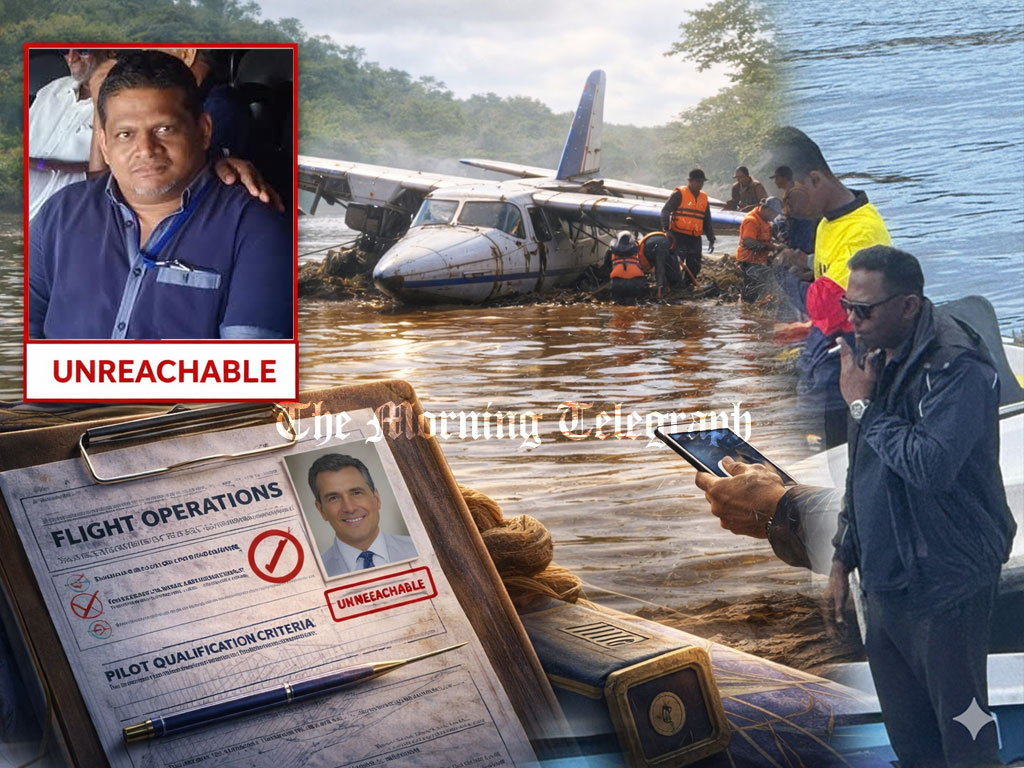
An aircraft in the mud, a senior aviation official smoking at the crash site, and a CEO who cannot be reached, at a moment when public trust and passenger safety demand answers. The Cinnamon Air crash at Lake Gregory has opened a disturbing chapter for Sri Lanka’s aviation and tourism sectors.
Safety in aviation is non-negotiable. Against that standard, the events surrounding the Cinnamon Air aircraft crash at Lake Gregory in Nuwara Eliya are deeply troubling and demand serious scrutiny.
Drawing on information previously published by The Morning Telegraph, it is shocking to note what appears to be a lackadaisical approach to safety by Cinnamon Air, most starkly demonstrated by the conduct of its own Director Flight/Ground Operations, Indika Premadasa. Premadasa was captured on video smoking a cigarette and flicking ash into Lake Gregory while rescue teams were in the process of retrieving the crashed aircraft that had become embedded in mud.

This conduct, occurring in close proximity to a crashed aircraft, posed a potentially serious risk to those present at the site. In any aviation environment, particularly one involving fuel, recovery operations, and emergency response, such behavior is wholly unacceptable. Lives were at stake, and the implications for safety cannot be downplayed.
The broader consequences extend beyond aviation alone. Cinnamon Air is frequently used by tourists for domestic travel, and any perception of compromised safety standards directly harms Sri Lanka’s tourism image. Public confidence is fundamental to aviation operations, and once shaken, it is exceedingly difficult to restore.
Despite issuing a single media release, Cinnamon Air’s management has since remained silent. More concerning still is the apparent unavailability of its leadership at a critical moment. Following the crash, The Morning Telegraph sought to contact the Chief Executive Officer of Cinnamon Air, Sean Dwight, to obtain responses to several serious safety-related questions arising both from the crash itself and the actions that followed. However, CEO Dwight could not be reached. An email sent to him triggered an automated reply stating that he would be uncontactable until 28 January 2026. In situations of this gravity, it is customary for senior executives to nominate an alternate point of contact, yet no such arrangement was indicated.
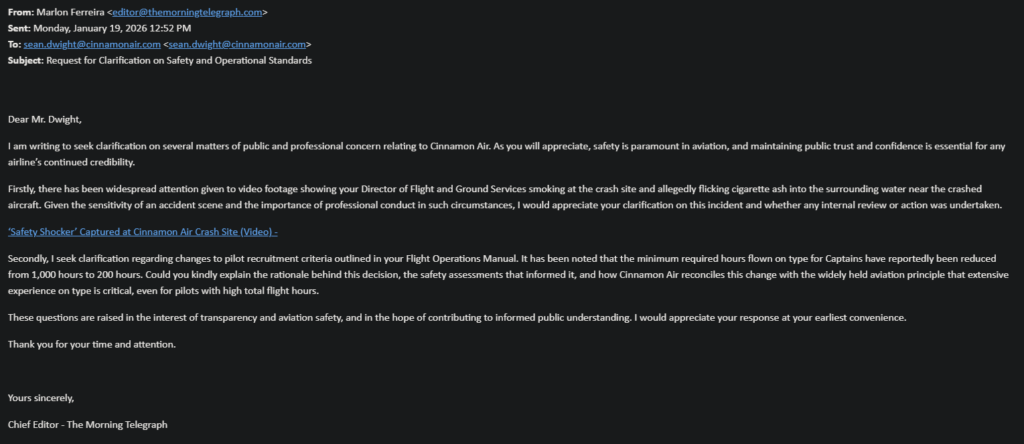

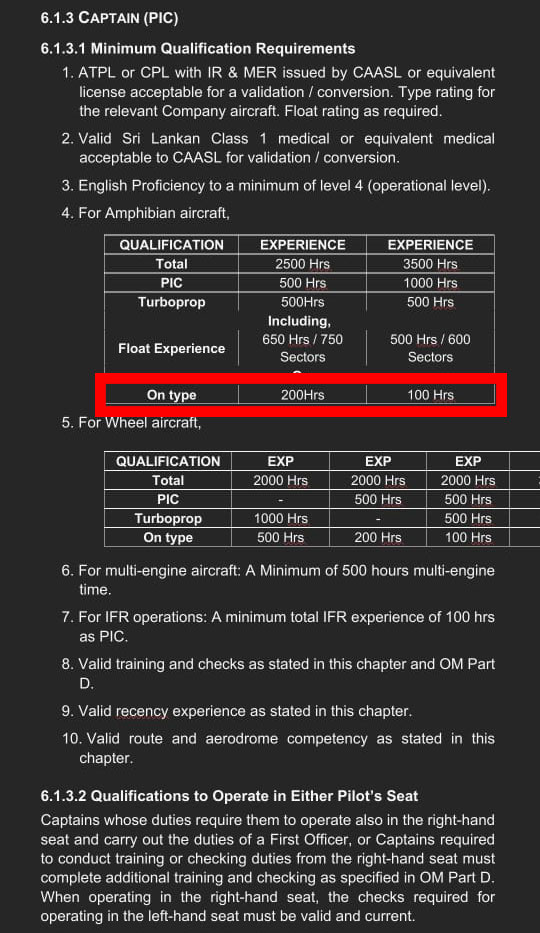
Among the critical questions raised was the qualification criteria used by Cinnamon Air when recruiting captains. Information made available to The Morning Telegraph indicates that Cinnamon Air amended its Flight Operations Manual to require only 200 flying hours on the specific aircraft type. Informants stated that the previous requirement had been 1,000 flying hours before this threshold was reduced. Many within the aviation community believe this change was intended to facilitate the recruitment of pilots who previously served in the Sri Lanka Air Force, who typically accumulate substantial flying hours during their service careers.
Equally pressing is the question of what disciplinary or administrative action, if any, Cinnamon Air has taken against its Director Flight/Ground Operations following the smoking incident at the crash site. The absence of transparency on this issue has only intensified public concern.
The credibility of the overall investigation has also come under serious doubt. Critics point to what they describe as an unsettling convergence: the pilot involved in the crash is a former airman; the Director Flight/Ground Operations of Cinnamon Air is a former airman; the Chief Investigator of the Aircraft Accident Investigation Board is a former airman; and the recently appointed Director General of the Civil Aviation Authority of Sri Lanka is also a former airman. Besides the CAASL Director General the other three are supposedly Air Force Squadron buddies with the Captain who crashed the aircraft being the senior of the trio. Many observers have drawn parallels to the well-known Sinhala saying, “Naduth Hamuruwo, Baduth Hamuduruwo,” implying a system where independence and impartiality are compromised.
In its continued pursuit of the truth surrounding this crash and the investigation that followed, The Morning Telegraph has uncovered what it describes as a glaring issue relating to the appointment of the current Aircraft Accident Investigation Board by the Civil Aviation Authority of Sri Lanka. These findings will be detailed in a forthcoming follow-up report.
The Appointed AAIB Team is as follows
Mr. V. G. Prabash Mahanama – Chief Investigator
Mr. Mahilal Dushyantha Ratnayake – (CAASL Airworthiness) – Member
Mr. Yashika Dasanayaka – (CAASL Airworthiness) – Member
Dr. Bimal Dias – (CAASL MEDICAL & HUMAN FACTORS) – Member
Capt. Ibrahim Rasheed (Maldives Float – Ops) – Member
Capt. Isuru Sarachchandra( CAASL-Ops) – Member
Capt. Duke De Zoysa (CAASL-Ops) – Member
Mr. Ananda Perera (MET Dept) – Member
Furthermore, five of the eight appointees are current CAASL employees, raising concerns of a breach of its own Act, while three members are former airmen with personal links to the Cinnamon Air pilot who crashed the aircraft.
At stake is not merely the outcome of a single investigation, but the integrity of Sri Lanka’s aviation safety framework, and the trust of the public and international visitors who rely on it.
Send in NOC President Suresh Subramaniam to head a investigation he will balance the matter
Yet to note the report on ” procedural lapses” conducted by the ” Lost Adjuster” appointed by ” Underwriter” of Cinamon Air not mentioned…. ! This info is very vital for the underwriters to move forward … multiple areas need to be addressed/ looked into by operator, AAIB …to determine root cause, not forgetting how the “landing Pilot” lost directional control on water with a deviation towards the river bank..!
Good luck n best
Capt Suranjan de Silva.
ATPL, IRE, CRE, FIE, FEE (rtd)
Ex .. CEO, Head of Pilot Trg;
Asian Academy of Aeronautics
Gan Maldives…
All these years Cinnamon Air did a fantastic operation adding lot of value to Sri lankan tourism and you failed to appreciate that..Were you missing during that time?.. Common accidents can happen but harsh article of this nature is unnecessary.