A sweeping national programme promises to rebuild cyclone-damaged religious sites, protect the Central Highlands, uplift plantation workers, reform education, and restore ethical foundations across Sri Lankan society.
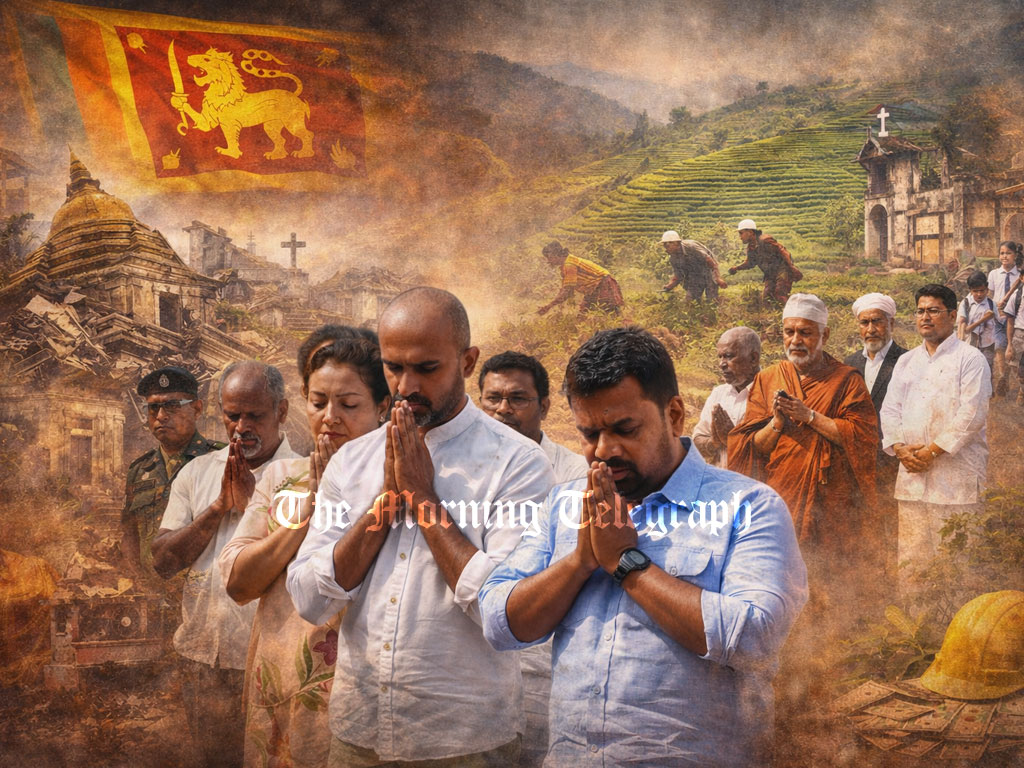
President Anura Kumara Dissanayake on Sunday announced a comprehensive national recovery and reform agenda, pledging that every religious site damaged by Cyclone Ditwah will be rebuilt while fully preserving its historical and cultural value. The pledge was made at the inauguration of the national programme “Godanagamu Adhishtanaye Sanhinda”, launched at Sri Bodhirukkarama Viharaya in the Peacock Hill area of Doragala, Gampola.

The programme marks the formal start of a nationwide effort to restore sacred, cultural and archaeological landmarks affected by one of the worst natural disasters in Sri Lanka’s recent history. In the Kandy and Udapalatha Divisional Secretariat areas alone, six religious sites were completely destroyed and another fifteen partially damaged. President Dissanayake took part in the ceremonial commencement of reconstruction at Sri Bodhirukkarama Viharaya, which had been entirely devastated by the cyclone.
Addressing the gathering, the President revealed that Cyclone Ditwah had damaged approximately 1,350 religious, cultural and archaeological sites across the country. He said the government has already initiated urgent measures to restore these locations, stressing that rebuilding temples, churches, kovils and mosques is essential to restoring village life, social harmony and cultural continuity.
In his full address, President Dissanayake described Cyclone Ditwah as one of the largest natural catastrophes Sri Lanka has faced in decades. Nearly two thousand landslides were recorded, with widespread loss of life, homes, livelihoods and economic opportunity. While acknowledging the scale of the devastation, he said the government, together with public officials, has managed to overcome the immediate crisis and restore a degree of normalcy. However, he emphasized that rebuilding homes, livelihoods and community institutions remains a major national task.
The President underscored the deep bond between villages and religious institutions, noting that temples and places of worship are not isolated structures but integral to daily life and social identity. He said the “Godanagamu Adhishtanaye Sanhinda” programme was designed to rebuild these sacred spaces in harmony with community life, ensuring that spiritual and cultural connections are fully restored alongside physical reconstruction.
Recognizing the severe hardships faced by rural temples, President Dissanayake announced a rapid development programme coordinated by the Ministry of Buddhasasana to uplift and strengthen selected rural religious institutions that operate under difficult conditions.
He also drew attention to the environmental crisis in the Central Highlands, citing a recent Asian Development Bank survey that highlighted worsening soil erosion, exposed rock formations and increasing siltation of reservoirs. Warning that inaction would lead to irreversible damage, the President announced the establishment of a new legal framework and a dedicated Authority to protect and nurture the Central Highlands. This body will unify conservation, restoration and development efforts under a single management structure, ensuring coordinated and urgent action to safeguard this critical ecological region.
Beyond environmental and cultural restoration, the President outlined an ambitious economic recovery plan. Under the Prajashakthi Programme, LKR 24,000 million has been allocated to rebuild livelihoods and economic foundations. Road development was identified as a priority, with the Road Development Authority allocating a further LKR 24,000 million this year to improve minor roads at the provincial level. Provincial councils have received over LKR 8,000 million, while local authorities are also contributing from their own revenue to accelerate infrastructure rehabilitation and restore economic connectivity.
A landmark announcement was made regarding plantation workers, who will, for the first time in Sri Lanka’s history, receive a daily wage of LKR 1,750 starting February 10. The President said the government will contribute LKR 200 of the LKR 400 daily increase, acknowledging the need to protect workers while maintaining the viability of plantation institutions. He described this as an initial but critical step toward long-overdue social justice for plantation communities.
Rural economic empowerment remains central to the government’s vision, with LKR 96 billion allocated this year to small- and medium-scale credit schemes aimed at uplifting rural livelihoods and creating new income opportunities.
Housing reconstruction also featured prominently. The 2025 budget provides for the construction of 31,000 new houses for underprivileged families, alongside 20,000 homes to replace those destroyed by Cyclone Ditwah. In total, 51,000 houses are planned for construction this year, with Divisional Secretaries and government agencies expected to play a key role in implementation.
Education reform was presented as the cornerstone of long-term poverty reduction. President Dissanayake noted that approximately 38,000 students drop out of school before sitting for the G.C.E. Ordinary Level examination, while a large proportion of incarcerated individuals lacked education beyond Grade 10. To address this, the government has launched a programme to enforce compulsory 13 years of education for every child.
Under the new system, parents will receive notifications when children miss school, and Divisional Secretariat-level teams will investigate repeated absences. The President stated unequivocally that no child should leave school without completing the full 13 years of education.
The education reform framework restructures learning into four continuous stages: Grades 1 to 5, 6 to 9, 9 to 11 and 11 to 13. Outdated curricula will be modernized to align with global knowledge and skills. The first cohort under the reformed system is expected to graduate in 2032, supported by a nationwide network of strengthened vocational training centers. For the first time, LKR 8 billion has been allocated specifically for vocational education, alongside legislative reforms, improved instructor salaries and upgraded facilities.
While acknowledging attempts by some groups to disrupt development through misinformation, the President said progress would not be halted. However, to ensure public confidence, Grade 6 reforms have been postponed to next year, while Grade 1 reforms will commence on the 29th of this month, accompanied by extensive awareness campaigns and parental engagement.
The President concluded by emphasizing the need to rebuild ethical human relationships alongside economic growth. He warned that trust between officials and citizens, teachers and students, and religious leaders and communities has eroded. Restoring these bonds, he said, is essential to rebuilding the nation. He expressed gratitude to the Maha Sangha and other religious leaders for guiding society toward harmony and constructive values.
Minister of Buddhasasana, Religious and Cultural Affairs Dr. Hiniduma Sunil Senevi reiterated the government’s commitment, noting that the programme launched from Kandy will rebuild religious sites across all faiths. Religious leaders from Buddhist, Hindu, Christian and Muslim communities participated in the event, which was attended by provincial officials, Members of Parliament, public servants and local residents.