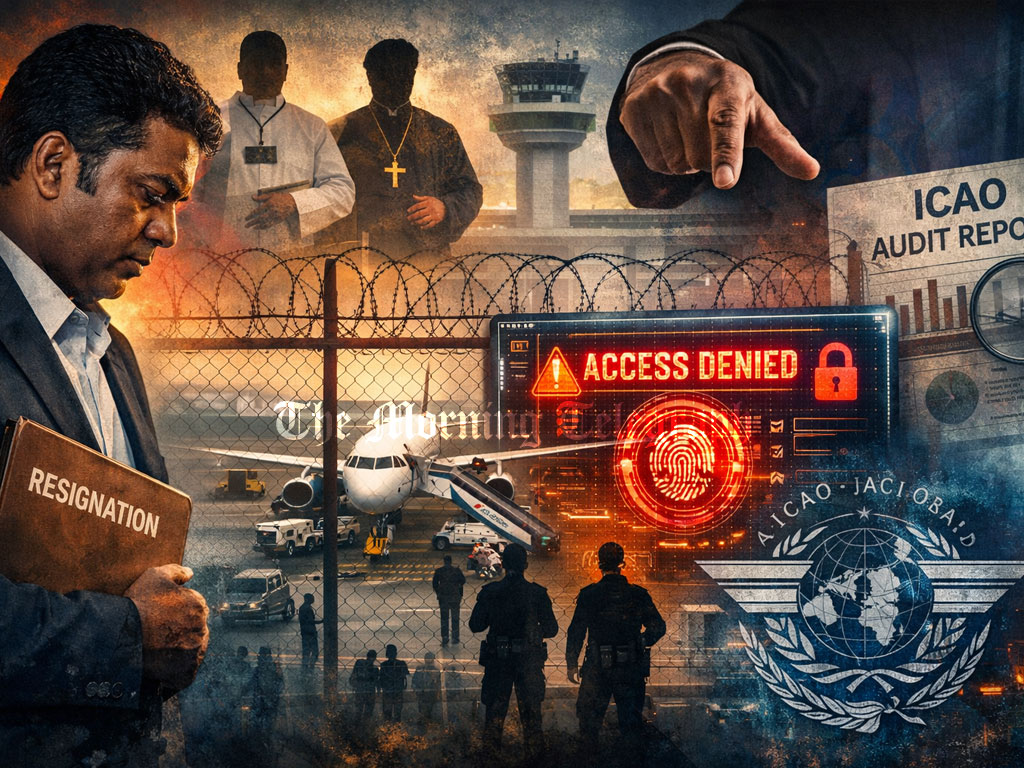
A nation’s top airport official resigns in a dramatic standoff. The reason? A government minister demanded special security access for powerful clergy, challenging the unbreakable global rules that keep flying safe. This isn’t just a local dispute; it’s a worldwide test of principle over power.
“All human life can be found in an airport.”
– David Walliams
The recent resignation of Air Chief Marshal Harsha Abeywickrama in Sri Lanka cuts far deeper than a simple news headline about a job change. It represents a critical flashpoint in the ongoing, global struggle to keep aviation security free from political interference. Abeywickrama was no ordinary bureaucrat; he served simultaneously as the Chairman of Airport and Aviation Services (Sri Lanka) Limited and is a former Commander of the Sri Lanka Air Force. His decision to lay down his office transcends typical administrative turnover. According to reports from those close to the matter, his departure was forced by a fundamental and irreconcilable clash over the very soul of aviation safety. The catalyst was a request, emanating from a ministerial level, to grant high-level security clearance to certain members of the clergy. This clearance would have allowed them access to the sterile areas of airports, those hyper-secure zones located beyond immigration and passenger checkpoints, governed by the world’s most stringent international protocols.

For a leader like Abeywickrama, whose entire career has been built on the bedrock principles of command discipline, risk management, and absolute accountability, such a request was impossible to reconcile with his duty. It represented a direct challenge to the normative rigidity demanded by treaties and standards that protect global aviation. The integrity of the entire system, in his view, was at stake. This was not a minor policy disagreement but a profound ethical breach, and it was this breach that made his continued leadership untenable. He chose principle over position.
This resignation is therefore not a mere internal administrative footnote. It is a significant juridical and ethical event that illuminates a dangerous fissure between the reach of executive authority and the sacrosanct, autonomous operation of aviation security protocols. It forces us to re-examine the precarious balance between political power and technical expertise within the international civil aviation system, a system deliberately crafted after eras of conflict and insecurity to shield safety and security from the shifting winds of political expediency. At its heart, this Sri Lankan controversy serves as a stark case study in the inherent peril that arises when political direction attempts to intrude upon security regimes that are, by international design, governed not by discretion, privilege, or symbolism, but by cold, hard risk assessment, systematic threat mitigation, and the uniform, unyielding application of global standards.
The Unshakeable ICAO Position
The entire edifice of international civil aviation security is built upon one foundational, non-negotiable premise: threats to an aircraft are utterly indifferent to a person’s rank, vocation, faith, or political symbolism. A bomb or a malicious act does not discriminate. This core truth is given concrete, legal form in Annex 17 (Aviation Security) to the Convention on International Civil Aviation. The language of Annex 17 is not suggestive; it is commanding and imperative. It speaks in the unambiguous grammar of legal duty, not optional discretion. It imposes on all Contracting States the binding obligation to create, implement, and relentlessly maintain a national civil aviation security programme. This programme’s sole purpose is to ensure the protection of civil aviation against acts of unlawful interference.
Critically, Annex 17 places the responsibility squarely on states to guarantee that access to security-restricted areas, most notably the sterile areas beyond the final passenger screening checkpoints, is strictly controlled, continuously monitored, and granted only on the basis of two clear criteria: proven operational necessity and verified, trustworthy background. There is no third category for social importance or political favor.
Within this rigorous global security architecture, sterile areas are not ceremonial spaces or zones where courtesy access is granted. They are juridically defined zones of heightened and concentrated vulnerability. Here, aircraft, passengers, crew, fuel, and critical infrastructure converge, creating an environment where a single, small security lapse can cascade with terrifying speed into a catastrophic event. Consequently, Annex 17, reinforced by the detailed guidance in the ICAO Aviation Security Manual, insists on a multi-layered, defense-in-depth security strategy. In this strategy, access control is not a favor an official can bestow. It is a hard-earned privilege granted only after exhaustive vetting, rigorous background investigations, and a clear, demonstrable need tied directly to aviation operations. The Manual is explicit: authorization must be rigidly predicated on the “need to access” principle. It further warns that any exemptions, no matter how benign or well-intentioned they may seem, introduce dangerous asymmetries and vulnerabilities that adversaries actively seek to identify and exploit.
It is against this uncompromising normative and operational backdrop that the reported Sri Lankan ministerial request must be soberly evaluated. The essential issue here is not one of faith, cultural respect, or the social standing of the clergy. The issue is one of structural and systemic integrity. Functional aviation security regimes are designed to be blind. They do not, and cannot, distinguish between individuals based on moral standing, social reverence, or political clout. They distinguish solely between those whose presence is essential to the safe operation of a flight and those for whom access constitutes an avoidable and unacceptable risk increment. The moment this clear, bright line is blurred or erased by executive direction, even once, the entire security edifice begins a process of insidious erosion. The damage is done not through a dramatic collapse, but quietly, through the setting of a perilous precedent.
The ICAO Aviation Security Manual offers a measured but unequivocal warning about the dangers of such ad hoc exemptions. It underscores that insider threats, those posed by individuals who have been granted trust and access, represent one of the most pernicious and challenging risks to mitigate. Why? Precisely because these threats exploit the very trust, familiarity, and perceived legitimacy that a special clearance grants. When access is authorized on grounds external to the formal security assessment process, the integrity of the entire access control system is instantly compromised. The very concept of a “security clearance” is devalued, becoming a token of privilege rather than a badge of verified trust. The Manual is particularly pointed on this, emphasizing that senior officials and politically exposed persons must never be exempted from standard security procedures, as such exemptions create glaring vulnerabilities that can be exploited directly or indirectly by hostile actors.
Air Chief Marshal Abeywickrama’s reported objection, therefore, must be understood correctly. It was not an act of institutional stubbornness or bureaucratic inflexibility. It was, rather, a profound act of fidelity: fidelity to binding international legal obligations and to the ethical imperatives of his professional responsibility. As both a former military commander and the senior custodian of national aviation infrastructure, his paramount duty was to protect the system, not to accommodate the misapplication of power where core security was concerned. In the high-stakes world of aviation security, professional, evidence-based judgment must never be subordinate to political convenience. In fact, this professional judgment is the primary mechanism through which states faithfully discharge their solemn obligations under the Chicago Convention.
Thus, his resignation shines a light on a deeper and more troubling global phenomenon: the creeping politicization of technical security functions. Annex 17 envisions a clear and vital demarcation. Policy formulation, which sets broad goals and allocates resources, may rightly reside in the political domain. However, the implementation of security measures, the operational decisions about who accesses which area under what conditions, must remain rigorously insulated from political interference. This demarcation is not just about organizational charts; it is epistemic. Aviation security is a specialized discipline governed by threat intelligence, probabilistic risk matrices, and constantly evolving countermeasure methodologies. Executive interference that bypasses or overrides these evidence-based foundations effectively replaces analyzed data with raw authority, and substitutes careful assessment with simple assertion. This is a recipe for systemic weakness.
The Cascading Dangers of Meddling
The authoritative use of arbitrary power in this context brings with it a cascade of inherent dangers that extend far beyond the immediate, tangible security risk of allowing an uncleared individual into a sterile zone. These dangers implicate the international standing and operational smoothness of the state itself. Under ICAO’s Universal Security Audit Programme (USAP), all states submit to regular, thorough audits that assess compliance with Annex 17’s Standards and Recommended Practices. Any finding, or even a strong indication, that access controls are subject to political override or special influence would expose the state to severe adverse audit findings. This triggers mandatory corrective action plans, increased ICAO scrutiny, and in extreme cases, can lead to enhanced security inspections and advisories from other nations. In our deeply interconnected global aviation system, such reputational damage is far from abstract. It translates into tangible consequences: increased security inspections for the national carrier abroad, operational delays at home, and a slow but sure erosion of trust from foreign airlines and their national regulators. The cost of a single political favor can be measured in economic inefficiency and diplomatic friction.
Moreover, executive intrusion into technical security decisions risks normalizing a corrosive culture of exception. Once the precedent is established that security clearances can be granted or influenced by ministerial fiat, the logical and moral foundation for refusing any subsequent request becomes progressively weaker. What begins as an isolated, perhaps emotionally framed request, “just this once, for these important people”, mutates over time into an implicit, unwritten doctrine of privilege. The ICAO Security Manual cautions directly against this exact phenomenon. It notes, based on historical security failures, that the gradual, piecemeal dilution of access control standards often precedes major security incidents. Catastrophe strikes not necessarily because the external threat environment has suddenly worsened, but because internal vigilance and procedural rigor have been quietly eroded from within by exceptions.
This episode also carries a significant constitutional and governance dimension that cannot be overlooked. Critical national infrastructure like international airports occupies a unique legal and moral space. It is infrastructure whose failure carries immediate transboundary consequences, implicating not just domestic law but also a state’s responsibilities under international law. The professionals entrusted with the security of such infrastructure are therefore bound by a higher standard of operational independence and personal integrity. When executive authority encroaches upon this insulated technical space, it risks converting expert custodians into mere functionaries who follow orders, not best practices. This undermines the very rationale for appointing seasoned professionals of distinction and experience, effectively neutering the independent judgment they were hired to provide.
Misconceptions of Sovereignty and the Cost of Silence
The subsequent silence from Sri Lanka’s Ministry of Aviation following this high-profile resignation only compounds these core concerns. In security governance, transparency is not the enemy of safety; it is its ally. Indeed, Annex 17 actively encourages states to foster a positive security culture grounded in clear accountability and unambiguous definition of roles and responsibilities. The absence of an official, credible explanation in the wake of such an event invites public speculation and, more damagingly, erodes public confidence. This erosion affects not just trust in the aviation security apparatus itself, but also in the broader governance structures that are supposed to oversee and protect it. In a field where public confidence is a crucial security asset in its own right, passengers must believe the system is secure to use it, such opacity becomes a direct operational and security liability.
Ultimately, this controversy reveals a profound and common misunderstanding of state sovereignty within the context of international civil aviation. Sovereignty, as defined and granted by the Chicago Convention, is not an unlimited license for a state to disregard the global norms it has voluntarily pledged to uphold. It is, instead, a weighty responsibility to enforce and champion those very norms. States retain complete and exclusive sovereignty over the airspace above their territory. However, this sovereignty is expressly exercised within an intricate framework of reciprocal obligations and standardized rules agreed upon by the global community. Annex 17 represents the collective, hard-won determination of that global community: that aviation security is too important, and its failure too catastrophic, to be left vulnerable to parochial political pressures, local symbolism, or short-term expediency. The consequences of a lapse are, by the nature of flight, global.
Therefore, the resignation of a senior security professional like Abeywickrama in defense of these principles should not be misinterpreted as an act of defiance against his government. It should be recognized for what it is: a courageous act of institutional conscience. It serves as a powerful reminder that the ultimate effectiveness of aviation security depends not only on advanced technology and meticulous procedures, but fundamentally on the moral courage of individuals who are willing to say “no” when “no” is the only responsible answer. When political executives interfere with or override technical security decisions, they do not merely substitute one opinion for another. They assume direct, personal responsibility for complex risks they may neither fully comprehend nor be institutionally equipped to manage, a dangerous transfer of accountability.
The Airport Manager’s Duty and the Potential of AI
The modern airport manager occupies a uniquely challenging role in this ecosystem. He or she is no longer merely an administrator of local infrastructure, but a fiduciary holding a vital piece of international trust. Airports have transcended their status as purely national assets; they are now critical nodal points in a delicate global network. The safety and security of this entire network depend on uniformity, predictability, and rigorous insulation from parochial influence. This is most evident in aviation security, where Annex 17 and its supporting Manual impose on states, and by direct extension, on the airport managers who execute the rules, a triad of obligations that are equally legal, operational, and ethical. Given the increasing tendency in many jurisdictions for executive authorities to intrude upon security-sensitive decisions, a question of systemic importance arises: How can airport managers lawfully and effectively resist or circumvent such political interference without undermining legitimate constitutional authority, all while preserving the impregnable integrity of aviation security?
Annex 17 is philosophically grounded in a deceptively simple idea: aviation security must be governed by immutable rules, not by mutable personalities. Its standards compel states to establish a national programme that clearly allocates responsibilities, enforces access control through technical and human means, and ensures that no person is granted access unless their trustworthiness is verified and their operational need is established through official channels. The ICAO Manual reinforces this by consistently warning that exemptions, informal authorizations, and ad hoc clearances are themselves systemic vulnerabilities. Together, these instruments envision a security regime deliberately engineered to be resistant to discretion exercised outside of its own structured, documented processes. This is because discretionary power is the primary conduit through which political pressure flows.
The first and most potent mechanism for an airport manager lies in what can be termed the juridification of security decision-making. When every process for access authorization, clearance, and exemption is codified in detailed procedures within the national programme, the manager’s role transforms. He or she ceases to be an individual wielder of personal discretion and becomes the executor of a pre-defined legal and regulatory framework. A political request, no matter how forcefully delivered, is thereby reframed. It is no longer a simple matter of accommodation between colleagues; it becomes a formal question of legal and regulatory compliance. In this dynamic, the manager does not directly refuse authority; he or she respectfully defers to a higher, binding norm, one grounded in international treaty law and incorporated into domestic regulation.
This strategic transformation of personal discretion into inviolable procedure has a profound defensive effect. Political intrusion thrives in the shadows of informality: in verbal understandings, unwritten promises, and “exceptional” gestures made off the record. It falters, however, in environments of strict formality, where every single decision must be documented in writing, justified against a published standard, and its traceability preserved for audit. Annex 17 implicitly supports this by requiring states to subject all aviation security measures to internal quality control, regular auditing, and systematic oversight. A manager who institutionally insists on a written request, a formal risk assessment memo, and a recorded determination is not being difficult. He or she is professionally neutralizing intrusion by exposing it to the disinfecting light of institutional and legal scrutiny.
Closely allied to this procedural armor is the strategic concept of institutional pluralism. The ICAO security framework was never designed to concentrate security authority in a single individual or office. It mandates, instead, coordination and shared responsibility among a web of entities: airport operating companies, national civil aviation authorities, law enforcement agencies, intelligence services, and designated security providers. When critical access decisions are made not by one manager alone, but collectively by a formally constituted security committee or a joint threat assessment panel, the avenue for unilateral political influence is dramatically narrowed. Executive pressure that might be effectively applied to a single office-holder becomes diluted and defused when it must contend with an interlocking network of independent professional judgments from different organizations, each with its own legal mandate. In such a structure, operational responsibility is intelligently diffused, but overall accountability to the standard is strengthened.
This diffusion is not a bureaucratic trick. It is a deliberate and wise safeguard against regulatory or operational capture. Aviation security is uniquely vulnerable to the personalization of power precisely because its failures are statistical and often remain invisible until a tragic event occurs. Annex 17, therefore, seeks to institutionalize a form of professional skepticism by ensuring that no single actor has sole control over both a security decision and its formal justification. Airport managers who actively cultivate and empower this culture of collective, multi-agency assessment are not evading their own authority. They are fulfilling the deeper spirit of international aviation law, which correctly understands and treats security as a systemic, network-wide function, not a top-down hierarchical command.
Yet, we must acknowledge that even the most robust procedural and institutional safeguards can remain vulnerable in political environments where executive authority is culturally accustomed to overriding formal norms through persistent informal channels. It is within this challenging context that Artificial Intelligence (AI) assumes a new and potentially transformative role as a guardian of integrity. Properly understood and implemented, AI in this sphere is not just another technological tool for efficiency. It is an epistemic intervention, a way of knowing and deciding, that can fundamentally alter the balance between human discretion and rule-based governance. When deployed thoughtfully within the Annex 17 framework, AI can function as a powerful institutional buffer, a layer of intelligent insulation between political impulse and operational execution.
One of the most immediate and powerful applications of AI lies in dynamic risk-based access control. The ICAO Manual stresses that access must be based on verified trustworthiness and need, and that this trustworthiness is not a static status but requires continuous reassessment. Modern AI systems are uniquely capable of this task. By integrating and analyzing real-time data streams from background check databases, individual access histories, behavioral analytics from sensors, and up-to-date threat intelligence feeds, AI can generate dynamic, evolving risk profiles for every credential holder. Access decisions in such a system are no longer anchored in a manager’s potentially pressured personal judgment at a moment in time. They are driven by an algorithmic assessment grounded in predefined, auditable criteria, applied uniformly to everyone. This is the automation of objectivity.
The normative and practical significance of this is substantial. When access decisions are primarily driven by AI-generated risk scores, direct political intrusion meets a formidable structural barrier. A directive seeking preferential access for a VIP must now confront not a person who can be persuaded or pressured, but a system whose logic is transparent, whose outputs are consistent and documented, and whose entire decision trail is auditable. To override such a system is no longer a quiet, private administrative act between two officials. It becomes a visible, documented deviation from the established security logic of the entire organization. It demands a formal written justification and, in a well-designed system, would automatically trigger supervisory review mechanisms. In this way, AI does not replace essential human oversight; it constructs a framework that rigorously privileges evidence-based rules over personal influence.
Furthermore, AI inherently reinforces one of Annex 17’s most sacred principles: the equal application of security measures. The gravest danger of political interference is the “normalization of the exception,” where special treatment for some becomes an accepted, if unofficial, practice. AI systems, by their fundamental design, resist exemption unless they are explicitly, and obviously, reprogrammed to allow it. This technical resistance can serve as a powerful, legitimate shield for airport managers. They can respond to pressure by truthfully stating that granting such a deviation is not within their personal power; it would require a formal, technical, and likely auditable alteration to the core security algorithm itself, a change that would itself demand high-level justification and review. The burden of responsibility is thus strategically shifted away from the individual manager’s conscience and onto the governance structures overseeing the technology itself.
AI also aligns powerfully with ICAO’s intense focus on insider threat detection. The Manual repeatedly identifies malicious insiders as among the most severe risks, precisely because they operate within the veil of trust. AI-powered security systems, equipped with analytics for video surveillance, access log patterns, and behavioral monitoring, can offer a level of continuous, impartial vigilance that is humanly impossible to sustain. These systems do not see a uniform, a title, or a familiar face. They see patterns of movement, frequencies of access, and anomalies in behavior. They detect deviations from an established, learned norm for each individual and for the environment as a whole. This epistemic neutrality, this blindness to status, perfectly mirrors the legal and operational neutrality demanded by Annex 17, which is meticulously indifferent to social standing and exclusively attentive to indicators of risk.
However, positioning AI as a bulwark against political intrusion carries its own set of risks that must be managed. An AI system that is a “black box,” whose workings are proprietary and opaque, or worse, one that can be secretly manipulated or retrained by executive fiat, risks becoming a sophisticated instrument of centralized power rather than a check upon it. For AI to genuinely serve the cause of security integrity, its governance must be transparent in principle, its core risk criteria subject to independent audit, and its specific decisions explainable in plain language. Airport managers must retain ultimate human responsibility for security outcomes. Therefore, any formal decision to deviate from an AI-generated assessment should require a mandatory written justification and automatically activate a review by a separate oversight body. Used this way, AI becomes a discipline for consistent decision-making, not a disguise for arbitrary power.
A deeper philosophical caution from the aviation security ethos remains vital in the AI age: security, in its final essence, is a human responsibility. Technology assists, informs, and constrains, but it cannot absolve human decision-makers of their ethical and legal accountability. The airport manager who deploys AI must do so as a means of reinforcing professional judgment and institutional ethics, not as a means of abdicating them. The true danger lies not in using algorithmic governance, but in allowing algorithms to become convenient, inscrutable alibis for moral and professional failure.
Perhaps one of AI’s most understated yet powerful contributions is in the realm of irrefutable documentation and traceability. Political pressure often operates through the most informal of channels: a quiet word, a phone call, an implied expectation. AI-driven security management systems that comprehensively log every access request, the associated risk score, the approval or denial, any manual overrides, and the official justification for that override create an immutable, time-stamped evidentiary trail. This digital paper trail acts as a powerful deterrent to improper interference simply by radically increasing the probability of exposure during an internal or ICAO audit. In a domain subject to such intense international scrutiny, this traceability is itself a potent form of institutional protection. It demonstrates that transparency and security are not opposites, but inseparable allies in the mission to maintain global trust.
In conclusion, the lawful circumvention of political intrusion by airport managers is not an act of resistance against the state. It is, at its finest, an act of profound fidelity to the state’s highest and most important obligations under international law. Annex 17 does more than list technical precautions; it articulates a coherent philosophy of governance for critical systems. It is a philosophy where security is intentionally insulated from the whims of the moment and anchored instead in reason, evidence, and universally shared responsibility. Artificial Intelligence, if deployed cautiously, ethically, and with robust governance, can powerfully reinforce this vital insulation. It does so by systematically embedding objectivity, unwavering consistency, and clear accountability into security systems that have historically been vulnerable to the full spectrum of human pressure, from subtle persuasion to direct command.
Yet, we must end with the irreducible human element. No legal framework, however brilliant, and no technological system, however advanced, can ever be a substitute for raw institutional courage. The airport manager who ultimately stands firm against improper interference, who points to the law, the procedure, the committee, or the algorithm, does so not in opposition to legitimate authority, but in its highest service, the service of the public interest and the preservation of hard-won international trust. In an era where threats to civil aviation are increasingly asymmetric, subtle, and innovative, the most dangerous vulnerability may no longer be a gap in the perimeter fence or a new type of explosive. It may be, as the Sri Lankan case so vividly illustrates, a political one. To guard against this most insidious of vulnerabilities is to understand a final, sobering truth: aviation security, once compromised by power, cannot be restored by a later explanation or a public apology. Its sanctity can only be preserved by building structures, legal, institutional, and increasingly, technological, that make such a compromise not merely difficult, but objectively, verifiably, and structurally impossible.
SOURCE :- SRI LANKA GUARDIAN