In an unprecedented legal battle over the “most devastating marine chemical tragedy on Earth,” Sri Lanka’s Supreme Court has drawn a line in the sand. Its landmark verdict orders a staggering initial payment of $1 billion from the owners of the MV X-Press Pearl. This is the story of a nation’s struggle for accountability, a detailed anatomy of a preventable disaster, and the beginning of a grueling fight to secure the full $6.4 billion in compensation for an ecosystem brought to its knees.
A profound silence now hangs over stretches of coastline near Negombo, where the laughter of tourists and the shouts of fishermen once mingled with the sound of the waves. This silence is the aftermath of a roaring, toxic inferno that burned for twelve days in May 2021, an event whose legal and environmental shockwaves are only now fully being understood. The historic verdict in the X-Press Pearl fundamental rights case, delivered on July 24, 2025, was not merely a legal judgment; it was a 360-page indictment of systemic failure and a bold declaration of a new environmental constitutionalism for Sri Lanka.

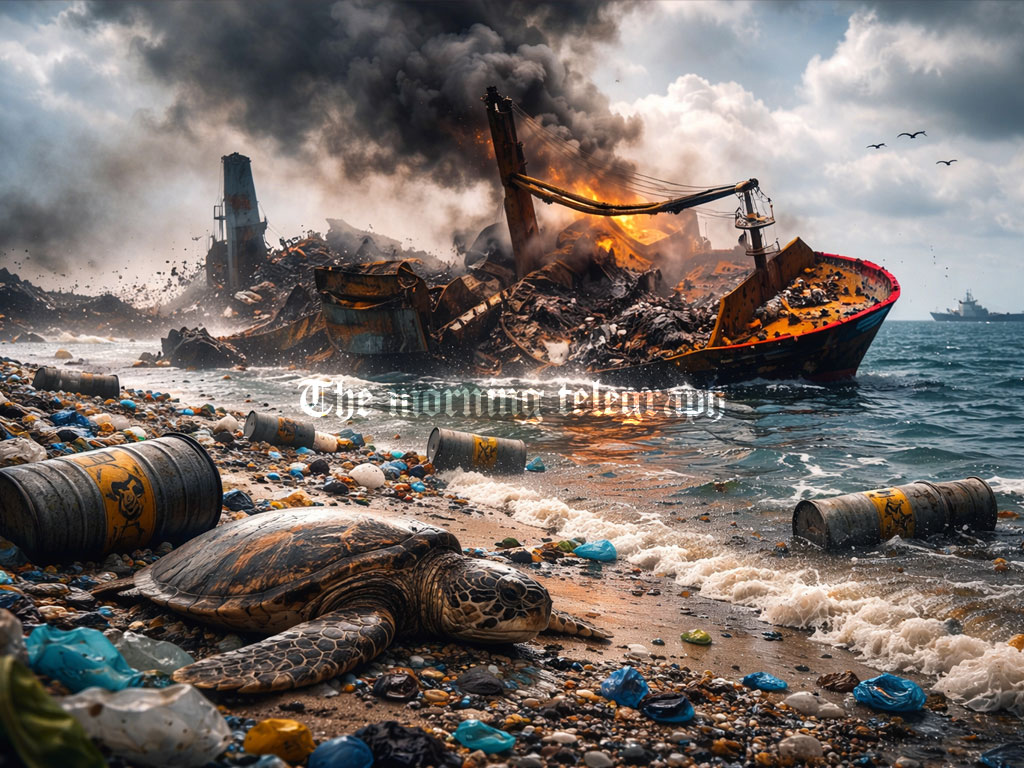
The facts of the disaster are as horrific as they are vast. The Singapore-registered container vessel MV X-Press Pearl, carrying 1,486 containers, caught fire 9.5 nautical miles off the Port of Colombo on May 20, 2021. Of its cargo, 81 containers were filled with highly toxic and hazardous chemicals, including nitric acid, caustic soda, and other dangerous goods. As the ship burned and eventually sank, it unleashed an apocalyptic cocktail into the pristine Indian Ocean: 278 tons of fuel oil, 50 tons of marine gas oil, and thousands of tons of plastic polymer pellets known as nurdles. The environmental forensic report, a key document in the case, detailed how nitric acid and heavy metals created toxic plumes in the water column, while billions of lentil-sized plastic pellets smothered the seafloor and beaches in a white, indelible plague.
The immediate carnage was heartbreaking. The petitioners before the Supreme Court presented verified data showing 417 dead turtles, 48 dolphins, and 8 whales washed ashore, their bodies often coated in oil and plastic. The mortality rate among smaller fish species was described as “incalculable.” But the true, haunting scope of the tragedy lies in its permanence. Microplastics have been integrated into the very fabric of the marine ecosystem, entering the food chain at a microbial level. Sandy beaches, once soft and brown, are now speckled with plastic pellets that cannot be mechanically separated, a condition experts testified could persist for 500 to 1,000 years. Coral reefs, the nurseries of the ocean, were coated and choked. For over a year, a government-imposed fishing ban stretched across an 80-kilometer radius, devastating the livelihoods of tens of thousands of families in coastal communities who depend on the sea for their daily survival and cultural identity.
A critical and damning fact established in court was that this floating catastrophe arrived in Sri Lankan waters already wounded. The MV X-Press Pearl was suffering from a known nitric acid leak from one of its containers. Ports in Hazira, India, and Hamad, Qatar, had identified the danger and refused the vessel permission to offload the compromised unit. Thus, the ship proceeded to Colombo as a port of last resort, a ticking chemical time bomb seeking a haven. This sequence of events formed the cornerstone of the legal argument that this was not a simple accident, but a preventable disaster born of negligence and failed duty of care.
In June 2021, recognizing the scale of the injury not just to nature but to the constitutional rights of citizens, a coalition of environmental and civil society groups filed a fundamental rights petition. This was a strategic and novel legal approach. Four separate petitions were consolidated, filed by the Centre for Environmental Justice (CEJ), Father Sarath Iddamalgoda, Dr. Ajantha Perera, and His Eminence Cardinal Malcolm Ranjith. They did not act alone; they represented the silent voices of fishing communities, tourism workers, and all Sri Lankans whose heritage and health were imperiled. This was explicitly framed as a public interest lawsuit, a legal action initiated for the benefit of the entire nation and its shared environment.
Arrayed against them were two sets of respondents. The first, the “Government Party,” included the Marine Environment Protection Authority (MEPA), the Sri Lanka Ports Authority (SLPA), the Attorney General’s Department, and a suite of ministries and officials, including then-State Minister Nalaka Godahewa and then-MEPA Chairperson Darshani Lahandapura. They were accused of dereliction of statutory duty, catastrophic failure in coordination, and violating the public trust by not preventing the disaster. The second group, the “non-Government Party,” comprised the vessel’s owners, operators, and insurers, represented locally by Sea Consortium Lanka Private Limited. They were the embodiment of the “polluter must pay” principle that would become central to the verdict.
The petitioners’ arguments were rooted in the Constitution of Sri Lanka. They asserted that the state’s failure to protect the environment violated Article 12(1) on the right to equality and equal protection of the law—as fishing communities were unfairly deprived of their livelihood. They further argued it violated Article 14(1)(g), which guarantees the freedom to engage in a lawful occupation, and the emergent right to a healthy environment, an essential condition for life itself. Their demands were sweeping: a full, impartial investigation; the creation of expert committees to assess the staggering damage; criminal prosecution of responsible state officials; and urgent legal reforms to update Sri Lanka’s maritime and environmental safeguards. The fishing communities specifically sought interim compensation of LKR 7.7 billion for their immediate economic paralysis.
The defense from the shipping company was one of deflection and jurisdiction. They claimed the crew was not fully aware of the leak’s severity and painted a picture of a vessel in distress, rejected by other ports, with no choice but to seek help in Colombo. They framed the ensuing fire as a tragic, unforeseeable, and uncontrollable accident. Most pointedly, they challenged the Supreme Court’s very authority to rule against a foreign shipping company, arguing that the proper forum was in Singapore or under international maritime arbitration.
The state respondents, for their part, offered a defense of constrained capacity. MEPA and SLPA officials argued they had followed standard protocols, citing the immense challenge of dealing with a chemical fire at sea. They subtly pointed to the operational restrictions of the COVID-19 pandemic as having hampered a more robust response. The Attorney General’s Department, revealing a shocking lack of confidence in the domestic judicial system, disclosed they had initially filed a civil case for compensation in the courts of Singapore, a move the Supreme Court would later scorn.
The five-judge bench, led by Chief Justice Murdu Fernando and including Justices Yasantha Kodagoda, Shiran Gunaratne, Achala Vengappuli, and Priyantha Fernando, heard this complex case over 30 days between April 2024 and May 2025. The resulting verdict was a masterpiece of judicial reasoning that dismantled these defenses one by one and established profound legal precedents.
The court’s findings of fact were unequivocal. It determined that Sea Consortium Lanka and the ship’s Singaporean owners “were well aware of the chemical leak” and had deliberately downplayed the urgency and severity of the situation when communicating with Sri Lankan port authorities. This was not a mere oversight; it was a calculated business decision that prioritized commercial convenience over environmental and human safety.
The condemnation of the state apparatus was equally severe. The judges observed a pattern of “laziness and slowness” and a stunning lack of proactive crisis management. Despite the known danger of the leaking container, there was a fatal delay in decisive action. The court rejected the pandemic as a blanket excuse, noting that even within restrictions, essential communication and coordination between the Ports Authority, Navy, Air Force, and MEPA were tragically inadequate. The failure to have robust, actionable maritime disaster contingency plans was laid bare.
The legal principles established are what make this verdict truly historic for Sri Lanka and for global environmental law.
- The Polluter Must Pay, Absolutely and Fully: The court resoundingly affirmed this core principle of international environmental law. It dismissed the jurisdictional challenge, ruling that Sri Lankan courts have full authority to adjudicate and impose liability for damages caused within its territorial waters and Exclusive Economic Zone, regardless of the polluter’s nationality. The ship’s owners were declared wholly liable.
- A Healthy Environment is a Fundamental Right: In a transformative leap, the judgment explicitly interpreted the existing constitutional rights to life and equality to include the right to a clean, healthy, and sustainable environment. This constitutionalizes environmental protection and opens the door for future public interest litigation on everything from air pollution to deforestation.
- State Officials Can Be Liable for Gross Negligence: The verdict pierced the shield of state immunity in a fundamental rights context. It ruled that then-State Minister Nalaka Godahewa and then-MEPA Chairperson Darshani Lahandapura had violated the fundamental rights of citizens through their gross failure to perform their official duties under laws like the Marine Pollution Prevention Act. This creates a powerful deterrent for future state inaction.
- Condemnation of Legal Cowardice: The court was scathing in its critique of the Attorney General’s decision to sue in Singapore. It called this move “arbitrary” and “without reasonable basis,” stating it reflected a lack of faith in Sri Lanka’s own judiciary and, by extension, its sovereignty. This was itself deemed a violation of the state’s duty to protect its citizens’ rights.
The operational orders were specific and demanding. The owners of the X-Press Pearl were ordered to pay an initial sum of USD 1 Billion to the Secretary of the Treasury, as a first installment toward the total estimated damages of USD 6.4 billion. The payment schedule was strict: $250 million by September 23, 2025; $500 million by January 23, 2026; and the final $250 million by July 23, 2026. Beyond this, the court mandated the creation of a dedicated Marine Environment Restoration Fund, ordered the CID to launch a criminal investigation within three months (with quarterly reporting to the Supreme Court), and instructed the Bribery Commission to probe allegations of state-sector corruption in the handling of the disaster.
The January 2026 Hearing: The Battle for Enforcement
The case was called again in late January 2026 to review compliance. The update revealed a nation inching toward justice but facing formidable resistance. On a positive note, the CID had initiated the criminal process, obtaining travel bans against 14 directors of the shipping company’s board and beginning the complex task of tracing and freezing assets globally. Legal proceedings had also commenced in Singapore, leveraging the Sri Lanka-Singapore bilateral trade agreement to enforce the judgment internationally.
However, a stark act of defiance overshadowed this progress. The court’s deadline of January 23, 2026, for the second installment of $500 million came and went. The shipping company had paid a sum, but it was 250 million Sri Lankan Rupees—equivalent to roughly $800,000 USD, a contemptuous fraction of the $500 million owed. The court rightly declared this a clear and willful act of “contempt of court.” This moment laid bare the realpolitik of environmental justice: a landmark verdict on paper means little without the relentless political and diplomatic will to enforce it. The judges urged all state institutions to unite in a concerted effort to compel payment and advance the criminal case.
The X-Press Pearl verdict is more than a ruling; it is a mirror held up to Sri Lanka. It reflects the tragic costs of regulatory capture and bureaucratic inertia. It showcases the courage of civil society and the judiciary in demanding accountability. The path ahead is daunting. Securing the full $6.4 billion will require sustained legal pressure, shrewd international diplomacy, and unwavering political commitment. It will test whether the principle that “the polluter must pay” can be made real against powerful transnational corporate interests. For the fishing communities of Negombo, for the dead turtles on the shore, and for the future of Sri Lanka’s blue economy, this historic battle, born from a twelve-day inferno, must now be fought to its last, decisive penny.