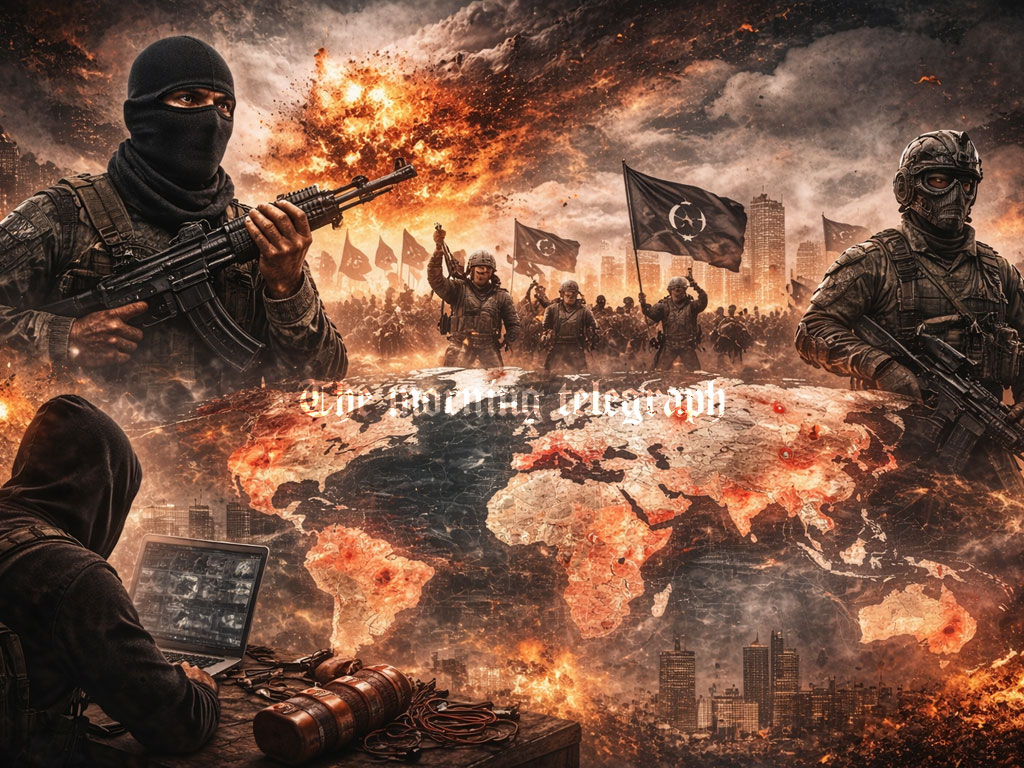
From fragile African states to simmering Asian fault lines, 2026 is shaping up to be a year where terrorism adapts, migrates, and quietly exploits global instability despite unprecedented counterterrorism pressure.
In 2026, the global threat landscape is being shaped by intense geopolitical competition alongside expanded counterterrorism and intelligence operations. While states invest heavily in surveillance, border security, and information sharing, non state armed groups driven by religious extremism, ethnic militancy, and radical ideologies continue to threaten governments and civilian populations across continents.

Terrorist and insurgent attacks are expected to span Asia, the Middle East, Africa, Latin America, and parts of the Western world. However, assessments based on extremist communications and government reporting indicate that more than 95 percent of these attacks will occur in active conflict zones such as Sudan, Mali, Somalia, Libya, Nigeria, Afghanistan, and Pakistan. Outside these regions, violence is expected to be sporadic but symbolically powerful, with isolated incidents likely in North America, Europe, Australia, and New Zealand.
Heightened security concerns have already reshaped public life in several Western capitals. In response to domestic disruptions and threat warnings, major cities scaled back or canceled New Year celebrations for the 2025 to 2026 period. Despite this, the core theaters of terrorism remain firmly anchored in the Global South, particularly across Asia, the Middle East, and Africa, where weak institutions, poverty, and prolonged conflict continue to fuel militant activity.
Even as overall attack numbers decline in Western countries, individual incidents still dominate headlines. The family based attack at Bondi Beach in Sydney in December 2025 is a reminder that sudden violence can erupt without warning. Fragmented migrant and diaspora communities, combined with radical networks operating in both physical and digital spaces, remain a persistent security challenge, ensuring that Western countries will continue to experience periodic attacks in 2026.
The center of global terrorism has gradually shifted away from the Middle East toward Africa and parts of Asia. That said, armed groups remain active in Iraq, Syria, Lebanon, and Yemen. Iran’s axis of resistance, which includes Shia groups across Iraq, Syria, Lebanon, and Yemen as well as Sunni factions in Gaza, has struggled to prevent Israeli strikes on Iranian interests. In response, Tehran has renewed support to Hezbollah in Lebanon and Ansar Allah in Yemen, both weakened by sustained Israeli operations, in an effort to restore regional influence. With the exception of Iran, most Middle Eastern governments now publicly reject terrorism, and the devastating Gaza conflict following October 7, 2023, has significantly reduced public appetite for both cooperation with militant groups and ideological extremism.
In Western societies, both far right and far left movements have gained visibility and, in some cases, operational capability. The rise of far right political parties in 2026 and beyond may create space for extremist offshoots. At the same time, enhanced intelligence cooperation has disrupted multiple planned attacks. US authorities, for instance, reportedly foiled coordinated bomb plots in Los Angeles during New Year celebrations. Online ecosystems remain a critical concern, with extremist groups using inflammatory language such as “Death to America” and rejecting peaceful protest as a viable path.
As in 2025, the majority of terrorist attacks in 2026 are expected to occur in the Global South. Counterterrorism datasets suggest that 60 to 70 percent of incidents will take place in African countries, where Islamic State and Al Qaeda affiliated organizations remain among the deadliest actors. In South Asia, attacks by Tehreek e Taliban Pakistan are projected to surpass those by Islamic State affiliates in Pakistan, raising the risk of cross border escalation involving Afghanistan. Terrorism is also rising in Bangladesh, where Islamist coordination with Afghan Taliban networks has intensified demands for Sharia implementation. This trend places minorities, particularly Hindus and Christians, at increased risk.
Recruitment by the Islamic State Khorasan Province continues across South and Central Asia, both domestically and within diaspora communities. While Central Asian governments have restricted religious spaces to limit radicalization, citizens working abroad remain vulnerable to recruitment by both Islamic State and Al Qaeda networks for operations in Russia, Europe, and beyond.
In Southeast Asia, threat levels have declined, but remnants of global jihadist networks persist. Authorities continue integration and deradicalization efforts, recognizing that while the intensity of violence has eased, the underlying risks have not disappeared in an increasingly volatile global security environment.