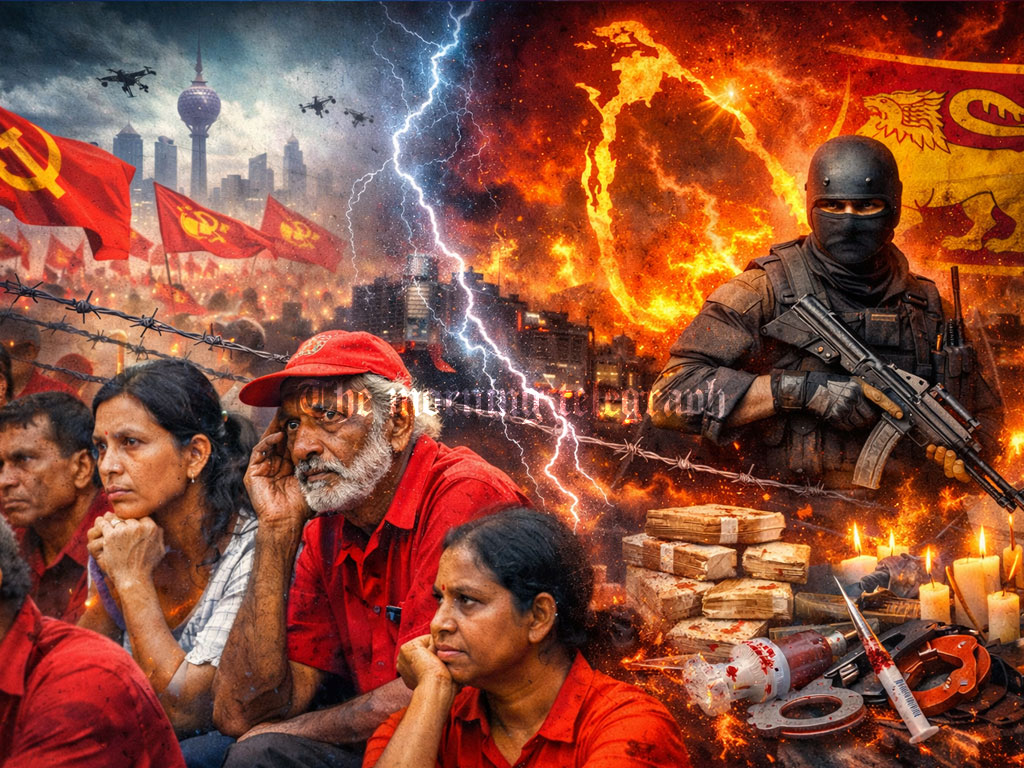
Sri Lanka enters 2026 calm on the surface but restless underneath, as security stability masks unresolved political wounds, diaspora tensions, and a deepening war against narcotics.
Sri Lanka stepped into 2026 with a security landscape that appeared steady and controlled, yet quietly burdened by unresolved structural weaknesses carried over from the post war period. While the country continued to enjoy the absence of terrorism linked fatalities and retained its place among the lowest risk nations globally, this calm revealed a deeper paradox often described as “negative peace”, where violence is absent but the political, ethnic, and social roots of conflict remain unsettled. Persistent diaspora activism, narcotics trafficking, and shifting regional security pressures combined to create a complex environment that challenged the idea of lasting peace.

The National People’s Power Government, led by President Anura Kumara Dissanayake and Prime Minister Harini Amarasuriya, inherited a security framework shaped by decades of counterterrorism policy, intelligence driven policing, and emergency era legal tools. Rather than dismantling or radically reimagining this architecture, the new administration largely chose continuity over rupture. This was especially evident in its handling of proscription regimes, surveillance frameworks, and intelligence coordination, signalling a cautious approach designed to preserve stability while avoiding political risk.
A defining moment in shaping the 2026 security narrative came on January 13, when the NPP Government issued an extraordinary gazette extending the long standing ban on the Liberation Tigers of Tamil Eelam and a wide range of Tamil diaspora organisations and individuals. By reissuing and updating the May 2025 proscription list, the Government reaffirmed its long held position that certain overseas Tamil political and advocacy bodies continued to pose security threats through alleged links to terrorism related activities.
Groups such as the Tamil Rehabilitation Organisation, Tamil Coordinating Committee, World Tamil Movement, Transnational Government of Tamil Eelam, World Tamil Relief Fund, National Council of Canadian Tamils, and Tamil Youth Organisation remained blacklisted, with updated identification details and revised reference numbers issued for 2026. Although no substantive new allegations were introduced, the decision reinforced the deeply securitised lens through which the Sri Lankan State continues to view diaspora mobilisation more than 15 years after the civil war ended. First introduced in 2014 under President Mahinda Rajapaksa, the proscription framework continues to criminalise contact with listed entities, restrict political engagement, and perpetuate mistrust between the State and Tamil communities abroad.
This persistence of hardline security measures stood in visible tension with the Government’s stated commitment to reform, reconciliation, and accountability. That contradiction was further sharpened by renewed international scrutiny over unresolved war time accountability. In June 2025, United Nations High Commissioner for Human Rights Volker Türk visited Sri Lanka, drawing fresh global attention to enforced disappearances and the absence of accountability for alleged war crimes.
During his visit, Türk met families of the missing in Trincomalee and the Jaffna District and received a joint letter from major Tamil political parties, including the Ilankai Tamil Arasu Kachchi, All Ceylon Tamil Congress, and Tamil National People’s Front. The letter warned against the instrumentalisation of international engagement to legitimise continued State inaction. Even sixteen years after the end of the war, the lack of tangible progress on accountability continued to fuel Tamil grievances and strengthen diaspora activism, which Colombo simultaneously seeks to suppress through legal and security mechanisms.
Despite these political fault lines, Sri Lanka’s internal security indicators remained strong and consistent. The country continued to benefit from the dismantling of organised terrorist infrastructure following the military defeat of the LTTE in 2009 and the sustained weakening of Islamist extremist networks after the 2019 Easter Sunday attacks. Sri Lanka’s zero score in the 2025 Global Terrorism Index and its ranking of 100 out of 163 countries reflected this reality.
Yet vigilance remained high. The State continued to monitor residual extremist threats, particularly transnational Islamic State linked networks, as demonstrated by surveillance operations and arrests carried out in preceding years. Intelligence sharing with regional partners, especially India, remained a central pillar of Sri Lanka’s counterterrorism posture. This cooperation was clearly illustrated by heightened security checks at Bandaranaike International Airport in May 2025 following intelligence inputs related to a terrorist attack in India.
Broader stability was further supported by data from the South Asia Terrorism Portal, which recorded zero insurgency related fatalities, arrests, or surrenders throughout 2025. The absence of measurable insurgent activity reinforced official assessments that no organised militant formations were operational within Sri Lanka during the year, underscoring the consolidation of the post war security environment.
Alongside terrorism, another defining security challenge shaping 2026 was Sri Lanka’s escalating battle against narcotics trafficking. Increasingly intertwined with organised crime and maritime security threats, the narcotics trade emerged as a central national security concern. On January 18, 2026, Police Media Spokesman Assistant Superintendent of Police F. U. Wootler disclosed that Sri Lanka Police had seized over 1,821 kilograms of heroin during island wide anti narcotics operations in 2025.
Additional seizures included more than 17,189 kilograms of cannabis, 3,865 kilograms of crystal methamphetamine known as ICE, and nearly four million narcotic pills. These figures highlighted Sri Lanka’s growing role as both a transit and destination hub within Indian Ocean drug trafficking networks, driven by its strategic location along key maritime routes. The Government’s decision to continue daily drug raids throughout 2026 under the direct supervision of the Inspector General of Police reflected an acknowledgment that narcotics posed a serious threat not only to public health, but also to crime control, institutional integrity, and national security.
Efforts to reinforce the credibility of enforcement mechanisms were also visible in the judicially supervised destruction of seized narcotics. In 2024, nearly 1.9 metric tonnes of heroin, ICE, ketamine, and cocaine were incinerated at facilities in Wanathawilluwa and Puttalam. A further 665 kilograms of heroin were destroyed between 2025 and early 2026. These measures were intended to address long standing concerns about the re circulation of seized drugs and to rebuild public trust in law enforcement agencies. However, the sheer scale of seizures underscored the resilience and adaptability of trafficking networks operating across Sri Lanka’s coastal and maritime regions, often exploiting economic vulnerabilities among fishing communities.
Politically, 2026 represented the consolidation phase of the NPP administration, which rose to power in 2024 on promises of anti corruption, social justice, and systemic reform. While the leadership projected a reform oriented image in areas such as economic governance and public finance, its approach to national security and ethnic reconciliation reflected cautious pragmatism rather than transformation.
The continuation of LTTE related proscriptions, asset freezes, and surveillance regimes indicated a reluctance to dismantle entrenched security doctrines, even as the Government sought to distance itself rhetorically from previous administrations. This balancing act highlighted the enduring influence of the security establishment and the political risks associated with appearing lenient on issues linked to separatism and terrorism.
Regionally, Sri Lanka’s security calculations remained shaped by instability across South Asia and the Middle East. The 2024 Arugam Bay threat against Israeli tourists, linked to tensions arising from the Gaza conflict, continued to serve as a reminder of Sri Lanka’s exposure to global geopolitical currents. Although no comparable incident occurred in 2025, the episode reinforced the importance of intelligence coordination and the protection of the tourism sector, which remains critical to economic recovery.
On the international stage, Sri Lanka sustained engagement with multilateral counterterrorism frameworks, building on its participation in initiatives such as the Combined Maritime Forces and its leadership role within the Indian Ocean Rim Association. The European Union’s extension of its LTTE ban in July 2024 continued into the assessment period, offering Colombo diplomatic validation of its counterterrorism stance. At the same time, Western governments and United Nations mechanisms maintained pressure on Sri Lanka to address accountability gaps, creating a dual track international environment marked by both cooperation and criticism.
In sum, Sri Lanka’s security environment in 2026 can best be described as stable but unfinished. The absence of terrorist violence concealed deeper unresolved tensions rooted in ethnic reconciliation, diaspora State relations, and transitional justice. While the NPP Government succeeded in maintaining law and order and intensifying the fight against narcotics, it stopped short of initiating transformative reforms within the security sector or advancing meaningful accountability mechanisms.
The persistence of expansive proscription regimes and securitised governance approaches risks entrenching long term grievances, even as immediate threats remain contained. Sri Lanka’s challenge moving forward lies in transitioning from a security paradigm focused on control and continuity toward one that addresses the political and social foundations of durable peace, without undermining the hard won gains of post war stability.