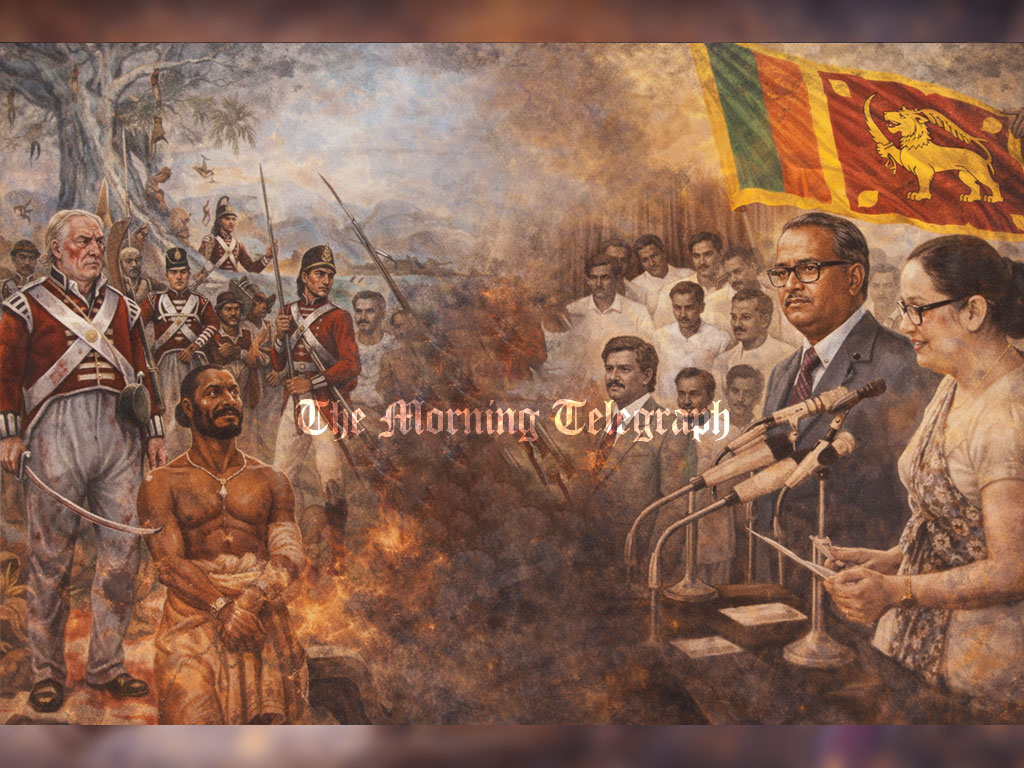
As Sri Lanka marks 78 years of independence, the journey from colonial subjugation to full sovereignty stands as a powerful story of resistance, reform, sacrifice, and constitutional transformation that shaped the nation we celebrate on February 4.
Today marks the 78th Independence Day of Sri Lanka. Since 1948, Sri Lankans have commemorated February 4 as the day the country formally broke away from British colonial rule. Yet the freedom celebrated today was not achieved overnight. It was the result of a long and complex struggle that unfolded over centuries, shaped by rebellion, reform, negotiation, and political awakening.
From the moment Sri Lanka became a full colony, resistance against foreign domination began to take root. Having endured over 130 years under colonial rule, the island passed through multiple stages of governance before achieving partial independence in 1948 and full independence decades later.

Becoming a British Colony
Three major milestones define Sri Lanka’s transformation into a British colony. In 1796, the British East India Company seized control of the island’s coastal regions from the Dutch. By 1802, these territories were transferred from company control to the British Crown. The final step came in 1815, when the Kandyan Kingdom fell under British authority through the Kandyan Treaty, bringing the entire island under British rule.
Following the capture of the coastal areas, British administrators from Madras were brought in to govern Sri Lanka between 1796 and 1798. During this period, heavy taxation was imposed to boost revenue. The exclusion of local officials from administration and the burden of excessive taxes triggered resentment among the people.
In 1797, a rebellion erupted in the coastal areas against the Madras officials and their harsh taxation policies. Although the uprising was suppressed, it led to the appointment of the Murren Commission, which recommended key reforms. These included replacing Madras officials with local administrators and abolishing unpopular taxes such as the coconut tree tax.
In 1798, Sri Lanka saw the appointment of its first British Governor, Frederick North. Between 1798 and 1802, a system of dual governance existed between the British East India Company and the British Crown. This arrangement ended in 1802, consolidating Crown control.
Throughout this period, the British strategically worked to subdue the Kandyan Kingdom. In 1803, Governor Frederick North led an invasion of Kandy, but the attempt failed. His successor, Governor Thomas Maitland, adopted a more diplomatic approach, maintaining relations with the Kandyan court through an envoy named John Doyle.
By exploiting internal dissent and dissatisfaction among Kandyan nobles toward King Sri Wickrama Rajasinghe, the British eventually succeeded. In January 1815, British forces launched another campaign, and on February 18, the Kandyan people surrendered the king and queen. The Kandyan Treaty was signed at the Magul Maduwa in Kandy on March 2, 1815, formally handing over sovereignty to the British Crown. The agreement was signed by Kandyan chiefs and Governor Robert Brownrigg.
The 1818 Rebellion
British rule was soon met with resistance. Just three years later, the Uva Wellassa rebellion broke out in 1818. The uprising was led by Doresamy, who claimed royal lineage, and supported by local leaders such as Kohukumbure Rala. Ironically, some Kandyan nobles initially sent by the British to suppress the rebellion defected and joined the resistance.
The British response was swift and brutal. The rebellion was crushed with overwhelming force, and by November 1818, key leaders including Doresamy and Maduwanwela were executed. The suppression left a deep scar on the Kandyan regions and marked one of the bloodiest chapters of colonial rule.
Colebrooke Reforms and the Rebellion of 1848
By the late 1820s, the cost of administering Sri Lanka exceeded the revenue it generated. In response, the British Secretary of State appointed the Colebrooke Commission in 1828 to recommend reforms. The resulting Colebrooke-Cameron reforms restructured governance by introducing legislative and executive councils and dividing the island into five provinces.
However, the reforms also paved the way for economic exploitation. The Lands Act of 1840 enabled the confiscation of vast tracts of uncultivated land. Later, Governor Lord Torrington introduced new taxes, including the body tax and dog tax, further burdening the population.
Public anger erupted once again in 1848, with resistance centered in Matale. Leaders such as Gongalegoda Banda and Weera Puran Appu emerged as symbols of defiance. Despite widespread support, the rebellion was swiftly suppressed by British forces.
Twentieth Century Reforms
As the twentieth century dawned, a new phase of resistance emerged, driven not by armed rebellion but by educated Sri Lankans advocating constitutional reform. Early leaders included Sir Ponnambalam Ramanathan and Sir Ponnambalam Arunachalam, who articulated demands for political representation and self-governance.
Sir James Peiris, a prominent middle-class reformer, sent a detailed memorandum to the Colonial Secretary outlining the need for constitutional change. These efforts resulted in the Crewe-Macallum reforms of 1910, which introduced limited representation through restricted suffrage. For the first time, an educated Sri Lankan, Ponnambalam Ramanathan, was appointed to the Legislative Council.
In 1919, the Ceylon National Association was formed, marking a milestone in the independence movement. Notably, it united representatives across ethnic lines. Its first president was Ponnambalam Arunachalam.
Further reforms in 1920 and 1924 gradually increased the number of unofficial Sri Lankan representatives. The most significant breakthrough came with the Donoughmore Constitutional Reforms of 1931. These reforms introduced universal adult suffrage and allowed Sri Lankans to elect their representatives through the ballot for the first time. It was a decisive step toward self-rule.
Soulbury System of Government and Independence
Although the Donoughmore system expanded local power, dissatisfaction grew over the executive committee structure. Calls intensified for a cabinet system and greater authority for Sri Lankan ministers. This led to the Soulbury Commission and the introduction of a new constitution.
The Soulbury Constitution established a parliamentary system with a House of Representatives and a Senate. In the 1947 general election, the United National Party emerged victorious, and its leader D. S. Senanayake became Sri Lanka’s first Prime Minister.
Even before the election, discussions with British authorities had confirmed that independence was imminent. After assuming office, Senanayake signed a security agreement with Britain, allowing British forces access to ports and airports if required.
The Ceylon Independence Act was passed by the British Parliament in November 1947 and came into effect on February 4, 1948. Sri Lanka gained independence, but it was Dominion status. The British monarch remained head of state, and Parliament faced limitations in lawmaking.
Full Independence and Becoming a Republic
Although the call for a new constitution had existed since the 1950s, it was not realized until 1972. The United Front government, elected in 1970 with a two-thirds majority, pledged to adopt a republican constitution.
Prime Minister Sirimavo Bandaranaike led the process that culminated in the First Republican Constitution on May 22, 1972. This constitution severed the final constitutional ties with the British Crown, abolished Dominion status, and declared Sri Lanka a republic.
With this step, Sri Lanka achieved full independence in both form and substance. The long struggle that began under colonial rule finally culminated in sovereignty defined by self-governance, constitutional authority, and national identity.
What We Celebrate on February 4
February 4 is more than a ceremonial anniversary. It represents generations of resistance, reform, and resilience. It marks the reclaiming of political authority and the enduring aspiration to shape Sri Lanka’s destiny as a free and independent republic.