Sri Lankan fishermen allege a violent attack inside national waters, prompting a formal protest from Colombo and intensifying a long-running maritime dispute with India.
The Sri Lankan government has formally protested an incident it describes as a brutal and unjustified assault on its fishermen by officers of the Indian Coast Guard, an episode that has once again exposed the fragile and often volatile nature of maritime relations in the northern Indian Ocean. The alleged attack, which Sri Lankan authorities say took place well within the country’s territorial waters, has left several fishermen injured and triggered public anger, political pressure, and renewed calls for accountability.

According to official accounts, twelve fishermen traveling on two multi-day fishing vessels from Wennappuwa and Vellamankarayya were attacked on January 29 as they were returning home after fishing in international waters. Fisheries Minister Ramalingam Chandrasekar confirmed that the Indian High Commission in Colombo had been informed of the incident and that Sri Lanka had lodged a strong diplomatic protest. The government, he said, rejected what it views as false allegations used to justify the violent interception.
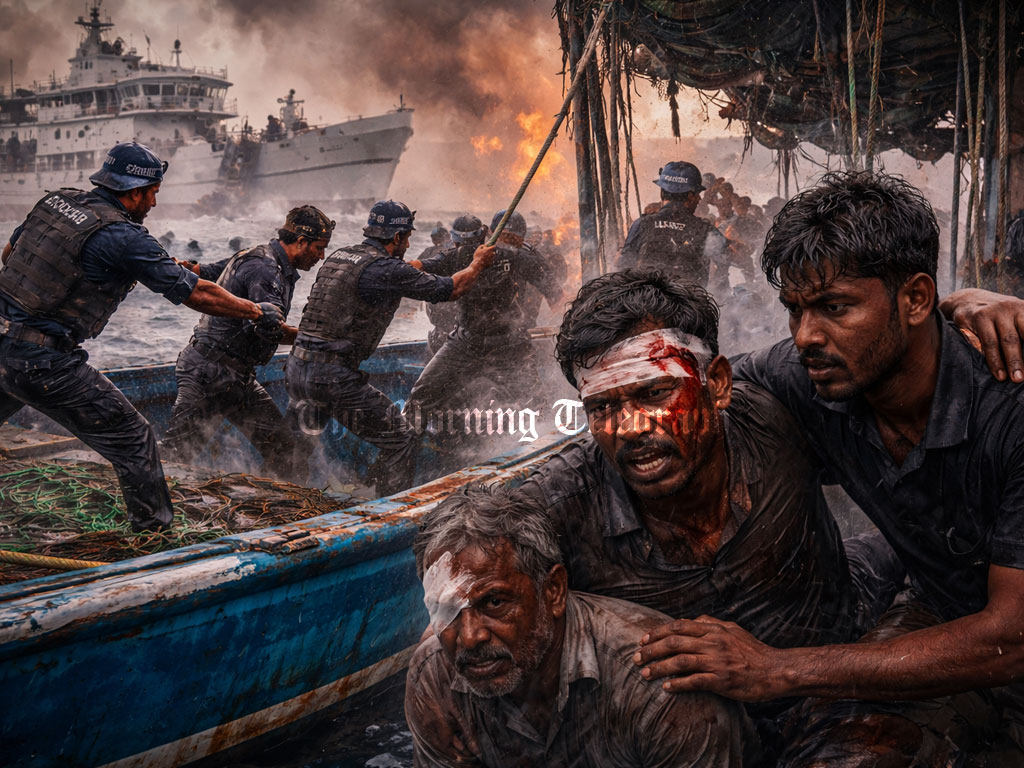
The Sri Lanka Navy later confirmed that four of the injured fishermen were admitted to the Karapitiya National Hospital in Galle for treatment. A naval vessel was dispatched to retrieve six other fishermen who were also attacked during the encounter. Navy Media Spokesperson Commander Buddhika Sampath said the injured men were receiving treatment for multiple blunt-force injuries, sustained during what the fishermen described as beatings involving sticks and kicks after Indian personnel boarded their boats.
The fishermen insist they were operating well within Sri Lankan waters when the Indian Coast Guard vessels intercepted them. They said they initially believed the approaching ships belonged to the Sri Lanka Navy and therefore stopped without resistance. What followed, according to their testimony, was a sudden and violent confrontation that has left them physically injured and psychologically shaken.
“I was taken inside the boat’s wheelhouse. Suddenly, someone grabbed me from behind and attacked me,” said Shewan Thiwanka, one of the injured fishermen, speaking from his hospital bed at Karapitiya National Hospital. His voice trembled as he described the moments after the boarding. He said several men speaking Indian languages came onto the vessel, along with one person who spoke Sinhala, before he was assaulted without warning.
Another fisherman being treated at the same hospital recounted a similar sequence of events. He said the group had set out to sea on December 23 and was returning home on January 20 when they were intercepted nine days later. “They searched us and checked the boat details,” he said. “They asked if we had seen an Iranian boat. They asked if there were drugs. They asked if we had a satellite phone. We said no to everything, but they didn’t accept it. Then they started attacking us. They beat us on the ground.”
The incident has provoked a furious reaction from industry representatives, who accuse both Indian and Sri Lankan authorities of failing to protect fishermen whose livelihoods depend entirely on access to the sea. Tyrone Mendis, president of the All Sri Lankan Multi-Day Fishing Vessel Owners Association, questioned how foreign personnel were able to cross into Sri Lankan waters and assault local fishermen without interception.
“What did the authorities do before they came inside Sri Lankan territory and attacked our people inhumanely?” Mendis asked. “Three vessels were attacked. Two of them were clearly in Sri Lankan waters. We need an immediate and proper investigation. This is not something that can be ignored.”
Mendis also criticized what he described as weak maritime surveillance and enforcement. He urged the government, the Navy, and the Fisheries Ministry to clarify whether any warnings were issued, whether radar systems or patrols detected the Indian vessels, and why fishermen continue to face such risks at sea despite repeated incidents over the years.
The Sri Lanka Navy responded cautiously to these criticisms, stating that it is practically impossible to monitor every point along the country’s extensive maritime boundaries at all times. Officials emphasized that while patrols are conducted regularly, the sea remains a vast and complex environment where incidents can unfold rapidly and without warning.
Hospital officials confirmed that the four fishermen currently being treated at the 58th Ward of the Karapitiya National Hospital range in age from 30 to 50 and are receiving care for blunt-force injuries. They were identified as Warnakulasuriya Suranga Nisal Peris, Shewan Thiwanka Mahewawa, Wanakulasuriya Suresh Fernando, and Habara Batuwatte Indika Madusankha Fernando, all residents of the Kudamaduwella and Thuduwawa areas.
Deputy Minister of Fisheries and Marine Resources Ratna Gamage visited the injured fishermen at the hospital and later addressed the media. He said the Sri Lanka Navy and the Ministry of Foreign Affairs had been instructed to immediately investigate the incident and establish whether the attackers were part of an official foreign operation or an unofficial group operating at sea.
“We have informed the Ministry of Foreign Affairs and the Navy to establish whether this was carried out by a foreign group, whether it was an official operation or not, and how such an incident could take place,” Gamage said. He added that Sri Lanka would pursue the matter diplomatically once the facts were fully established.
The incident unfolds against a long backdrop of friction between Sri Lankan and Indian fishermen and maritime authorities, particularly in contested or sensitive waters. Over the years, arrests, boat seizures, and occasional clashes have been reported, often linked to allegations of illegal fishing or accidental border crossings. However, Sri Lankan officials argue that this case stands apart due to the level of violence alleged and the claim that it occurred clearly within Sri Lankan territorial waters.
For fishing communities and their families, the episode has deepened a sense of vulnerability. Multi-day fishing voyages often last weeks and take crews far from shore, where they rely on mutual trust and the belief that maritime boundaries and human life will be respected by state authorities. The testimonies emerging from Karapitiya Hospital suggest that trust has been badly shaken.
As investigations begin, pressure is mounting on Colombo to secure clear answers from New Delhi and to ensure that similar incidents do not recur. For fishermen already struggling with rising fuel costs, declining catches, and unpredictable seas, the fear now is that the greatest danger may not come from the ocean itself, but from those tasked with policing it.