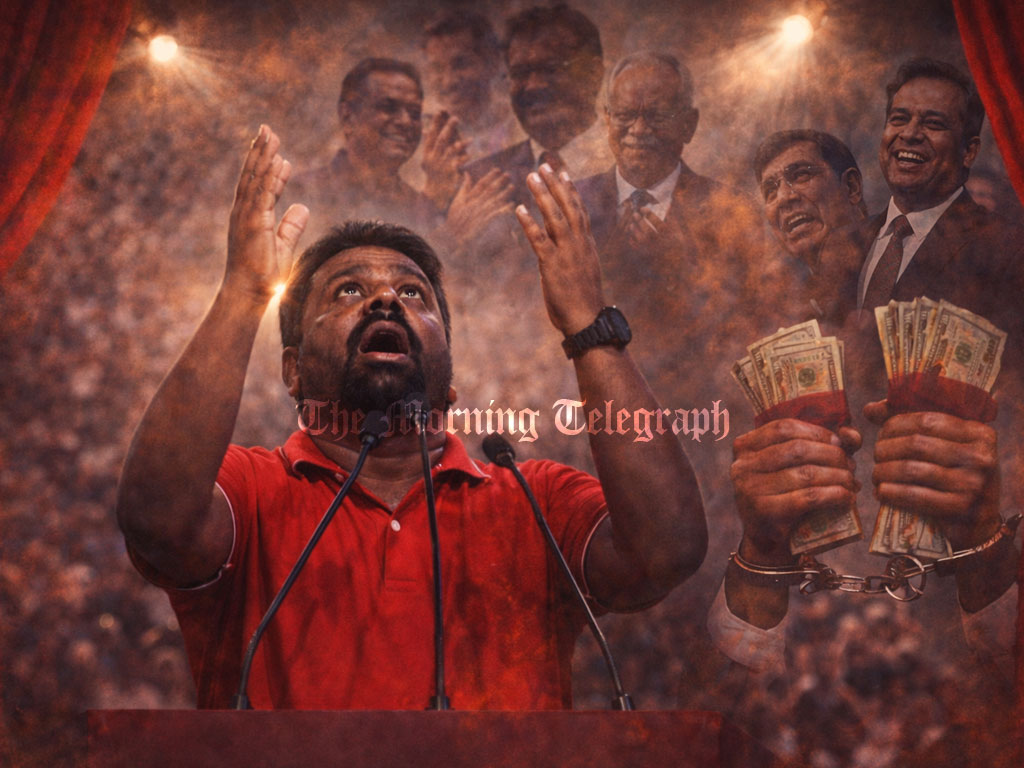
Bold speeches, louder slogans, and endless commissions have turned anti-corruption into political theatre, leaving Sri Lanka trapped in a cycle where reform is performed, not practiced, and accountability is promised but never delivered.
Though Sri Lanka boasts one of the highest literacy rates in South Asia and proudly displays it as proof of civilizational maturity in global development rankings, the country has repeatedly revealed a troubling indifference to dignity, accountability, and consequence. Literacy, it seems, has not shielded society from deception. Instead, it has trained the public to absorb political falsehoods with greater fluency and less resistance.

Time and again, Sri Lankans have shown a willingness, and sometimes an eagerness, to be misled by leaders who lie without hesitation, deceive without remorse, and treat dishonesty as a refined political skill. Every election cycle becomes a ritual of self-humiliation, where sincerity is punished and theatrical deceit is rewarded. Political accountability gives way to spectacle, and governance is reduced to performance.
As the country marks yet another Independence Day, Sri Lanka remains stuck in a grim farce. Power is held by a new generation of moral exhibitionists who speak endlessly of reform while fighting only for their own political survival. Unable to admit incompetence, they manufacture drama to conceal failure. Reform becomes rhetoric, and transparency becomes a slogan rather than a standard.
These are not leaders who make mistakes reluctantly. They err loudly and then declare error to be courage. One publicly attacks Buddhist clergy with language so crude that it would be unacceptable in any civil setting, then celebrates the act as revolutionary honesty. Another delivers endless lectures on social reform and progressive education, invoking imported academic jargon about inclusion and pedagogy, while overseeing school textbooks so poorly designed that they expose children to inappropriate online content. Responsibility is brushed aside with ideological arrogance. A third figure dominates Parliament with hours of hollow speeches whenever public outrage threatens to harden into consequence, flooding debate with noise so allies can retreat, regroup, and return with revised narratives. This pattern is deliberate. It is method, not accident.
What binds these figures together is not vision, but fear. They cannot acknowledge the absence of competence, foresight, or administrative capacity. Such honesty would require humility, and humility is fatal in a political culture addicted to bravado. Instead, every failure is rebranded as resistance, every criticism dismissed as conspiracy, and every call for accountability recast as sabotage. Anti-corruption thus becomes a performance rather than a principle, a pose rather than a practice. In Sri Lanka, anti-corruption has evolved into a refined art form of corruption itself.
This cycle did not begin recently. The first betrayal occurred in 1948, when independence was mistaken for liberation. The colonial administrative machinery remained largely intact, merely staffed by local elites fluent in reformist language but resistant to structural change or economic justice. Independence arrived without introspection. There was no serious effort to dismantle inherited hierarchies, redesign economic systems, or build inclusive national institutions. The flag changed. The system did not. What was celebrated as freedom was, in reality, continuity disguised as transformation.
By 1956, politics had discovered the intoxicating power of slogans. Language was weaponised, identity simplified, and grievance monetised at the ballot box. “Sinhala Only” was sold as cultural revival but functioned as electoral arithmetic framed as historical justice. The applause it generated marked not empowerment, but a nation consenting to its own division. From that point onward, populism became Sri Lanka’s dominant political language, prioritising emotional mobilisation over institutional thinking. Alienation, conflict, and eventually civil war followed, not as accidents, but as logical outcomes.
The 1970s brought another illusion, the belief that ideology could replace competence. Socialist rhetoric promised equality and people’s power, yet delivered scarcity, unemployment, and repression. Educated youth discovered that qualifications did not guarantee dignity, and protest did not produce progress. The state responded with force rather than reform. The lesson absorbed by the political class was not that governance requires pragmatism, but that slogans could pacify the public until coercion became necessary.
Economic liberalisation in 1977 replaced socialist idealism with market fundamentalism, wrapped in moral language about righteousness and growth. Development arrived unevenly, while corruption became more creative and entrenched. The Executive Presidency concentrated power without safeguards. Economic reform proceeded without judicial independence or strong regulation. The outcome was not shared prosperity but institutionalised predation. When violence erupted, most notably in 1983, the response was denial rather than accountability, reinforcing a culture where power insulated itself from consequence.
The end of the civil war in 2009 should have been a moment of reckoning. Instead, victory hardened into permanent propaganda. National security replaced governance. Militarisation seeped into civilian life. Debt-funded vanity projects were justified as development, while dissent was branded as betrayal. Reconciliation was postponed indefinitely. The war ended, but authoritarian habits endured.
The promise of good governance in 2015 proved to be the most sophisticated deception of all. It mimicked the language of reform while hollowing out its substance. Commissions multiplied, speeches improved, and words like transparency and accountability were carefully pronounced for international audiences. Yet corruption merely adapted, becoming more technical, more legalistic, and more insulated. The Central Bank bond scandal was not an exception. It was a diagnostic moment, exposing a political class convinced that ethical language could substitute for ethical conduct.
The economic collapse of 2022 should have destroyed the credibility of slogans forever. Instead, it birthed a new one, system change. Once again, rejection was mistaken for construction. Anti-corruption rhetoric returned with evangelical intensity, wielded as moral absolutism. Institutions remained unchanged, personnel recycled, and habits preserved. Coal tenders shrouded in opacity, delayed laboratory reports, procurement controversies buried under procedure. Parliamentary leadership descended into farce, while transparency systems in critical sectors were dismantled quietly through administrative sabotage. These were not isolated failures. They reflected a governing culture that fears transparency because transparency exposes emptiness.
Sri Lanka’s deepest tragedy is not merely corrupt politicians, but a corrupted political imagination. The country confuses literacy with wisdom, eloquence with intelligence, outrage with ethics. It rewards confidence over competence and noise over nuance. Those who shout anti-corruption the loudest are granted moral immunity, even as they reproduce the same patronage networks. Anti-corruption has become a performative industry, selectively enforced, strategically deployed, and theatrically invoked to punish enemies and protect allies.
Every Independence Day arrives with ritual and amnesia. Flags rise, anthems play, speeches echo. Yet the state continues to operate as a marketplace of impunity. Independence, stripped of institutional courage and ethical consequence, has become repetition without learning. Sri Lanka has not only been betrayed by its leaders. It has betrayed itself by choosing slogans over systems, charisma over competence, and spectacle over the patient work of institution-building. Until this addiction to performance is confronted with intellectual honesty and structural reform, anti-corruption will remain the country’s most elegant and destructive illusion.
SOURCE :- SRI LANKA GUARDIAN