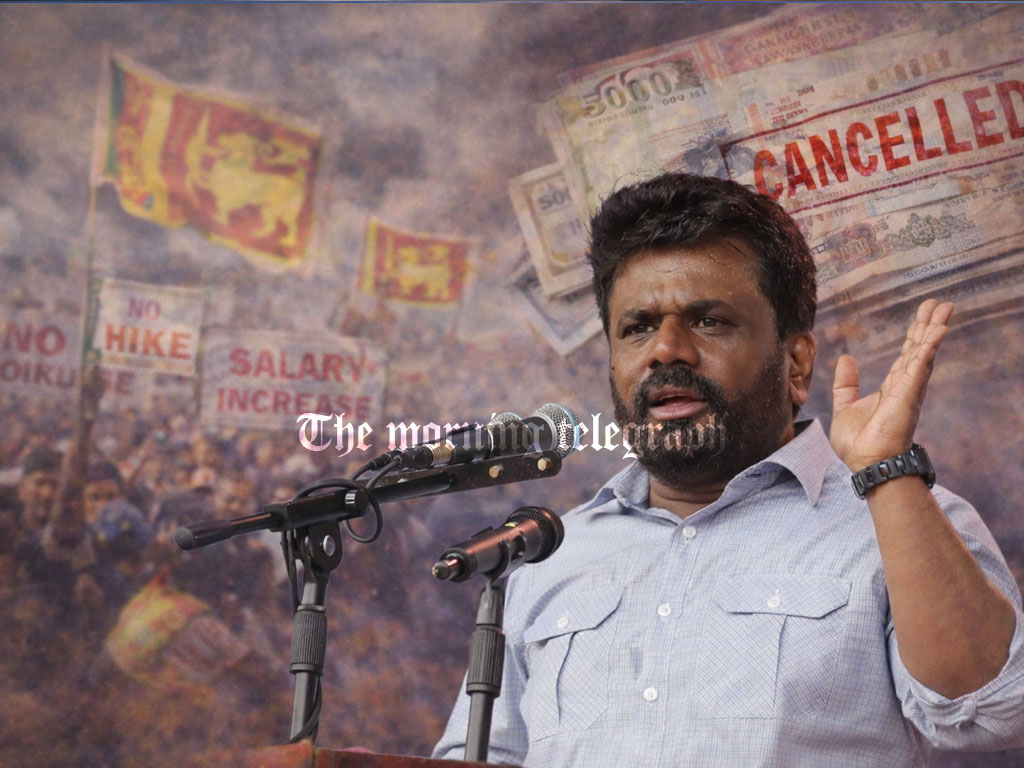
President Anura Kumara Dissanayake draws a firm line on wages, warning that no protests or pressure will force allowance hikes before the final salary increase scheduled for 2027.
President Anura Kumara Dissanayake has made it clear that no salary or allowance increases will be granted this year, regardless of protests or public pressure, insisting that the government will stick to its planned wage policy until the final phase of public sector salary revisions is completed in 2027.

Speaking in Kandy yesterday, the President said that until the third and final salary increment is implemented in 2027, no additional allowances will be increased under any circumstances. He stressed that demonstrations, strikes, or street protests would not alter this position.
The President was addressing a public program held yesterday morning at the Central Provincial Council Auditorium, organized to distribute compensation to individuals and industrialists whose homes and properties were fully or partially damaged by Cyclone Ditva. The event was held under his patronage and attended by public officials and beneficiaries from affected areas.
During his address, President Dissanayake explained that the government has already committed an enormous financial allocation toward public sector salary increases across a three year period. He stated that in 2025 alone, Rs. 11,000 crore has been spent on increasing basic salaries of public servants. A further Rs. 11,000 crore will be spent in 2026, with another Rs. 11,000 crore planned for 2027. By the end of that cycle, the total expenditure on public sector salary increases will reach Rs. 33,000 crore.
Referring to fresh demands for higher allowances, the President was firm. “Now that such a salary increase has been made, I see some people asking to increase this allowance again, to increase that allowance. It will not happen. First, we will think about the other allowances after the third salary increase in 2027 and the impact on our budget,” he said.
The President also reflected on the country’s ongoing economic difficulties, pointing out that Sri Lanka is still dealing with the aftershocks of a major economic collapse. He attributed the crisis to years of poor economic planning, short term political decision making, bribery, and corruption. According to him, the damage caused by these failures has not yet fully subsided.
He revealed that he recently requested a report to assess the cost of restarting major development projects that were halted during the economic collapse. Out of 43 major projects reviewed, 20 were closely examined. If those projects had been completed in 2022 or 2023, they would have cost approximately Rs. 300 billion. Today, restarting them would require around Rs. 610 billion, more than double the original estimate.
Despite these challenges, President Dissanayake said the government is focused on ensuring that economic recovery benefits ordinary citizens rather than a privileged few. He said past economic gains had been concentrated around a small group of families and individuals linked to corruption, a pattern his administration is determined to end.
“We do not want to pocket a single penny of the public’s money,” he said, adding that the government’s priority is to distribute economic benefits to people at the bottom of the economic ladder. He highlighted ongoing relief efforts for those affected by Cyclone Ditva, including housing reconstruction, road development, and infrastructure restoration, with support from friendly nations such as India and China, as well as private sector partners.
The President concluded by emphasizing that economic development must go hand in hand with the rule of law. He acknowledged serious institutional weaknesses within the judiciary, law enforcement bodies, and investigative agencies but said reforms are underway. Measures have already been approved to strengthen the Commission to Investigate Allegations of Bribery or Corruption, including better pay structures and direct recruitment of officers, as part of a broader effort to restore public trust and accountability.