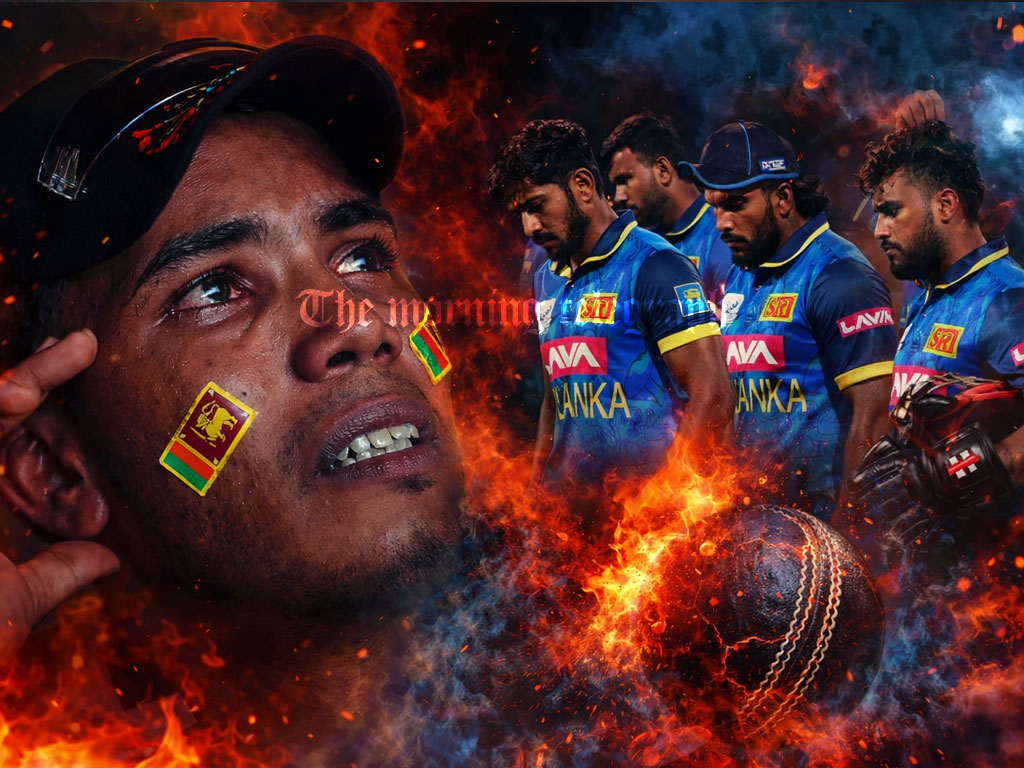
A painful England series has exposed deep frustrations among Sri Lankan cricket fans, with questions over selection, leadership, mindset, and readiness ahead of the T20 World Cup now dominating public debate.
Sri Lanka’s national cricket team is facing an intense backlash from its own supporters following a disappointing performance during the recently concluded England tour, which many fans had viewed as the final and most crucial preparation ahead of the upcoming ICC T20 World Cup.

The strongest criticism has emerged after Sri Lanka lost all three T20 matches against England at the Pallekele Stadium in Kandy. While England dominated the series on paper, many supporters believe the margin of defeat, especially in the final match, reflected poor application rather than a lack of talent.
In the deciding T20, Sri Lanka was set a modest target of 128 runs. What should have been a routine chase quickly unraveled as careless shot selection and a lack of composure saw the team bowled out for just 116. Six Sri Lankan batsmen failed to reach double figures, a statistic that has since become a rallying point for fan anger.
Captain Dasun Shanaka’s batting and leadership were singled out for particularly harsh criticism, with many questioning whether the team’s on-field direction matched the importance of the occasion.
Growing anger among supporters
The England tour carried added significance as it marked Sri Lanka’s final international assignment before the T20 World Cup, scheduled to begin on February 7. Expectations were therefore high that the squad would use the series to sharpen tactics, settle combinations, and build confidence.
Instead, Sri Lanka managed to win just one ODI across six matches, losing all three T20Is and failing to show consistency even in the longer format. The T20 losses at Pallekele, played on home soil, intensified the disappointment.
Videos circulating on social media showed visibly angry spectators protesting outside the stadium. Some fans said they had traveled long distances from places such as Vavuniya and Polonnaruwa, only to witness what they described as careless and uninspired cricket.
Others questioned the commitment of certain players, arguing that if individuals cannot perform under pressure, they should be replaced with younger or hungrier options. A more extreme section of supporters even suggested boycotting stadium attendance during Sri Lanka’s World Cup matches as a form of protest.
A harsh reality in the numbers
The criticism is not limited to one series. Sri Lanka’s recent T20 record has been troubling, and fans have been quick to point out that the England tour merely confirmed a longer-term decline.
Sri Lanka exited the 2024 T20 World Cup in the first round, losing two of their three group matches and seeing another abandoned due to rain. Since that tournament, Sri Lanka has played 34 T20 internationals over the past two years, winning only 13.
During the same period, the team has participated in 12 T20 tournaments, including the Asia Cup and a tri-nation tournament in Pakistan, but has lifted the trophy only twice, against West Indies and Zimbabwe. For a nation with Sri Lanka’s cricketing history, these figures have fueled concerns about competitiveness at the highest level.
Expert view urges perspective
Responding to the public outcry, veteran international cricket commentator Roshan Abeysinghe offered a more measured assessment. He argued that while the criticism is understandable, dwelling on the England tour now serves little purpose.
“Whatever we talk about the England tour, there is no point now. Everyone in this team knows their shortcomings,” he said.
Abeysinghe identified Sri Lanka’s biggest weakness as their struggle against spin bowling, a flaw that England exploited repeatedly. He noted that even the captain has publicly acknowledged this issue.
“Even if we stand here and shout with our heads, there is nothing we can do about it now,” he added, emphasizing that solutions must come from preparation rather than public anger.
World Cup focus must begin immediately
Looking ahead, Abeysinghe stressed that Sri Lanka must mentally reset before the World Cup. According to him, the team cannot afford to carry the psychological baggage of the England losses into a global tournament.
“I think we need to put our heads together, forget about the loss to England and focus on the World Cup. That is our hope as Sri Lankans,” he said.
He highlighted the importance of mental strength, urging players and coaches to address weaknesses quickly and decisively. Sri Lanka’s opening World Cup matches against Ireland and Oman were described as crucial confidence-builders.
“We need to win those matches well, not just by winning,” Abeysinghe said, explaining that convincing victories are essential to build belief before facing stronger opponents such as Australia.
Selection decisions under scrutiny
Beyond performances on the field, the selection committee has also come under heavy criticism. One of the most debated decisions involved giving Dhananjaya de Silva an opportunity at the expense of Kamindu Mendis as the World Cup approached.
Many fans questioned the timing of the change, arguing that it disrupted team balance. When asked about this, Abeysinghe suggested the selectors had a clear rationale.
“Whether our fans like it or not, the selection committee expected something from Dhananjaya,” he explained. Dhananjaya’s ability to bowl, combined with the hope that he could anchor the innings, likely influenced the decision.
However, Abeysinghe acknowledged that the England tour showed those expectations were not met, prompting a quick correction.
“The selection committee must have realized that Kamindu can do more than that. I am glad the problem was resolved quickly,” he said, adding that prolonged uncertainty could have harmed Dhananjaya mentally. He also reminded fans that Dhananjaya remains a quality Test player with proven credentials.
Experience versus opportunity
Kusal Janith Perera’s role has also sparked debate. As the most experienced player in the World Cup squad, many fans expected him to feature during the England tour, yet he did not get a game.
Abeysinghe was clear in his assessment. “If Kusal Janith Perera is in the squad, he must play,” he said. At nearly 35, Kusal brings experience that could prove vital in high-pressure matches.
He noted that the England tour would have been an ideal opportunity to assess Kusal’s form and readiness, suggesting that the absence left unanswered questions ahead of the World Cup.
Young talent and future promise
On opening batsman Kamil Mishara, Abeysinghe struck a more optimistic tone. He acknowledged that Mishara has shown promise but needs refinement.
“He can bat well and fast. If he improves a little more, it will be good for him and the team,” he said, predicting a positive future if development continues.
The discussion also turned to the balance of the side, particularly the number eight position. Asked whether Mahish Theekshana or Dunith Wellalage should fill that role, Abeysinghe said the answer depends on conditions and opposition.
“The team is selected based on the pitch and the opponent,” he explained, adding that having versatile players like Theekshana and Wellalage gives Sri Lanka flexibility. Both, he said, are capable of contributing with bat and ball when required.
A moment of truth for Sri Lankan cricket
The backlash following the England tour reflects more than frustration over a single series. It highlights a deeper anxiety among fans about Sri Lanka’s direction in T20 cricket and its ability to compete with the world’s best.
While emotions are running high, experts stress that constructive preparation, clear selection policies, and mental resilience will matter far more than protests or social media outrage. With the World Cup just days away, Sri Lanka stands at a crossroads.
The coming matches will determine whether the team can transform criticism into motivation or whether fan anger will deepen into long-term disillusionment.