There are moments when a democracy does not collapse loudly, but quietly lowers its standards.
When power moves faster than conscience, and cruelty begins to pass as strength.
This is not a political argument. It is a human observation of what is becoming normal.
By Roshan Jayasinghe
I have been watching what is happening in America, and I am trying to remain honest with myself about what I am actually seeing.
Not what I am encouraged to defend.
Not what I am expected to celebrate.
Not which side I am meant to belong to.

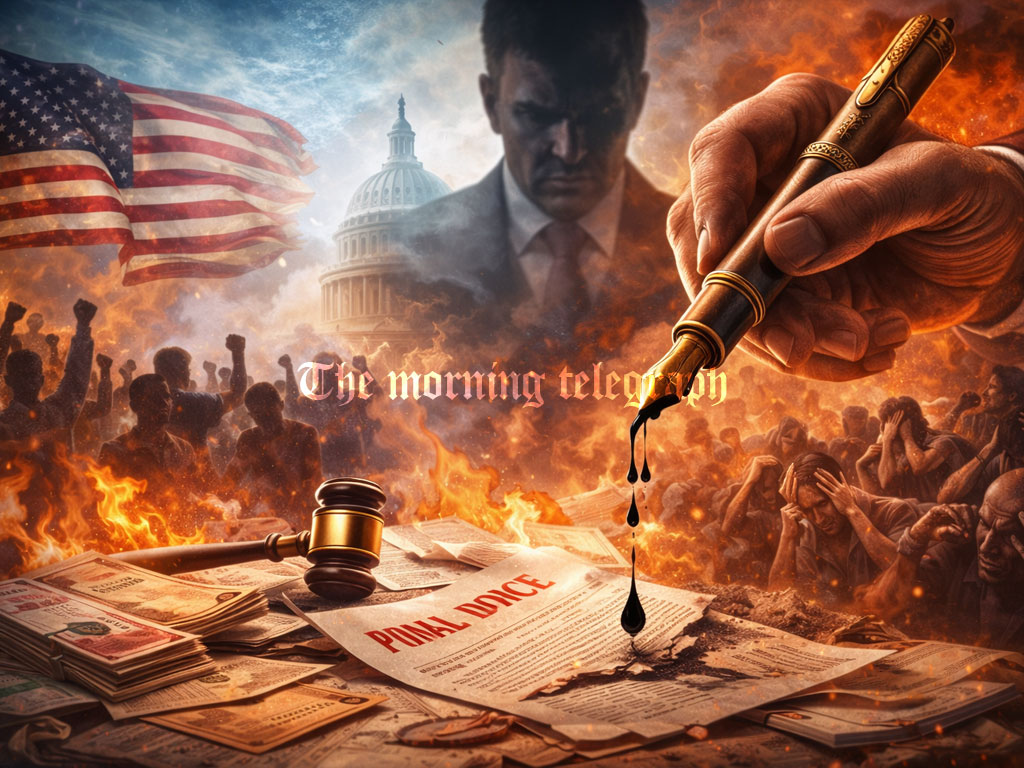
What I see is one man using the power of the pen at a speed and scale that directly alters the lives of human beings. Not in theory. Not in policy language. In lived reality.
What troubles me is not only what is being written into action, but what is being silently expected of the people in return. The expectation no longer feels rooted in human dignity. It feels rooted in alignment with power. Alignment with wealth. Alignment with dominance.
It feels as though democratic process is being replaced by loyalty.
And once loyalty becomes more important than conscience, something essential has already shifted.
The pen was never meant to serve ideology. It was meant to serve people. All people. Citizens, yes, but also human beings sharing one planet. What I am witnessing instead is the pen being used to reward alignment and punish difference.
If you align, you are protected.
If you do not align, you are exposed.
That is not governance grounded in humanity. That is authority grounded in control.
What makes this possible is not only the individual holding the pen. It is the condition of the society receiving it.
People are exhausted. Tired of complexity. Tired of systems that feel slow. Tired of feeling unheard. A misaligned leader does not create this exhaustion. He exploits it.
When people are exhausted, they stop asking whether something is right and start asking whether it feels decisive. This is how misuse of power becomes acceptable. Not because people fully agree, but because they no longer have the energy to resist.
Exhaustion is not consent. But it functions like it.
Another thing I notice is that we are no longer standing on shared ground when it comes to truth. Facts are filtered through loyalty. Evidence is treated as opinion. Reality itself has become divided.
When truth fractures, power no longer needs to justify itself. It only needs to repeat itself. The pen becomes effective not because it is right, but because there is no longer agreement on what right even means.
This is a dangerous condition for any democracy.
Something else has shifted quietly. Citizenship no longer feels like shared belonging. It feels conditional. You are protected if you align. You are suspect if you question. You are disposable if you resist.
This is where the pen stops serving all people and starts serving a chosen identity. Not Americans as human beings, but Americans as loyal subjects to a worldview.
At that point, democracy becomes performance rather than principle.
What has disturbed me deeply is not only the policies or the orders, but the tone that is being modeled. Cruelty is no longer treated as a failure of character. It has become a communication style.
Mockery replaces argument.
Humiliation replaces leadership.
Racism is passed off as boldness.
When a sitting president mocks a former president and his wife in a racist and degrading way on social media, it is not humor. It is not strength. It is not leadership.
It is cruelty.
Even a child understands this. A child knows that mocking others is not courage. A child knows that humiliation is not authority. Yet this behavior is defended, repeated, and normalized.
This is how harm begins. Not only through laws, but through permission.
Permission to ridicule.
Permission to dehumanize.
Permission to divide people into worthy and unworthy.
Once permission is granted, the next step always becomes easier.
Legality is often used to excuse this. It is legal. It is allowed. It is within authority. But legality has never been the same as morality. History has made that clear many times.
Some of the greatest human harm was legal.
The pen is most dangerous when it hides behind law while abandoning conscience.
There is also something larger being forgotten. Leadership today carries planetary responsibility. What is written in one country ripples across borders, economies, environments, and human lives.
The pen was never meant to serve one ideology, one nation’s grievances, or one man’s anger. A leader who governs from vengeance and self interest is not only misaligned nationally. He is misaligned globally.
What concerns me most is not only that a corrupt and deceitful leader is taking advantage of this moment.
It is that we are being trained to forget what good leadership looks like.
Calm.
Restraint.
Dignity.
Care.
Humility.
Once those are forgotten, misuse of power no longer shocks us. It simply confirms what we have lowered ourselves to expect.
That is how corruption becomes normal without ever announcing itself.
I am not writing this from hatred. Hatred narrows the mind. Hatred is also part of what is being cultivated in this moment.
I am writing this to stay sane. To stay clear. To not look back later and pretend I did not see what was happening while it was happening.
A democracy is not only a structure. It is a standard of behavior. It is a shared agreement that even when we disagree, we do not abandon our humanity.
When leadership models division and cruelty, and when people accept it, that agreement begins to fracture.
This is not only about policy.
It is about what kind of human behavior is being rewarded.
It is about what kind of world we are quietly agreeing to live in.
Author’s note
I write this as a human being observing power in motion and trying to remain honest with myself.
These reflections are not meant to instruct or accuse. They are offered to be shared, questioned, and tested against your own sense of truth. If this aligns with your understanding, I invite you to carry the conversation into your own communities. If it does not, I am open to hearing where your view differs.
Clarity is not something we impose on one another. It is something we arrive at through honest seeing.
For now, this is simply what I see.
About the Author
Roshan Jayasinghe is a writer and observer of human systems. His work explores the gap between man made constructs and lived humanity, with a focus on how economics, trade and everyday choices intersect with questions of fairness, responsibility and inner alignment. Through essays for publications in The Morning Telegraph, he aims to remind readers that they are not passengers in a fixed machine, but active custodians of a shared world.