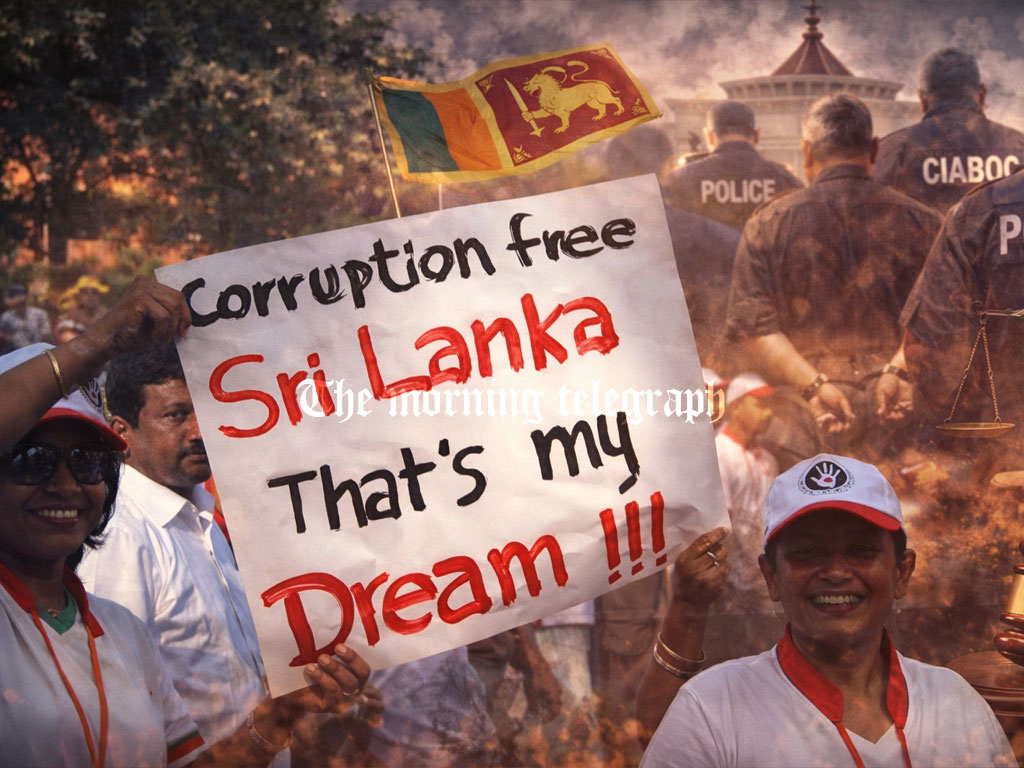
Thousands of complaints, stalled prosecutions, and headline-making arrests reveal how Sri Lanka’s anti-corruption push is colliding with institutional weakness, political inertia, and a justice system struggling to keep pace.
Sri Lanka’s fight against corruption has returned to the spotlight following the release of the 2025 Progress Report of the Commission to Investigate Allegations of Bribery or Corruption, a document that paints a troubling picture of ambition outpacing execution. While authorities continue to speak of a shift toward proactive enforcement, the report exposes widespread procedural failures across State institutions and underscores how deeply corruption is embedded within the public sector.

Covering the period from 1 January to 31 December 2025, the report coincides with major investigations into the Department of Motor Traffic and the Department for Registration of Persons. Together, these cases have come to symbolise a broader pattern, where corruption is not confined to isolated individuals but appears systemic, normalised, and resistant to reform.
According to the findings, the commission received 8,409 complaints during 2025, reflecting the scale of public frustration and grievance. Yet 3,660 of those complaints were not pursued, either due to insufficient evidence or because they fell outside the commission’s legal mandate. This gap highlights a structural weakness in a complaints-driven enforcement model, where volume does not necessarily translate into accountability. During the same year, CIABOC carried out 130 raids. Of these, only 68 were deemed effective, while 57 produced no substantial results and six were postponed. These operations led to the arrest of 84 suspects, a figure that appears significant but modest when set against the number of complaints received.
The challenge becomes sharper when measured against judicial outcomes. Despite the scale of investigations, the conversion of complaints into prosecutions remains limited. In 2025, the commission filed 115 new cases, including 75 bribery cases, 21 corruption cases, 14 cases related to unexplained wealth, and five cases under money laundering provisions. Although the inclusion of money laundering reflects the expanded mandate under the Anti-Corruption Act No. 9 of 2023, the court system remains heavily congested. By year’s end, only 42 convictions had been secured, while 288 cases were pending before the High Courts. In total, 305 cases were stalled across all courts, reinforcing concerns about delay and deterrence.
These findings echo long-standing warnings from Transparency International Sri Lanka, which has repeatedly argued that legal reform without political will and enforcement capacity delivers limited results. The organisation has pointed to persistent gaps in tracking illicit funds and criticised the absence of a centralised beneficial ownership registry, a weakness that hampers efforts to trace money laundering and verify asset declarations. It has also cautioned that digitisation initiatives, often promoted as clean governance solutions, can themselves become avenues for abuse if procurement systems and oversight mechanisms remain weak.
Sri Lanka’s stagnant performance on the global Corruption Perceptions Index reflects these structural concerns. Watchdogs argue that the persistence of impunity continues to erode public trust, even as arrests increase. The CIABOC report shows how corruption cuts across institutions. The Sri Lanka Police recorded the highest number of arrests, with 30 officers taken into custody, including senior ranks such as Chief Inspectors and Inspectors. Local government bodies were also implicated, with several pradeshiya sabha chairpersons arrested, while the judiciary and revenue sectors saw cases involving court officials and a senior Inland Revenue officer.
The arrest logs for 2025 include several politically exposed individuals, signalling that investigations have reached higher levels of power. Former ministers, state ministers, ex-parliamentarians, and senior figures from State-owned enterprises, including SriLankan Airlines and the Ceylon Petroleum Corporation, were implicated. In some instances, investigations extended to family members, highlighting how kinship networks can be used to conceal illicit gains.
One of the most significant cases involved the Department of Motor Traffic, following a raid at its Werahera branch in May 2025 that uncovered Rs. 4.1 million in cash allegedly intended for internal distribution. The operation led to the arrest of the former Commissioner General and several senior officials, with wider investigations continuing under the Anti-Corruption Act.
Parallel concerns have emerged at the Department for Registration of Persons at the Suhurupaya complex, where allegations of attendance fraud and overtime irregularities surfaced through media reporting. While no formal complaint has yet been lodged, authorities have indicated that a proactive investigation may follow.
Against this backdrop, CIABOC leadership has spoken of strategic transformation under the National Anti-Corruption Action Plan for 2025–2029, shifting toward prevention, institutional strengthening, education, and enforcement. Yet the 2025 report makes one reality clear. Bridging the gap between law and lived experience remains Sri Lanka’s most difficult and defining anti-corruption challenge.