By Jonathan Ferreira
A global enforcement showdown unfolds on the high seas as the US military intercepts a defiant oil tanker that crossed oceans to evade sanctions, highlighting far-reaching power and pressure over Venezuelan oil exports.
The United States military has boarded and inspected an oil tanker in the Indian Ocean after tracking the vessel for thousands of miles from the Caribbean, according to the Department of Defense.
US officials said the ship, named Aquila II, had been operating in defiance of a US imposed quarantine on sanctioned vessels in the Caribbean region. The department said the tanker attempted to evade enforcement but was continuously monitored as it travelled across multiple oceans.

In a statement shared on social media, the Department of Defense said the vessel fled initial monitoring efforts but was pursued without interruption. Officials added that US forces would enforce sanctions by land, air, or sea and would act regardless of distance.
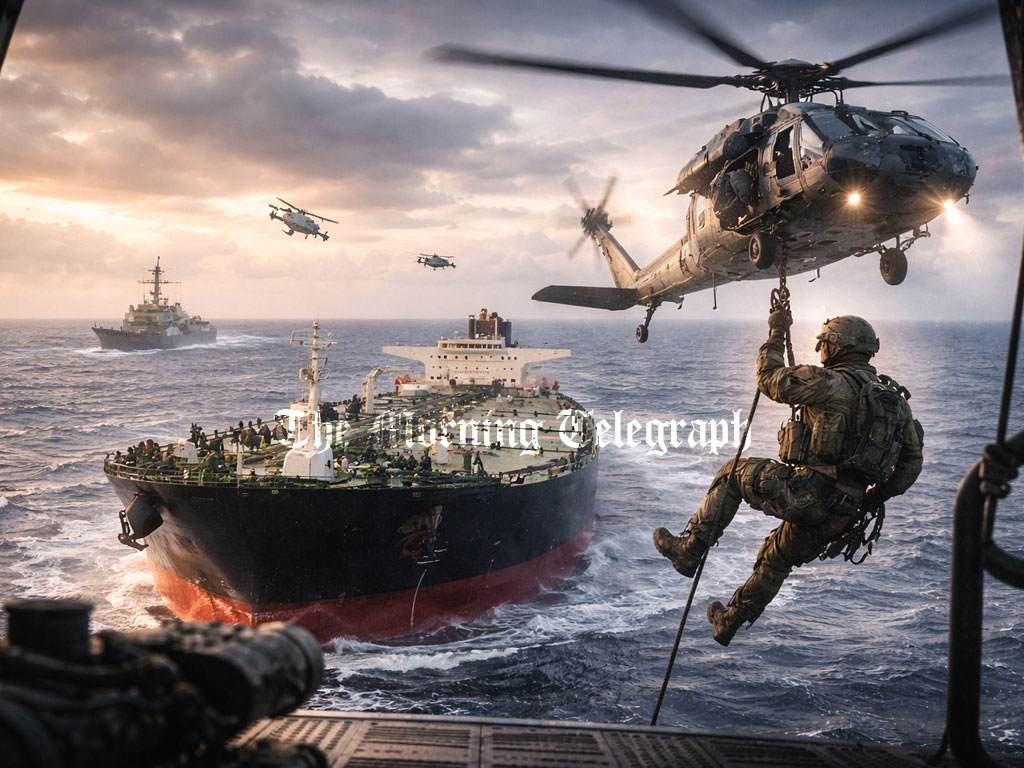
Military personnel later boarded the tanker and carried out an inspection. Video released by the department showed servicemembers descending from a helicopter onto the deck of the ship while it was at sea.
US authorities say the operation is part of a broader effort to restrict the flow of Venezuelan oil, which remains the country’s primary economic resource. At least seven oil tankers have been seized by the United States since last year as enforcement efforts have intensified.
The Trump administration has taken a hard line on Venezuelan oil shipments, including a blockade designed to limit exports. The US military previously carried out a raid in Caracas in December during which Venezuelan President Nicolas Maduro was seized from his residence.
The Department of Defense said the Aquila II was tracked from the Caribbean all the way to the Indian Ocean, demonstrating what it described as global enforcement capability. Officials said no location was beyond reach when it came to enforcing sanctions.
The blockade has significantly reduced Venezuelan oil exports. Analysts say shipments dropped sharply in January, with exports falling to about four hundred thousand barrels per day, roughly half of previous levels. Only vessels linked to Chevron and destined for the United States are currently allowed to operate without interference.