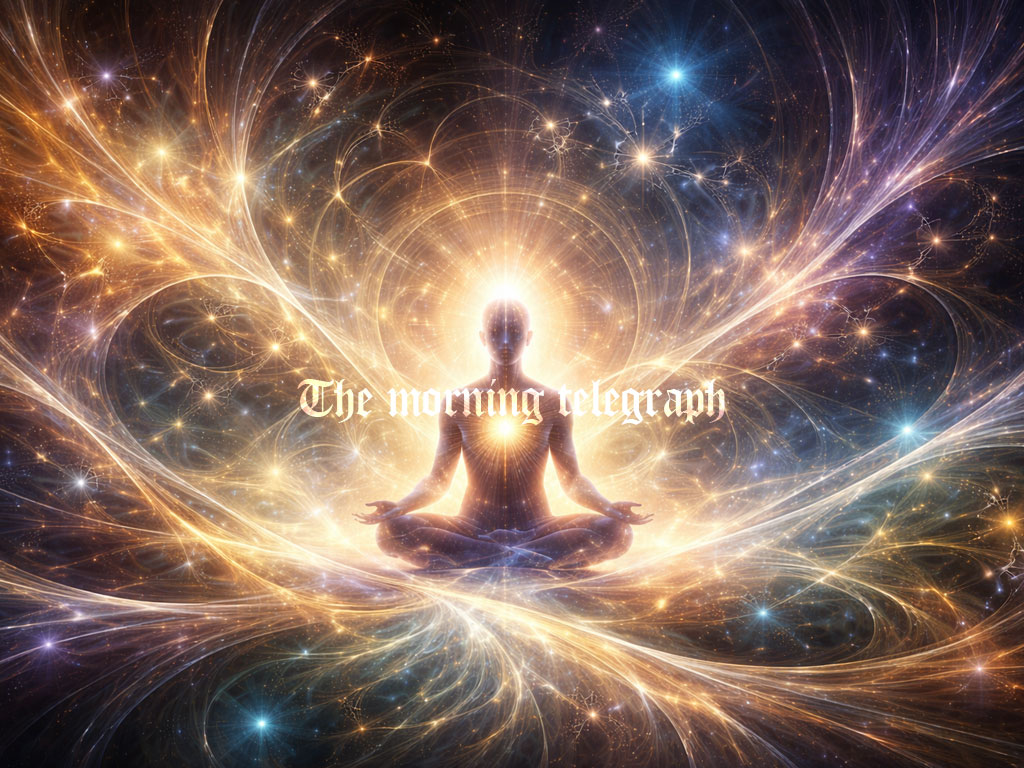
Before the mind speaks, something in you is already aware. This reflection returns to that place.
By: Roshan Jayasinghe
A thought came to me quietly as I sat with myself. It was not complicated. It did not feel philosophical. It was simple.
Maybe what we call spirituality did not begin in thinking. Maybe it began in feeling.
The more I stayed with that, the more something settled in me.
We often speak about spirituality as if it were something humanity developed once language matured and culture evolved. As if goodness, compassion and awareness were ideas built by intellect.
But when I look honestly at my own experience, it does not feel that way.
Thought clearly has its role. It helps me plan, protect, respond and navigate the physical world. It organizes life. It is useful.
But kindness does not feel invented by thought. Compassion does not feel calculated. The quiet sense of what is true does not feel intellectual.
Before I could explain goodness, I could feel it.
Before I could describe compassion, I could experience it.
Language came later to describe what was already alive.
When I observe closely, I see the same pattern everywhere.
A mother holding her child is not thinking compassion into existence.
When I feel moved by someone’s pain, I am not running logic.
When I stand before a sunset and feel awe, I am not reasoning my way into beauty.
I feel first.
Then thought arrives and interprets.
This is love.
This matters.
The feeling comes before the explanation.
I also see how much of my understanding depends on contrast.
I recognize light because I have known darkness.
I understand kindness because harm exists.
I appreciate beauty because harshness exists.
Contrast allows recognition.
As this reflection deepened, the thought grounded itself in something I live every day.
I live inside complex design every day.
I drive a car without understanding every system beneath the dashboard. I ride a motorcycle without knowing every engineering detail that shaped it. I sit in an airplane without grasping the mathematics that keep it in the sky.
Yet I trust the design.
I participate in systems I did not create. I do not own their blueprint, yet I live comfortably within their intelligence.
When I apply that to being human, something becomes clear.
My consciousness feels like a design too. Emotional, sensory, responsive. Thought is part of it. Feeling is part of it. Awareness is part of it.
This does not mean life happens to me and I simply watch. I still have responsibility. I still have choice. I can strengthen my body, sharpen my mind, and change how I respond. Awareness does not remove effort. It gives effort direction.
I did not create the system.
I am within it.
And then the question surfaces naturally.
Who am I?
Am I the thoughts that pass through me, or the one aware of them?
To make it real, I began watching ordinary moments.
A thought appears and says I am not doing enough.
Another says I should have handled something differently.
Another predicts failure.
They feel convincing.
But there is something steadier than the thought itself.
The fact that I can notice it.
The thought moves. The awareness of the thought remains.
The same happens with emotion.
Fear rises in the chest.
Grief tightens the throat.
Love softens the body.
A feeling moves through me.
A thought moves through me.
A story forms and dissolves.
Yet something remains present.
Not mystical. Not dramatic. Simply aware.
That is what I mean when I speak of soul or consciousness. Not an abstract belief, but a direct experience of being the awareness behind what moves.
The ego has its place. It helps me navigate this life. It makes decisions. It protects what needs protecting. It allows me to function in the world.
But when I begin living as the ego instead of using it, everything tightens. I become reactive. Defensive. Concerned with image.
When I return to the deeper awareness, something opens. Breath steadies. The need to prove fades.
The ego is a tool.
It is not who I am.
If I trace this back, it feels as though I arrived in this life already carrying that quiet awareness. Before my name. Before my identity. Before my beliefs.
And when I look honestly at death, not dramatically but simply as another transition, it becomes clear that what will cease is the body and the personality attached to it.
But the quality of what I lived as feels more fundamental than the story I built around it.
Call it energy. Call it consciousness. Call it soul.
If anything continues beyond this body, it will not be my titles or achievements.
It will be the quality of my being.
The honesty I lived from.
The compassion I practiced.
The clarity I returned to when I could have stayed reactive.
Maybe that energy continues into another form.
Maybe it dissolves back into something larger.
Maybe it ends completely.
I do not claim certainty.
But I am no longer confused about who I am.
I am not the noise of thought.
I am the awareness behind it.
And if that is true, life becomes very simple.
Live honestly.
Refine the energy.
Use the ego, but do not become trapped in it.
If you wish to test what I am pointing to, you do not need belief.
When the next strong thought appears, pause.
Notice the thought.
Notice the sensation in your body.
Then ask quietly, who is noticing this?
Not as philosophy. As direct experience.
In that space, clarity is not something you construct.
It is something you recognize.
That recognition, for me, is the beginning of knowing who I am.
Author’s Note
This reflection comes from personal observation and lived experience. It is not offered as doctrine, but as an invitation to notice how thought, feeling and awareness move within you.
I write from what becomes clear when I observe rather than react.
About the Author
Roshan Jayasinghe is a writer and observer of human systems. His work explores the gap between man made constructs and lived humanity, with a focus on how economics, trade and everyday choices intersect with questions of fairness, responsibility and inner alignment. Through essays for publications in The Morning Telegraph, he aims to remind readers that they are not passengers in a fixed machine, but active custodians of a shared world.