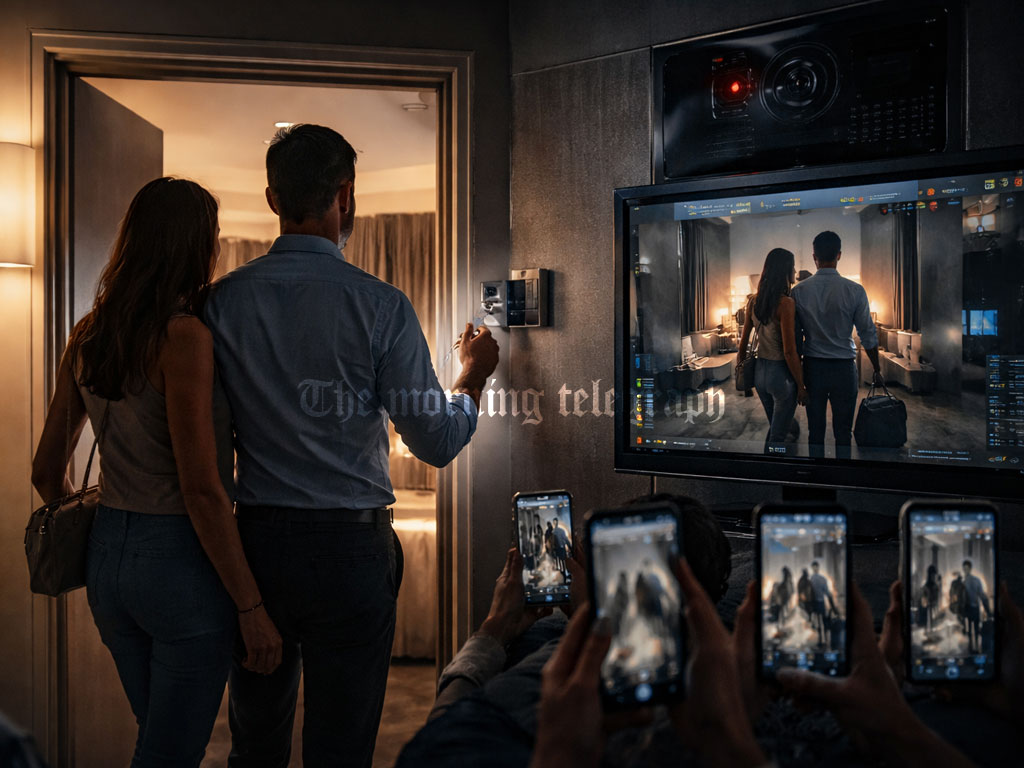
A chilling global investigation exposes a hidden surveillance racket where hotel room key cards activate secret cameras, streaming private moments live to paying subscribers across the world.
Imagine this. You arrive at a luxury hotel after a long journey. You are exhausted. You open the door, step into a neatly arranged room, and insert your key card into the wall slot. Instantly, the lights glow, the air conditioning hums to life, and the television flashes a personalized welcome message.

But what if that single action does more than illuminate the room?
What if, at the exact moment you activate the power, something else quietly switches on as well?
You believe you are alone. Perhaps you are with your partner, enjoying a private getaway. Yet hidden behind a plug socket, inside a smoke detector, or concealed within a wall cavity, a tiny camera awakens. Within seconds, your movements are transmitted live across the internet to strangers watching on their phones.
This is not fiction. It is the disturbing reality uncovered in a recent international investigation that has shaken global travelers.
The threat goes far beyond a simple hidden camera story. It reveals a sophisticated surveillance business model built on invasion of privacy and digital exploitation. Many people assume that hidden cameras run on batteries and eventually stop recording when power drains or memory cards fill up. That assumption is dangerously outdated.
In this emerging scam, cameras are wired directly into the mains electricity supply of hotel rooms. They are connected to internet routers. They do not rely on batteries. They do not need manual retrieval. Once installed, they can operate continuously for months or even years.
The most alarming detail is the trigger mechanism. When a guest inserts the hotel key card and activates room power, these covert devices begin recording and streaming. They are effectively synchronized with the room’s electrical system.
Investigators discovered that entire subscription networks operate through encrypted messaging apps such as Telegram. Users pay monthly fees, similar to a streaming platform subscription. After payment, they gain access to live feeds from hundreds of compromised hotel rooms across multiple countries.
It is surveillance as entertainment. Voyeurism packaged as a business.
Consider the experience of Eric and Emily, names changed for protection. Eric, a young professional from Hong Kong, stumbled across a video online that left him frozen. The footage showed him and his girlfriend in a hotel room weeks earlier. Their private conversations, personal interactions, and intimate moments were broadcast without consent.
The realization felt like a theft of dignity. Emily was devastated. She became anxious about leaving home, worried that someone might recognize her. The psychological trauma was severe.
During months of undercover investigation, journalists documented how advanced these camera systems have become. Some devices are no larger than a pencil tip. They can be hidden among wiring behind televisions, inside internet routers, or within bathroom fixtures.
Traditional detection methods are no longer reliable. Many travelers shine a phone flashlight around mirrors and ceilings to look for lens reflections. Yet newer lenses are designed to minimize glare. Some devices are so discreet that they blend seamlessly into electrical components.
The criminals behind this network describe their activity casually, even arrogantly. For them, planting hidden cameras is a challenge and a source of easy money. They profit from livestream subscriptions and recorded content sales. The privacy of unsuspecting guests becomes a commodity.
While awareness may still be limited in certain regions, the implications are global. As smart technology and connected devices expand in hospitality environments, cybersecurity risks increase. Hotel WiFi networks, electrical systems, and connected appliances can become gateways for exploitation.
This story forces uncomfortable questions about digital privacy, surveillance capitalism, and the vulnerability of personal spaces. When technology integrates so deeply into everyday life, privacy is no longer guaranteed by locked doors.
Before your next hotel stay, pause for a moment. Inspect power outlets. Be cautious about unusual wiring. Cover suspicious openings. Use portable camera detectors if possible. Basic vigilance may reduce risk.
The deeper issue, however, is systemic. As surveillance technology becomes cheaper and more accessible, regulatory oversight must evolve. Hotels must implement stronger inspection protocols. Law enforcement must prioritize cybercrime investigations. Guests deserve protection.
We once believed that privacy began when the door closed. Today, invisible networks blur that boundary.
So the question remains. In an era where hidden cameras can be activated with a simple key card swipe, do we still truly own our private lives? Or have we unknowingly stepped into a global reality show without consent?
The next time you enter a hotel room and switch on the lights, ask yourself who else might be watching.