When you remove the option of retreat, you unlock a level of focus, courage, and inner strength that can transform your life forever.
Imagine you are a general standing on the Persian coast. Behind you, the sea. Before you, an enemy army ten times larger than yours. Your soldiers are afraid. You can see it in their eyes. They keep glancing back at the ships that carried them across the water. In their minds, there is comfort. If we fail, we can escape.

Then comes the command that changes everything.
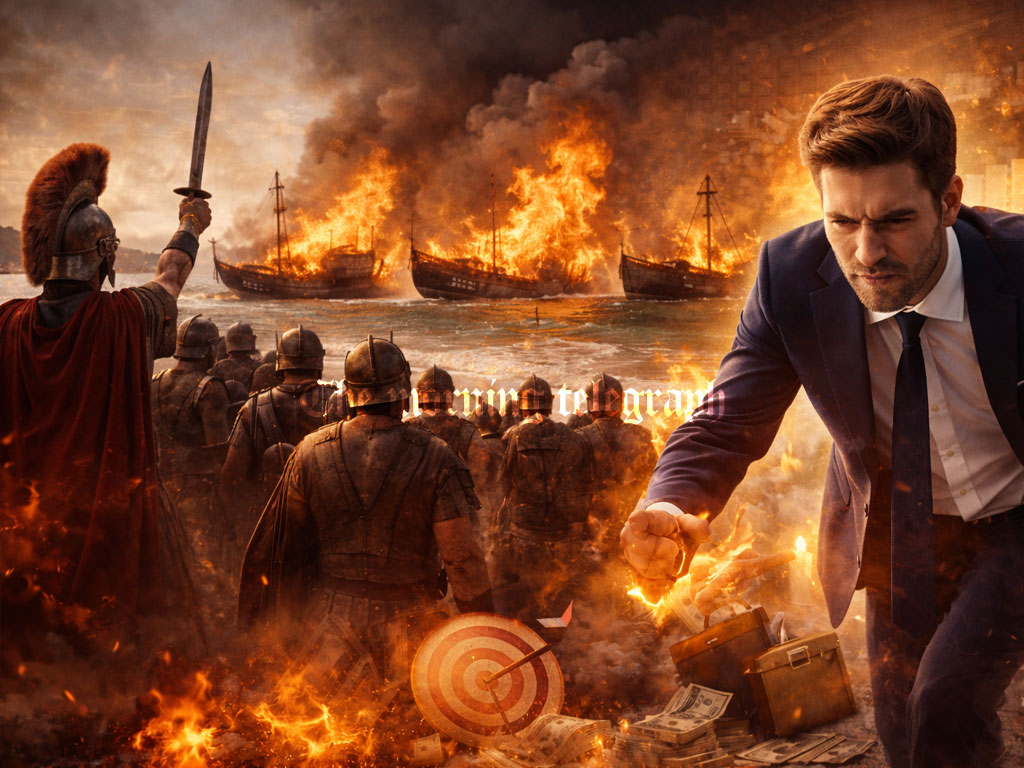
Alexander the Great turns to his generals and orders, “Set fire to the ships.”
The flames rise. The wood cracks. Smoke fills the sky. The only path home disappears before their eyes. Suddenly, the soldiers understand the truth. There will be no retreat. No rescue. No second chance. They will either win the battle or die on that shore.
In that moment, something shifts inside them. Fear turns into fierce determination. Doubt disappears. They become dangerous, not because they are stronger, but because defeat is no longer an option.
Why does a person become so powerful when they run out of options?
The human brain is built to protect us. Whenever we face risk, it searches for an exit. If this business fails, I can go back to my old job. If I do not pass this exam, I can try something easier. If this relationship ends, I will settle for something safe. These thoughts feel comforting. They reduce anxiety. But they also reduce effort.
As long as we have a safety net, we rarely give one hundred percent. We fight with half our strength because we know losing will not destroy us. There is always something else.
Alexander removed that something else.
When survival depends entirely on victory, the mind and body release extraordinary reserves of energy. Scientists call it survival instinct. It is the deep, innate drive to exist and overcome. Under pressure, focus sharpens. Distractions fade. Commitment becomes absolute.
In modern life, our ships are rarely wooden vessels. They are habits, excuses, and emotional attachments. You want to start a new business, but you cling to old routines that keep you small. You want a new chapter in life, but you still replay painful memories from the past. You dream of success, but you refuse to distance yourself from friends who drain your time and ambition.
These are your ships.
Without burning them, you will never conquer your own Persia, your big goals. This does not mean acting without a plan or taking reckless risks. The real lesson is commitment. When you decide on a path, remove the doors that lead backward. Too often, Plan B quietly weakens Plan A. It becomes a comfortable escape hatch.
Put your energy into one clear direction. Remove the environments that limit you. Choose to think, I have to make this work. This is not about violence or aggression. Being dangerous in this sense means being unstoppable. It means being willing to sacrifice comfort for purpose.
History repeats this pattern.
In 49 BC, Julius Caesar stood at the Rubicon River. By law, he was forbidden to cross it with his army. Crossing meant declaring war on Rome. He paused for a moment, then rode forward and declared, “Alea iacta est.” The die is cast. He erased the middle ground. He would either become ruler or be destroyed. There was no safe return.
In 1519, Hernán Cortés landed in Mexico with a small force facing the vast Aztec Empire. His soldiers wanted to retreat. Instead, he ordered the ships sunk or burned. With no way back to Cuba, his men had one choice. Move forward.
Even in literature and cinema, this theme appears again and again. Captain Ahab in Herman Melville’s Moby Dick dedicates himself entirely to his pursuit, cutting off the ordinary ties of life. In the film 300, King Leonidas and his warriors stand at Thermopylae without hope of rescue. When threatened with overwhelming force, Leonidas responds with calm defiance. They have chosen their ground. They will not retreat.
In each story, the hero abandons the exit strategy.
The philosophy behind this idea connects even to Taoism. The concept of wu wei speaks of acting in harmony without inner conflict. When the soldiers kept looking at their ships, their minds were divided. Part of them was already retreating. Once the ships burned, their focus became singular. They flowed into battle like a river flowing downhill. No hesitation. No split attention.
A divided mind rarely achieves greatness. A committed mind becomes powerful.
Seventy percent effort rarely changes a life. Full commitment does. Think about your own journey. What are you holding onto that gives you permission to quit? A comfortable job that kills your passion? A relationship that keeps you stuck? An identity built around fear?
Victory becomes powerful only when it becomes necessary.
Every great transformation begins at a point of no return. It is the moment you decide that retreat is no longer acceptable. From that point forward, energy aligns. Your thoughts sharpen. Your actions intensify. You stop negotiating with doubt.
This does not mean ignoring wisdom or preparation. It means choosing wholeheartedly. When you eliminate the constant mental rehearsal of failure, you free yourself to focus entirely on success.
Are you the hero of your own story, or are you still standing safely on the deck, watching your dreams from a distance?
Burning the ships is not about destruction. It is about decision. It is about removing the comfort of retreat so that courage can rise. When winning becomes a must, you become stronger than you ever imagined.
Sometimes the path to greatness begins with a simple, fearless choice.
Burn the ships.
A quote