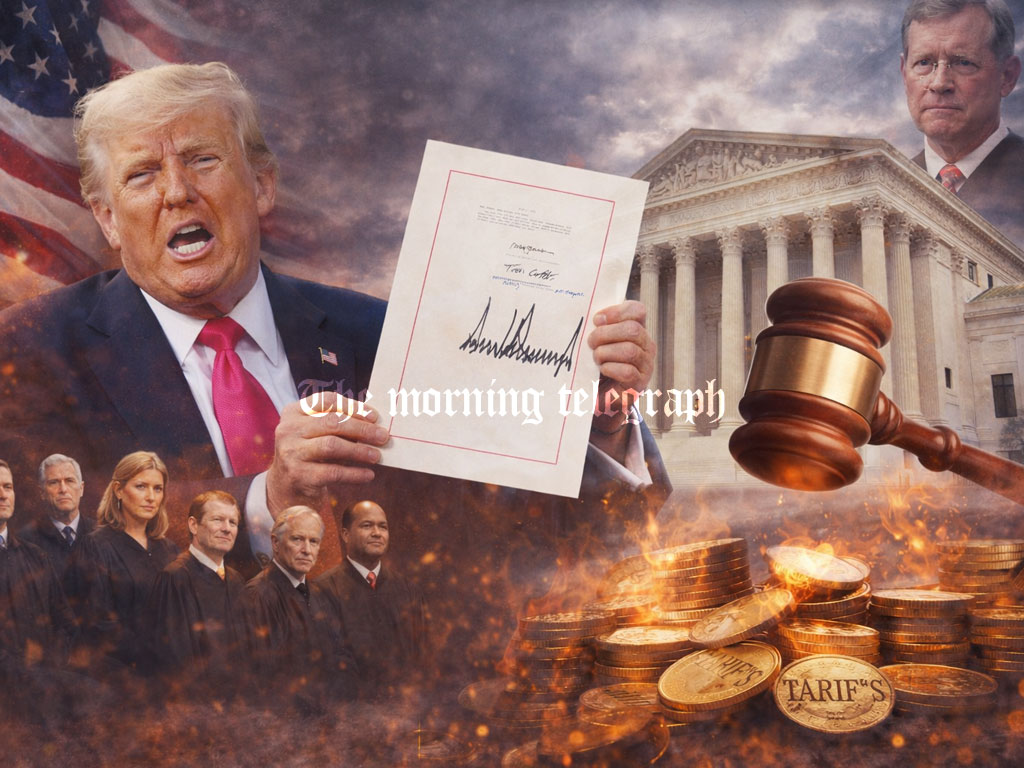
A dramatic Supreme Court ruling has struck down President Donald Trump’s sweeping emergency tariffs as illegal, throwing $134 billion in collected revenue into doubt and pushing the American economy back into global trade uncertainty after the White House swiftly unveiled a new 10% import tax.
Yesterday Friday, the US Supreme Court ruled that the massive Emergency Tariffs unilaterally imposed by President Donald Trump on countries around the world violate federal law and are illegal. The judgment is widely viewed as the most serious judicial setback of the Trump administration in its second term, marking a decisive constitutional confrontation over executive power and trade policy.

The 6-3 verdict was delivered by a bench headed by Chief Justice John Roberts. The court held that the 1970s International Emergency Economic Powers Act IEEPA, which allows the president to regulate imports during genuine national emergencies, does not grant authority to impose unlimited tariffs of sweeping scale and duration.
In delivering the ruling, Chief Justice John Roberts stated, “There must be an express authorization of Congress for such a tax to be unlimited in amount, duration, and scope.” Conservative Justices Amy Coney Barrett and Neil Gorsuch joined liberal justices in backing the majority decision, reinforcing the constitutional principle that Congress holds the primary power of taxation.
The ruling now casts uncertainty over more than 134 billion dollars in tariff revenue already collected from over 301,000 importers. Businesses across the United States are closely monitoring the next legal steps, as the Supreme Court did not issue a direct refund order. The question of repayment is expected to move to the lower courts, creating financial and administrative complexity for the Treasury Department.
President Trump described the decision as “shameful” while addressing governors at the White House. The administration had consistently argued that tariffs were essential to protecting American manufacturing, strengthening domestic industry, and preventing the United States from becoming economically weaker in global trade competition.
Under the disputed measures, tariffs had been raised to 145 percent on Chinese imports and 50 percent on countries including India and Brazil. The Supreme Court ruling significantly curtails the president’s ability to impose broad trade taxes without explicit congressional approval, reshaping the balance of power between the executive branch and Capitol Hill.
Meanwhile, President Donald Trump moved quickly to introduce a new 10 percent global import tax following the ruling. In a statement issued immediately after the judgment, he labeled the verdict “horrendous” and criticized the justices for limiting presidential authority. The White House invoked a separate and previously unused legal mechanism, Section 122, to justify the new measure, effective from February 24.
Although Canada and Mexico are exempt under the USMCA trade agreement, major trading partners such as Britain, the European Union, and India will face the new 10 percent tariff. Financial markets reacted cautiously. Wall Street’s S&P 500 index rose 0.7 percent on initial optimism after the court decision, reflecting relief over limits on sweeping emergency tariffs.
However, economic analysts warn that the fresh tax announcement reintroduces global trade uncertainty. With ongoing litigation, potential refund battles, and new tariff measures, the American economy faces a volatile period where constitutional law, international trade, and political strategy collide in unprecedented ways.