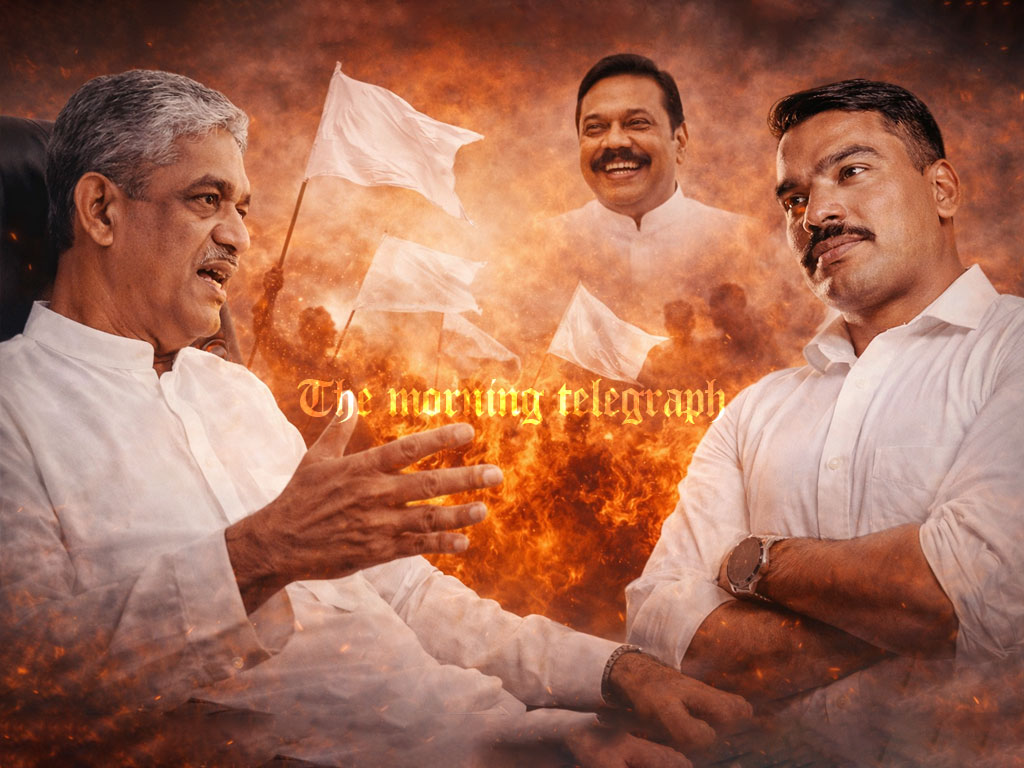
A heated political exchange over the final days of the war has reignited old wounds, revived white flag controversy claims, and sharpened the debate over Mahinda Rajapaksa’s legacy.
Did you tell him to shoot when he brought the white flags? Did you help him escape? – Namal Confuses Fonseka’s Story
Sri Lanka Podujana Peramuna National Organizer and Parliamentarian Namal Rajapaksa said it is a very good thing that Sarath Fonseka himself has stated that Mahinda Rajapaksa is not a murderer.
He made these remarks in response to questions from journalists about a recent statement by Sarath Fonseka.

Namal Rajapaksa further commented that Sarath Fonseka may be controversial, but during the final phase of the war President Mahinda Rajapaksa openly declared through the media that all that remained for Prabhakaran was to lay down arms and surrender to the Sri Lanka Army. He emphasized that this was not a new statement or hidden position.
At the same time, he pointed to what he described as inconsistencies in Fonseka’s narrative. On one occasion, Fonseka is quoted as saying that when white flags were brought, Mahinda Rajapaksa gave orders to shoot innocent people. On another occasion, he allegedly stated that he himself facilitated an escape route. Rajapaksa questioned how both claims could coexist, arguing that the public deserves clarity on the so called white flag incident and the end of the civil war.
He stressed that the war was not against Tamil civilians but against the LTTE terrorists. Thousands of Sri Lankan war heroes sacrificed their lives to defeat terrorism. According to him, Mahinda Rajapaksa’s sole objective was to eliminate terrorism with minimal loss of civilian life and property. He said that every strategic and military decision taken during the humanitarian operation was aimed at ending decades of violence while protecting innocent lives.
Namal Rajapaksa also expressed gratitude to Fonseka for stating that Mahinda Rajapaksa was not a bloodthirsty or murderous leader, as some diaspora groups, members of the JVP government, and LTTE sympathizers have claimed. He described Mahinda Rajapaksa as a leader who sought to save the maximum number of innocent lives and restore national freedom, rather than cause destruction.
He further contrasted this legacy by stating that Mahinda Rajapaksa was not a leader associated with burning buses, destroying public property, attacking post offices, or harming members of the Maha Sangha. Instead, he credited him with safeguarding religious leaders, developing infrastructure such as expressways and airports, and positioning Sri Lanka as one of the fastest developing economies in Asia during that period.
Turning to contemporary political discourse, Namal Rajapaksa accused some within the current government of treating the Maha Sangha as aligned to a so called Rajapaksha faction. He claimed that disrespect toward Buddhist clergy has become normalized, including public ridicule and the failure to address monks with traditional honorifics. He said that this pattern of criticism extends to other religious leaders including Islamic, Hindu, and Catholic communities.
He emphasized that Sri Lanka is a Buddhist country rooted in Hela culture, and that protecting Buddhism does not undermine other religions. On the contrary, he argued that safeguarding Buddhist heritage ensures equal respect for all faiths. He rejected accusations of racism, stating that openly identifying as a Buddhist and defending cultural heritage should not be politicized.
Finally, he called on the government to stop criticizing religious leaders, warning that such rhetoric may strengthen extremist elements seeking to divide the country along ethnic and religious lines. He maintained that unity, respect for religion, and recognition of the sacrifices made during the war remain central to Sri Lanka’s national stability and reconciliation process.