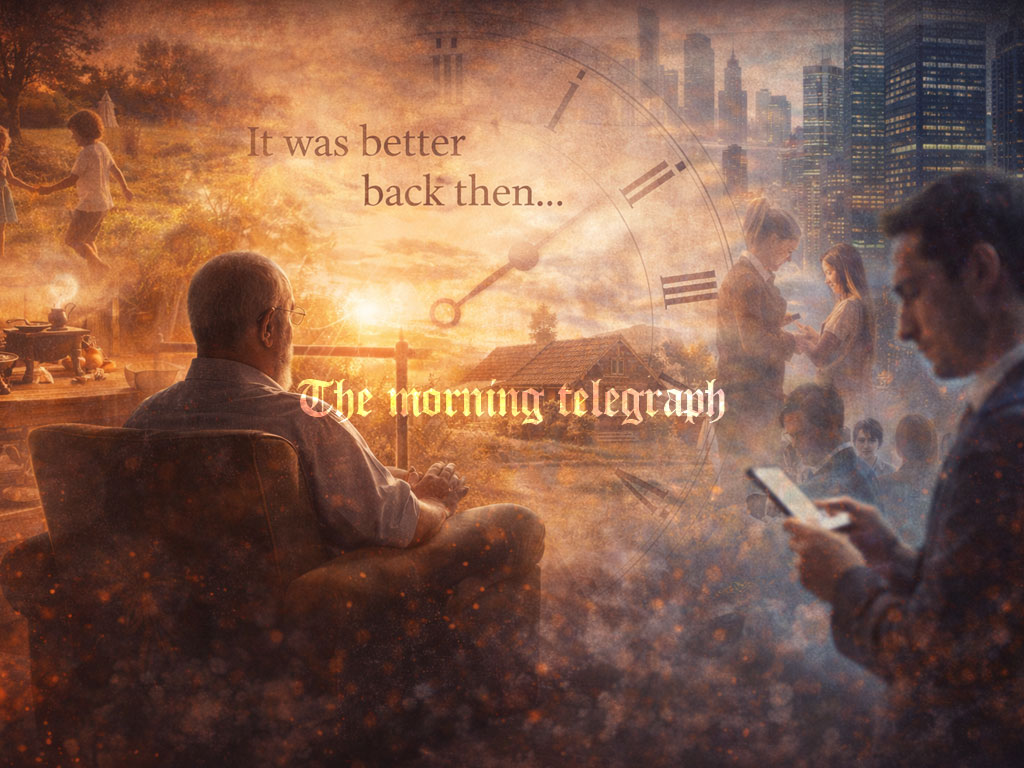
Why We Keep Saying It Was Better Back Then
By: Roshan Jayasinghe
There is a quiet habit in all of us.
We look back.
And when we do, we often say the same thing.
“It was better back then.”
This is not a complaint about the present day.
It is not an argument against progress.
It is simply an inquiry.
Why does yesterday so easily become superior to today?
And what exactly are we protecting when we say so?
I have been noticing something quietly in myself and in others.

How easily we say,
“It was better back then.”
Food was better.
People were better.
Music was better.
Parenting was better.
Sri Lanka was better.
Life was simpler.
Even today, when we present something from the present day, we reach backward.
Wood fired.
Handmade.
Old style.
Traditional method.
And immediately it feels trustworthy.
Why is that?
When did yesterday become superior to today?
I am not arguing with it.
I am simply looking at it.
If I sit still and examine my own memory, I notice something subtle.
When I remember the past, I am not remembering everything.
I remember moments.
The warmth of a kitchen.
The smell of something cooking slowly.
The way evening light fell across the yard.
Who was sitting nearby.
How my body felt younger.
How responsibility felt lighter.
What I rarely remember are the inconveniences.
The frustration.
The waiting.
The limits.
The complaints I had at the time.
It is as if memory softens the edges and keeps the glow.
So when I say, “It was better,”
maybe what I am really saying is,
“I felt different.”
Was the world better?
Or was I lighter?
There is another thing I notice.
The past is finished.
It cannot surprise me anymore.
It cannot demand adaptation.
It cannot fail me again.
The present is alive.
It asks me to adjust.
To keep learning.
To keep moving.
The future asks even more.
Perhaps the mind prefers what is already complete.
Familiarity feels like quality.
But they are not the same thing.
And yet, I do not want to dismiss the other side.
There was depth in slower living.
Food made with hands carries a different energy.
Conversations lasted longer because there were fewer distractions.
Communities leaned on each other more directly.
Effort was visible.
The present day has given us efficiency.
But efficiency is not the same as meaning.
We gained speed.
We lost slowness.
We gained access.
We lost ritual.
We gained convenience.
We lost certain forms of intimacy.
Both sides are true.
This is not about choosing one over the other.
It is about seeing the whole.
I also see something more personal.
If the past was not better,
then what I came from was not extraordinary.
My childhood.
My early struggles.
My culture.
My formative years.
They shaped me.
So I protect them.
When someone says, “The new way is better,”
it can feel like they are diminishing where I began.
So perhaps I defend the old not because it is always superior,
but because it carries my identity.
That is worth looking at honestly.
There is one more thing that becomes very clear when I stay with this inquiry.
The past only exists now as thought.
It is not physically here.
It is not happening.
It appears as memory. Images, sensations, interpretation.
And when I look closely, I see that what I am holding onto is not the past itself, but the story my mind has built around it.
That story gives continuity to “me.”
If that story weakens, something feels unstable.
So maybe this attachment to “better back then” is not about time at all.
Maybe it is about preserving the psychological structure of who I think I am.
And that, quietly, is the deeper layer.
Perhaps what we call “the good old days” is not history.
Perhaps it is memory wrapped in emotion.
Perhaps we are not longing for a time.
Perhaps we are longing for a state of being.
And if that is true, then the doorway is not behind us.
It is here.
There is also irony here.
When I was living in those so called better days,
I wanted more.
I wanted progress.
Opportunity.
Speed.
Expansion.
Now that many of those things exist in the present day,
I sometimes glorify the simplicity I once tried to move beyond.
So what exactly is happening?
Is it that the past was better?
Or is it that memory filters pain and keeps warmth?
Is it that the present day is worse?
Or is it that I am less present in it?
If I am distracted today,
fragmented today,
half here and half elsewhere,
will I one day look back at this exact moment
and say,
“That was the good time”?
Meaning now.
I am not trying to win an argument.
I am observing.
The past carries warmth.
The present carries demand.
The future carries uncertainty.
The mind prefers warmth and certainty.
But life only unfolds here.
So I leave this with you, and with myself.
When you say the past was better,
what exactly are you remembering?
The system?
The taste?
The structure?
Or the way you felt?
And if it is the feeling, that warmth, that simplicity, that sense of being held, then let us be honest.
The past did not create that.
Presence did.
The past only feels better because memory is softer than reality, and today is unfinished.
But the simplest truth is this.
The good old days were not a time.
They were a state.
And that state is still available.
Not by going backward.
By coming here.
Author’s Note
This reflection is not about rejecting tradition or celebrating the present day.
It is about observing the subtle way thought shapes our relationship with time.
Every generation believes something has been lost.
Every generation believes something has been gained.
Both are true.
But clarity begins when we examine what we are actually holding onto.
If the warmth we miss came from presence, then presence is still within reach.
And perhaps that is the real inheritance we carry forward.
Roshan Jayasinghe
About the Author
Roshan Jayasinghe is a writer and observer of human systems. His work explores the gap between man made constructs and lived humanity, with a focus on how economics, trade and everyday choices intersect with questions of fairness, responsibility and inner alignment. Through essays for publications in The Morning Telegraph, he aims to remind readers that they are not passengers in a fixed machine, but active custodians of a shared world.