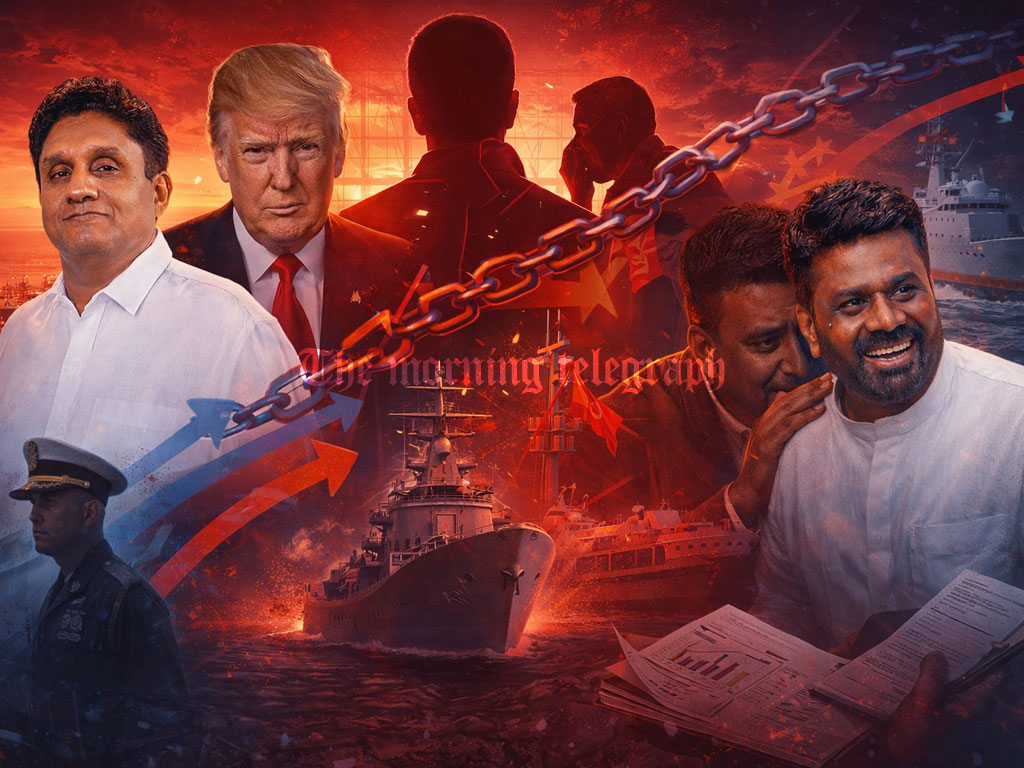
A high-powered US naval visit to Colombo signals a dramatic shift in the Indian Ocean power game, just as a brutal internal coup unfolds within Sri Lanka’s main opposition party. We expose the mastermind trying to oust Sajith Premadasa, the secret meetings, and why Washington now sees the island as its most crucial strategic asset. This is the full inside story of a nation under siege from both foreign powers and internal saboteurs.
In this column, we have repeatedly reported on the geopolitical manoeuvring of China, India and the United States around Sri Lanka. At different times, each of these powers has attempted to expand its influence within the island. There were moments when China surged ahead, overtaking India and the United States. At other times, India and America pushed back, limiting Beijing’s advance.
We previously highlighted how China leveraged projects such as the Hambantota Port and the proposed Hambantota Refinery to deepen its footprint in Sri Lanka. We also reported how pressure mounted over Chinese research vessels entering Sri Lankan waters, a development that appeared to push China onto the defensive. Last week, we revealed that construction of the Hambantota Refinery has been temporarily halted over issues linked to such vessels, and that promised Chinese funding for the Central Expressway has also been suspended.
Against that backdrop, another critical development has emerged in the triangular contest between China, India and the United States over Sri Lanka.

Washington’s New Playbook in the Indian Ocean: Why Sri Lanka Matters More Than Ever Before
Last week, the US Senate Foreign Relations Committee convened to dissect American foreign policy in South Asia, with Assistant Secretary for South and Central Asia, Samir Paul Kapur, taking the hot seat. During this high-stakes discussion, Kapur dropped a geopolitical bombshell regarding Sri Lanka that sent ripples through diplomatic circles in Colombo and beyond. His testimony, which lasted nearly two hours, covered multiple aspects of US engagement in the region, but it was his focused remarks on the island nation that captured the attention of strategic analysts worldwide.
He explicitly stated that Sri Lanka has now ascended to the status of the most critical maritime location in the entire Indian Ocean and South Asia region. This was not merely rhetorical flourish; it was a carefully calibrated statement reflecting months of internal US government assessments. Kapur reminded the committee that the island sits astride the planet’s most vital energy and trade arteries, where massive Middle Eastern oil shipments and global commerce pass daily. He provided specific data points: over 60 percent of the world’s tanker traffic and approximately 50 percent of container shipments transit the Indian Ocean shipping lanes that run adjacent to Sri Lanka’s southern coast. The island’s natural deep-water harbors, particularly Trincomalee on the eastern coast and Colombo on the western, offer unparalleled strategic depth for any naval power operating in the region.
Kapur admitted that Washington had perhaps been guilty of neglect towards Sri Lanka in recent years, citing budget constraints, competing priorities in the Middle East, and a post-Afghanistan withdrawal reassessment of regional commitments. However, he stressed that this oversight could no longer continue. The island nation, he argued, cannot be merely categorized as another South Asian state; it is a strategic prize of immense value that demands focused attention and dedicated resources. He pointed out that the Pentagon’s own internal modeling suggests that in any future conflict scenario involving great powers, control over or denial of access to Sri Lankan ports and airfields would be a decisive factor.
He pointed out that Beijing had woken up to this reality long ago and has been methodically consolidating its influence through what he termed “debt-trap diplomacy” and infrastructure investments with dual-use potential. Kapur specifically flagged China’s operational control of the Hambantota Port under a 99-year lease and the controversial 2022 visit of a Chinese research vessel capable of underwater surveillance and mapping as flashing red alerts. These developments, he warned, are significant warning signals of China’s expanding maritime footprint and its willingness to project power far from its shores. He concluded that the United States, in close coordination with India as the lead partner in the Quad and bilateral arrangements, must now meticulously monitor these dynamics and the broader Indo-Pacific tensions fueled by China’s assertive rise. The message was unmistakable: the era of treating Sri Lanka as a peripheral concern is over.
The US Strategy Unveiled: A Comprehensive Roadmap to Win Sri Lanka
When pressed by committee members on the practical steps required to pull Colombo closer to the American orbit without triggering a backlash or appearing neo-colonial, Kapur laid out a detailed and comprehensive roadmap that covered economic, diplomatic, and security dimensions. His response was notable for its specificity and its acknowledgement of the delicate balancing act required in Sri Lanka’s domestic politics.
He acknowledged that Sri Lanka is still navigating the treacherous waters of recovery from a catastrophic economic meltdown that saw the country default on its external debt for the first time in history, experience runaway inflation, and witness public protests that toppled the previous government. Crucially, he noted that Colombo currently lacks a cohesive, long-term economic blueprint that can guide sustainable recovery and attract private sector investment. According to Kapur, the United States should step in to fill this vacuum by assisting in formulating that very economic plan, drawing on the expertise of American financial institutions, think tanks, and development finance corporations. This would include providing robust support through the International Monetary Fund mechanisms, where the US holds significant sway, to ensure that reform programs are designed in a way that promotes transparency, reduces corruption, and opens markets to American and allied businesses.
He zeroed in on Sri Lanka’s ongoing struggle with debt restructuring and its parallel difficulty in attracting direct foreign investment as key areas for intervention. Kapur suggested that Washington should actively encourage Colombo to deepen its ties with New Delhi as a natural counterbalance to Beijing, while simultaneously weaning the nation off its dependency on Chinese loans, particularly for infrastructure development that often comes with opaque terms and conditions. He cited the example of the Colombo Port City project, largely financed and built by China, as the kind of development that should have attracted Western investment but did not due to a lack of strategic focus in previous decades.
On the sensitive matter of security cooperation, he proposed a calibrated and phased approach that would avoid the political landmines associated with establishing a permanent American military base on Sri Lankan soil. Such a move, he acknowledged, would be politically explosive given Sri Lanka’s history of non-alignment and the sensitivity of its ethnic and religious communities to foreign military presences. Instead, he advocated for a significant expansion of naval collaboration through existing mechanisms. This includes ramping up intelligence sharing on maritime domain awareness, expanding joint training programs for Sri Lankan naval personnel in the United States and with allied navies, and providing advanced equipment support such as patrol vessels, radar systems, and communication technology. All of this would be done while positioning India as the central hub for maritime security in the region, a nod to New Delhi’s traditional role as the dominant power in South Asia and its own anxieties about Chinese encirclement. He also underscored the necessity of strengthening surveillance systems to combat drug trafficking, human smuggling, and illegal fishing in the vast expanse of the Indian Ocean, areas where Sri Lanka has faced significant challenges.
These remarks present a dual-edged sword for Sri Lanka’s policymakers. On one hand, they open a gateway for substantial investment and economic backing at a time when the country desperately needs both. The promise of American engagement could unlock access to international financial markets, boost investor confidence, and provide alternatives to Chinese largesse. On the other hand, they starkly highlight the island’s precarious position as a prime target in the escalating great-power rivalry, where every decision will be scrutinized and every gesture interpreted by one side or the other. The critical unanswered questions remain: How will Beijing react to a visible uptick in US engagement, especially given the recent suspension of funding for the Hambantota Refinery and Central Expressway? Will China see this as a provocation requiring a counter-move? And how will New Delhi, traditionally wary of external powers in its neighborhood even when they are allies, respond to increased American proximity and influence in what it considers its exclusive sphere of influence? Sri Lanka’s foreign policy navigation in the coming months will require the deftest of touches, a quality that has often been in short supply in Colombo’s diplomatic history.
The Admiral’s Sudden Arrival: Timing That Speaks Volumes
Just days after Kapur’s testimony in Washington, a highly significant visitor touched down in Colombo under circumstances that suggested more than routine diplomatic engagement. Admiral Steve Keller, the Commander of the US Pacific Fleet, arrived for what was officially described as a three-day visit focused on maritime security cooperation, reinforcing regional stability, and enhancing military interoperability with Sri Lankan forces. Keller’s presence was notable for several reasons. Having assumed his command on April 4, 2024, his first official visit to Sri Lanka occurred on October 10, 2024, shortly after President Anura Kumara Dissanayake assumed office following his election victory. This latest trip, therefore, marked his second visit in a relatively short span of just over four months, an unusual frequency that signaled the priority the US Pacific Command places on the Sri Lankan relationship.
What made this visit particularly electric and drew intense scrutiny from regional analysts and intelligence agencies was its timing relative to global events. Keller arrived in Colombo less than 24 hours after the Pentagon had briefed President Donald Trump in the White House Situation Room that US forces were poised for potential action against Iran. The briefing, which lasted several hours, reportedly covered a range of military options from airstrikes on nuclear facilities to more limited strikes on Revolutionary Guard positions. Trump subsequently issued a public ultimatum from the Oval Office, giving Iran a window of 10 to 15 days to pursue a peace agreement and halt its nuclear enrichment activities, failing which military action remained firmly on the table. The rhetoric was the most bellicose since the assassination of General Qassem Soleimani years earlier.
Given this charged geopolitical backdrop, Keller’s sudden and unannounced arrival in Colombo drew immediate questions. Was this a routine port call as officially claimed, or was there a more urgent purpose? Speculation ranged from discussions about access to Sri Lankan facilities in the event of a broader conflict, to coordination on intelligence sharing regarding Iranian activities in the Indian Ocean, to simply reassuring an ally at a moment of heightened tension. The US embassy in Colombo maintained a low profile, issuing only brief statements about the visit’s routine nature, but the silence only fueled further speculation among the diplomatic corps.
Adding another layer to this complex diplomatic choreography, President Dissanayake, during a concurrent visit to Delhi for the AI Summit, held a meeting with Sergio Gore, Trump’s Special Representative for South and Central Asia who also serves as the US Ambassador to India. The two had previously connected during the UN General Assembly in New York, where Gore had assured Sri Lanka of continued American support regardless of which party held power in Washington. The Delhi meeting, held on the sidelines of the summit focused on technology and innovation, was described by both sides as cordial and productive, but the subtext was unmistakable: the United States is investing significant high-level attention in building relationships with Sri Lanka’s new leadership. Last week, it was unequivocally clear that Sri Lanka was fixed firmly under Washington’s strategic spotlight, and the administration in Colombo would need to navigate these pressures with unprecedented skill.
The Great Coup: Exposing the Plot to Topple Sajith Premadasa
In our Inside Politics column, we have consistently exposed the shadowy forces operating behind the scenes to sabotage the potential alliance between the Samagi Jana Balawegaya (SJB) and the UNP. We have revealed the clandestine “Colombo 7 elite house coups,” maneuvers carried out with equal parts open ambition and secretive scheming in the drawing rooms of Colombo’s affluent neighborhoods where political fortunes are often decided away from the public eye.
As part of this ongoing vigilance, we previously uncovered attempts to dislodge Sajith Premadasa from the party leadership using anonymous briefings to the media and orchestrated campaigns on social media. While in the past we only hinted at the identities of the conspirators to protect our sources and allow for the possibility of reconciliation, this time we are prepared to name them directly, laying bare exactly who they are and who is leading the charge. The reason for this full disclosure is that just last week, another coordinated operation was launched to surgically remove Sajith from the SJB leadership and seize control of the party apparatus. This operation was not a spontaneous expression of dissent but a carefully planned maneuver involving meetings, media strategy, and attempts to win over wavering MPs.
The Sajith Factor: Why Loyalty Matters in Sri Lankan Politics
To understand the current crisis, one must understand the political history that created the SJB. After the United National Party (UNP) suffered repeated electoral defeats under the decades-long leadership of Ranil Wickremesinghe, which saw the grand old party reduced to a shell of its former self with only a handful of parliamentary seats, Sajith Premadasa and a group of dedicated followers made the painful decision to break away. They formed the Samagi Jana Balawegaya following the 2019 Presidential Election, a move that was fraught with legal challenges, organizational hurdles, and the emotional weight of leaving a party their families had often been associated with for generations. In its very first general election test as a new entity, the fledgling SJB secured more than 2.5 million votes, a stunning result that defied expectations and was widely interpreted as a personal mandate for Sajith himself. This phenomenon became known as the “Sajith factor,” a recognition that his name, his family legacy, and his campaign style resonated with voters in ways that traditional UNP politics had failed to do.
Since that split, Ranil Wickremesinghe has repeatedly tried to fracture the SJB and lure its MPs back to the UNP fold through a combination of persuasion, pressure, and patronage. However, because Sajith commanded such a deep and resilient popular base, most MPs who maintained quiet, pragmatic ties with Ranil ultimately resisted the temptation to cross over. A clear example came after Ranil assumed the Presidency in 2022 with the backing of Pohottuwa MPs following the Gotabaya Rajapaksa resignation. He launched a major offensive to break the SJB, offering a cornucopia of perks: massive sums from the decentralized fund that gave MPs control over development projects in their electorates, lucrative liquor licenses that could be sold for substantial profits, and even production licenses for arrack and other spirits. Some were dangled ministerial portfolios with their attendant budgets, security details, and official vehicles to entice them into the government ranks. A handful of SJB MPs, tempted by these offers and perhaps doubting Sajith’s political future, accepted these offers and joined Ranil’s government. Others, despite quietly accepting privileges and maintaining cordial relations with the presidential secretariat, chose to remain within the SJB. The calculus was simple: Ranil, even as President with all the power of incumbency, lacked an organic voter base and was seen as a liability in direct elections, while Sajith and the SJB retained the loyalty of the electorate that had proven resilient across multiple contests.
This political reality was proven definitively and brutally in the subsequent general election. Every single SJB MP who had defected to Ranil’s government, lured by short-term benefits, lost their parliamentary seat, often finishing in fourth or fifth place in their electorates. The voters punished their perceived betrayal and opportunism. In stark contrast, those who had accepted privileges but stayed loyal to Sajith were re-elected, swept back into office by the enduring voter base that Sajith and the party had painstakingly built through years of grassroots work and constituency service. The lesson should have been clear: in Sri Lankan politics, a personal voter base is the ultimate currency, and Sajith Premadasa possessed that currency in abundance while his rivals did not.
The ‘Blueprint’ That Backfired: When Policy Fails to Connect
However, in the wake of electoral defeats, a convenient narrative began to take root within certain circles of the SJB, placing the responsibility squarely on the shoulders of party leader Sajith Premadasa. For months, this column has exposed the internal tensions, particularly the efforts to weaken ties between the SJB and the UNP, and the persistent attempts to challenge Sajith’s leadership through anonymous briefings and orchestrated leaks to friendly media outlets.
The party’s economic policy had been entrusted to a high-profile team comprising Dr. Harsha de Silva, a US-educated economist with international experience, Kabir Hashim, a seasoned politician with a reputation for fiscal conservatism, and Iran Wickramaratne, a businessman with private sector credentials. Together, they produced an elaborate economic framework branded as the “Blueprint,” launching it with great fanfare in Colombo’s leading hotels such as the Cinnamon Grand and the Shangri-La, events attended by diplomats, business leaders, and civil society representatives. They issued multiple updated versions over time, each incorporating feedback from focus groups and international financial institutions.
The problem, critics now argue vociferously, was one of communication and accessibility. While the business elite and Colombo-based think tanks understood the policy jargon, appreciated the charts and graphs, and nodded along to the presentations, grassroots supporters and even many SJB MPs found themselves unable to explain its tenets to ordinary voters in the villages, small towns, and urban slums. The “Blueprint” spoke of fiscal consolidation, inflation targeting, and structural reforms, but voters wanted to know about jobs, prices, and subsidies. The result was a strategic failure of communication. In the last presidential election, Ranil Wickremesinghe secured over 2.2 million votes on the strength of his “reform” narrative and his image as the experienced hand needed to guide the country through economic crisis. Anura Kumara Dissanayake stormed to victory with 5.6 million votes, powered by a simplified, resonant economic message that connected with the masses: anti-corruption, relief for the poor, and a break with the old political families. Sajith polled at 4.7 million, a respectable but losing number. Critics within the party argue that the sophisticated “Blueprint” failed to resonate with the common man, yet its architects, they say, have consistently avoided taking responsibility for this failure, instead pointing fingers at Sajith’s campaign style or the party’s organizational weaknesses.
The Ward Place Meeting: The Night They Tried to Seize Power
The group did not stop with their initial criticisms. After the presidential election defeat, a gathering took place late into the night at a hotel on Ward Place, Colombo, where Harsha, Kavinda Jayawardena, Hirunika Premachandra, and several others assembled to digest the results and discuss the way forward. Witnesses describe the atmosphere as tense and charged with recrimination. The very next morning, this group marched to the party office and delivered an ultimatum that shocked many who heard about it: they insisted that Sajith should immediately step down as SJB leader and hand over the reins to Harsha without delay, arguing that a new face was needed to rebuild the party’s image. We reported this incident previously without naming names to protect the sources who trusted us with the information and to allow for the possibility that cooler heads would prevail. At that time, Harsha was determined to remove Sajith and take control, viewing himself as better equipped to lead the party’s economic messaging and appeal to urban voters. However, the attempted coup failed spectacularly because, apart from two or three MPs with close ties to Ranil and perhaps personal grievances against Sajith, no other SJB members supported Harsha’s power grab. The party apparatus, the district organizers, and the majority of MPs remained loyal to Sajith, recognizing that removing him would trigger a split that would benefit only their political opponents.
The Undermining of the Opposition: A Pattern of Suspicious Behavior
Subsequently, Harsha launched a series of operations within the SJB that repeatedly embarrassed both the party and its leader, raising eyebrows among even his former supporters. During Ranil’s government and later under the NPP administration, Harsha, despite being regarded as the SJB’s premier economic expert and the public face of its alternative policies, failed to use his parliamentary position to educate the public about the government’s economic missteps. Instead, he frequently issued statements that appeared to benefit the ruling governments and actively weakened the opposition’s stance at critical moments. For instance, during Ranil’s tenure, when serious economic problems arose including fuel shortages, tax increases, and revenue shortfalls Harsha did not sharpen the SJB’s attack or propose compelling alternatives. On the contrary, as Chairman of the Committee on Public Finance (COPF), he often justified Ranil’s policies in terms that echoed government talking points, praising the administration’s efforts while his own party struggled to differentiate itself. Despite this, Sajith never removed Harsha from his parliamentary or party posts, valuing his expertise and perhaps hoping for loyalty in return. In fact, when Ranil’s government attempted to replace Harsha with Pohottuwa MP Rohitha Abeygunawardena as COPF Chairman in a blatant political maneuver, Sajith personally intervened with the Speaker and other party leaders to ensure Harsha was reinstated, a gesture of support that many found inexplicable given Harsha’s behavior.
The pattern continued and even intensified under the current government. On one notable occasion, when the opposition was preparing a powerful, coordinated attack on the government over a major issue involving alleged corruption in a state enterprise, Harsha rose in Parliament and declared that the treasury had “overflowed” under Anura’s leadership, citing revenue figures that seemed to contradict the opposition’s narrative of economic mismanagement. His statement immediately deflated the opposition’s momentum, leaving SJB MPs and other opposition members sputtering and unable to continue their offensive. The government benches erupted in cheers and taunts. Since then, Harsha has issued multiple statements that have consistently undermined opposition unity on issues ranging from the IMF program to public sector wages, fueling persistent suspicions among party workers and even some MPs of secret dealings or a tacit understanding with the government. These suspicions have been fueled by his absence from key opposition protests and his apparent comfort with the administration’s economic direction.
The Party Strikes Back: Charith Abeysinghe and King Nelson Speak Truth to Power
Despite repeated complaints from MPs, organizers, and grassroots members about Harsha’s double-dealing and the damage it was causing to the party’s credibility, Sajith took no action, remaining steadfast in his trust of a colleague he had known for years and relied upon for policy formulation. This trust was so profound that during the last presidential election, Sajith publicly announced Harsha de Silva as his future Finance Minister in a major campaign rally, elevating him above other senior figures and signaling his complete confidence. From the SJB’s founding, Sajith also appointed Harsha as Treasurer, the fourth highest position in the party hierarchy with responsibility for fundraising and financial management. Yet, in six years, insiders allege that Harsha has not contributed a single cent to party funds from his own resources or networks. Despite five massive election campaigns costing billions of rupees spent on rallies, posters, media advertising, and travel, Harsha reportedly provided no financial support, nor did he participate in protests, marches, or May Day rallies in his official capacity as Treasurer, often sending excuses or simply staying away.
The simmering frustration among the party rank and file finally boiled over when SJB organizer Charith Abeysinghe, a fiery speaker with grassroots credibility, openly criticized Harsha’s “overflowing treasury” claim during a widely viewed YouTube discussion. Charith, speaking with visible anger, argued that Harsha was systematically sabotaging the opposition whenever it tried to gain traction on issues that resonated with voters, causing immense frustration not only among SJB members but across the entire opposition spectrum. He questioned Harsha’s motives and demanded an explanation for his repeated interventions that seemed designed to help the government. Although Charith’s attack resonated deeply with grassroots members who had been complaining privately for months, some senior SJB figures dismissed his criticism as indiscipline and rushed to defend Harsha in background briefings to the media. What was particularly striking was that certain seniors who had previously slandered Sajith in private conversations remained conspicuously silent in the face of Harsha’s actions, even though Charith’s words echoed the true sentiments of the party base and the voters they needed to reach.
The Confrontation: “If You Can’t Accept My Leadership, Leave”
This time, we decided to reveal Harsha’s actions in full detail because he once again made disparaging remarks about Sajith during a YouTube discussion last week, suggesting that the party needed new leadership and a fresh direction. It was evident to anyone watching that his comments served to undermine Sajith and the SJB while indirectly benefiting Ranil and Namal, who are positioning themselves for future political battles. At the SJB parliamentary group meeting held soon after these remarks surfaced, Harsha faced a torrent of direct criticism from multiple MPs who had finally decided that silence was no longer acceptable. Even Sajith himself appeared surprised by the intensity and breadth of the condemnation, which came from unexpected quarters.
The first to speak was MP King Nelson, a veteran politician known for his blunt speaking style and his loyalty to the party leadership. Speaking without notes and with visible emotion, King named Harsha directly and declared that Harsha had made several statements insulting the party leader, which was completely unacceptable in any political organization. He declared firmly that anyone unwilling to accept Sajith’s leadership should leave the party immediately rather than undermining it from within. “There are people within our party who insult the leader publicly and expect to face no consequences. Now MP Harsha has given an interview, making such statements. This cannot continue. Sajith Premadasa is the leader of this party, elected by the members and accepted by the voters. If anyone cannot accept his leadership, leave immediately. Sajith is also our next presidential candidate, the only one with the recognition and following to compete. How can we campaign in villages when senior members themselves are undermining him on YouTube? If anyone, regardless of rank or position, speaks against the leadership publicly, strict action must be taken. We cannot move forward otherwise as a united party.”
Sajith then added his own measured but firm response, speaking slowly and deliberately: “I too saw this video. I have heard the comments. If someone cannot accept my leadership for whatever reason, please go to someone who can. Do not remain inside the party and act in ways that embarrass us publicly. We have work to do and elections to win, and we cannot be distracted by internal disputes.” Harsha was present at the meeting, sitting silently through the criticism, but chose not to respond publicly or defend his actions. Instead, he later sent a text message to King Nelson’s phone, asking: “Why are you so angry? What did I do wrong?” The message, which King shared with several colleagues, was seen as disingenuous and further evidence that Harsha either did not understand the damage he was causing or did not care.
Internal Firestorm: Sujeewa Senasinghe and the Constituent Assembly Clash
Following this intense exchange over leadership, MP Sujeewa Senasinghe, a senior lawyer and former minister known for his independent thinking, shifted the discussion to another contentious issue, heating the atmosphere further. He launched a strong critique of the SJB’s role in the Constituent Assembly, the body responsible for approving key appointments including the Auditor General, a crucial oversight position. Sujeewa specifically targeted Sajith and Ajith P. Perera, who represent the party in that body, for what he characterized as a failure of accountability. He argued that the SJB had set a dangerous precedent by approving the appointment of a Deputy Auditor General as Auditor General, despite her name having been rejected previously on valid grounds related to qualifications and perceived independence. This decision, he argued, compromised the party’s anti-corruption credentials.
Mujibur Rahman, a thoughtful MP from a minority community, supported Sujeewa’s intervention, questioning how such important decisions were made without transparency or consistency within the party’s own ranks. Sajith defended the decision as necessary to maintain a working relationship with the government and to ensure balance in the appointment process. Sujeewa rejected this explanation outright, insisting in his lawyerly fashion that wrong decisions cannot be justified as mere “balance” or political expediency. He pointed to delays in the issuance of Auditor General reports and inconsistencies in their content as further evidence of bias and compromise. Sajith responded again, noting that the decisive power in the Constituent Assembly lies with the three civil society representatives appointed by the President, not with the political parties. Sujeewa countered that it was the responsibility of SJB representatives to persuade those members to reach the right decision and to make the case publicly if persuasion failed. This led to a heated exchange between Sujeewa and Ajith P. Perera, with voices raised and fingers pointed, which Sajith had to personally intervene to calm. Sajith promised that future Constituent Assembly matters would be shared with the full parliamentary group in advance to ensure transparency and collective decision-making.
The Condom Controversy and Other Parliamentary Turmoil
Meanwhile, a bizarre and widely mocked controversy erupted last week when the Health Ministry’s official Facebook page posted a cartoon of Opposition Leader Sajith Premadasa alongside a message promoting condoms over birth control pills. The post claimed condoms were healthier, prevented unwanted pregnancies, and reduced the risk of sexually transmitted diseases, using Sajith’s image in a way that seemed designed to humiliate. Social media backlash was swift and severe. Critics, including members of the ruling party’s own youth wing known as Compass, condemned the post as unethical, juvenile, and a new low in political discourse, questioning how a government ministry could publish derogatory content about another party leader using official government resources. Within hours, the Health Ministry removed Sajith’s image from the post and issued a brief statement claiming the post was unauthorized and the work of a low-level employee, but the damage to the ministry’s credibility and the government’s image had been done. Opposition MPs demanded an apology and an investigation, but none was forthcoming.
In parallel, SJB MPs discussed growing suspicions about three opposition MPs, originally from other parties who had joined the SJB alliance, who were allegedly leaking internal party information to the ruling party. These informants had reportedly tipped off the government about a planned opposition protest in Parliament, allowing the ruling party to prepare in advance with their own MPs and security personnel, neutralizing the impact of the protest and embarrassing the organizers. Names were mentioned in private conversations, and suspicions are now running high. As the SJB grapples with external geopolitical pressure from Washington and Beijing, and internal volcanic turbulence from leadership challenges and policy disputes, the coming weeks will test whether the party can unite around a common purpose or fracture under the accumulated strain of defeat and division. The stakes could not be higher, with local government elections looming and the next parliamentary contest already on the horizon.