Mahaweli farmer leaders accuse the government of siding with powerful rice mill owners, slashing paddy prices and pushing cultivators toward economic collapse.
The Mahaweli Farmers’ Rights Protection Organization alleges that successive governments have consistently betrayed farmers in favor of large scale rice mill owners, and that the present administration has followed the same path, leaving cultivators helpless during the crucial Maha harvesting season.

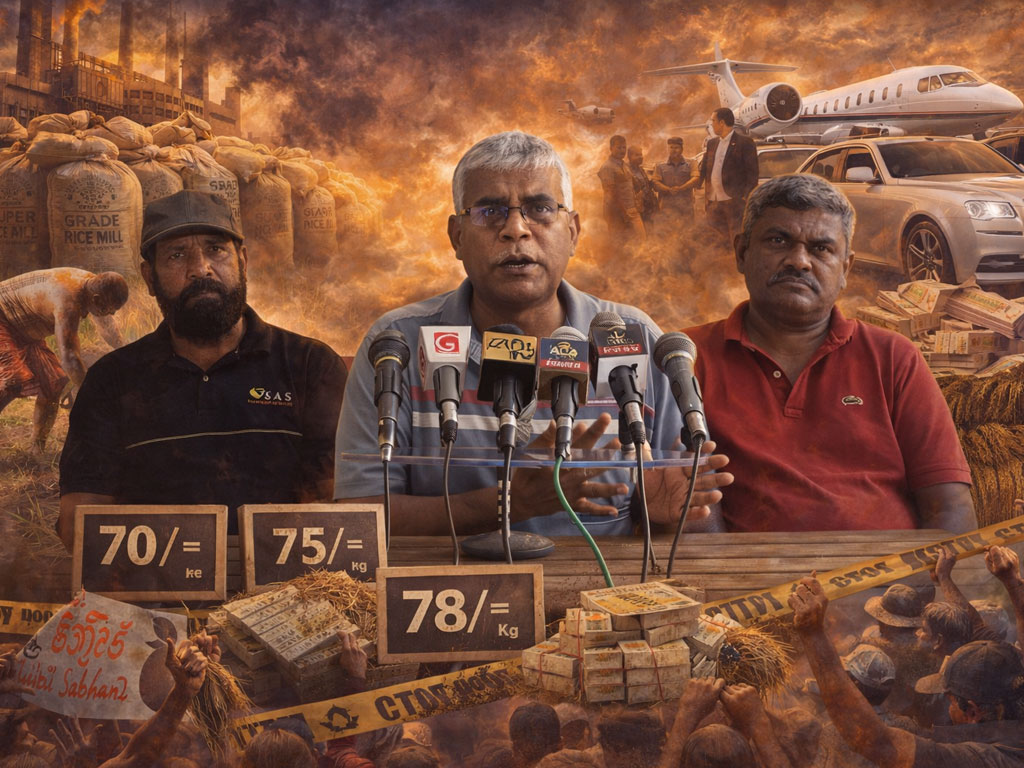
Speaking at a press conference in Dehiattakandia, the organization’s president, Mr. Randeniya, criticized what he described as political hypocrisy and policy failure in agricultural governance. He claimed that leaders who once stood in muddy fields with farmers are now distant from rural realities.
“These rulers got power by taking away our Amuda. Those who went down to the fields and engaged in acting with the farmers, eating gourds and bathing in mud, are now ruling the country leaving the farmer alone. Anura Kumara, Lal Kantala, Namal Karunaratne mobilized the farmer for power then by removing the Amuda. But today they have put the Amuda on the farmer who was wearing a saree, and finally lost that Amuda as well. This government is working to bring it to the streets.”
Mr. Randeniya noted that harvesting has already begun in the Ampara district. Although the government announced a guaranteed price of 102 rupees per kilo for wet paddy, he alleged that farmers are currently forced to sell at 70, 75 and 78 rupees. He stressed that these prices do not even cover production costs, including fertilizer, fuel and labor.
Harvesting in the Mahaweli C region is expected to begin within ten days, yet he claimed there is no clear procurement plan. He further alleged that authorities have failed to clear old rice stocks from warehouses, limiting storage space for the new harvest.
According to him, paddy farming has become a high risk gamble controlled by powerful mill owners, while policymakers indirectly enable their dominance. He warned that if immediate steps are not taken to ensure fair paddy purchasing, farmer unrest could intensify across rural Sri Lanka.