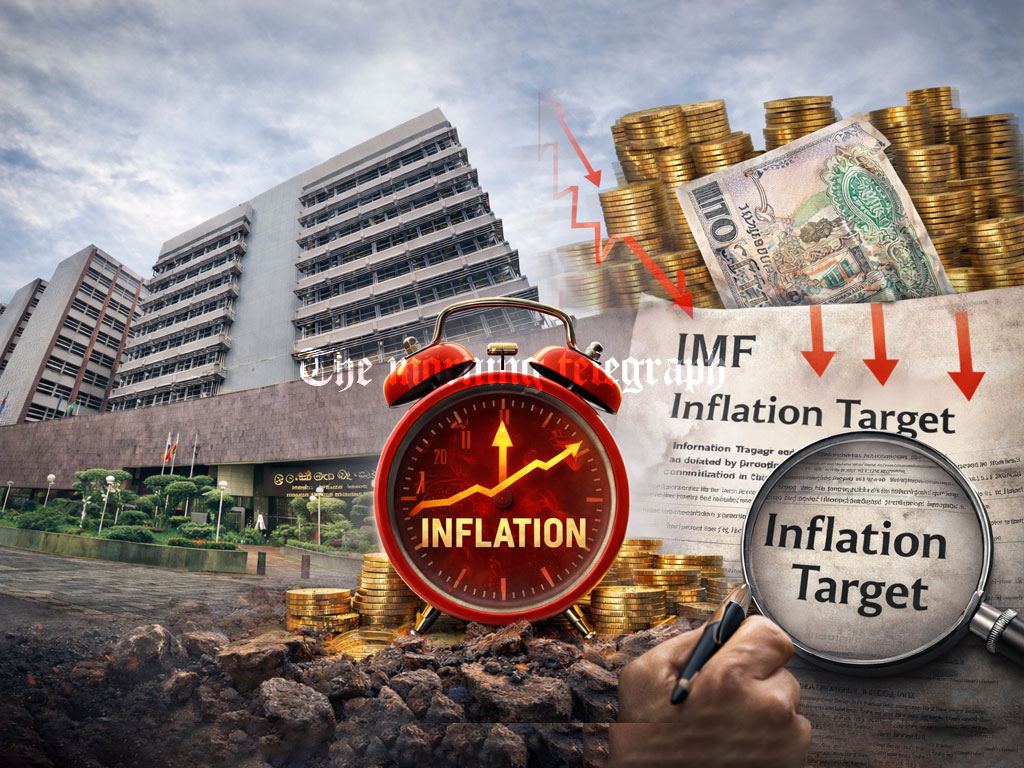
Sri Lanka’s monetary guardians are reconsidering their inflation framework amid mounting pressure for stricter limits, raising fresh questions about currency stability, sovereign risk, and the future direction of economic policy.
Sri Lanka’s central bank has signaled that it will revisit its inflation target as part of renewing its formal agreement with the government, a move that comes amid growing concern over whether the current framework gives excessive room for price growth.
Director of Economic Research S Jegajeevan confirmed that the target will undergo renewed technical assessment. The existing arrangement, signed in October 2023 under the new Central Bank Act following sovereign default, defined price stability around a 5 percent inflation objective. Critics argue that this level, effectively a floor rather than a strict ceiling, permits aggressive monetary policy and liquidity injections that could once again destabilize the currency.

Reassessment of the Policy Framework
“We can continue at the same rate or we can revise it,” Jegajeevan told reporters in Colombo, indicating that evolving economic conditions justify a fresh review. He noted that global shifts, recent movements in inflation, and changes in domestic macroeconomic conditions necessitate updated technical analysis.
Sri Lanka’s post-war period was marked by repeated currency crises under similar inflation targeting arrangements. Forex shortages emerged after liquidity injections were used to maintain policy rates, often resulting in currency depreciation and balance of payments stress. Critics have described such policy support, a term frequently used by the International Monetary Fund, as overly expansionary.
The cumulative outcome, according to analysts, contributed to the eventual sovereign default. The argument is that a 5 percent inflation objective provided the operating space for expansionary rate cuts and credit cycles that extended beyond sustainable levels.
Monetary Stability Since 2022
Since September 2022, the central bank has delivered relative monetary stability. Inflation creation has remained limited, roughly 4 percent over more than three years, allowing debt servicing to resume and helping normalize prices following the currency collapse.
This period of restraint was aided by benign global monetary conditions, particularly Federal Reserve policy that helped contain commodity prices. However, observers note that a controversial rate cut in May 2025 may have complicated reserve accumulation efforts.
Despite improved price indices and external stability, debate persists about the long term adequacy of the framework. The key question is whether Sri Lanka should retain a flexible inflation target or adopt a tighter ceiling to restrain future inflationary pressures.
Wider Engagement and Cabinet Oversight
Jegajeevan indicated that stakeholder consultation will accompany the renewed technical review. Once recommendations are finalized, a proposed target will be submitted for agreement. If consensus is not reached between the government and the central bank, the Cabinet of Ministers will determine the final target.
Under the new legal framework, once established, the inflation target becomes binding on the central bank, which is expected to achieve it through monetary policy tools including open market operations, policy rate adjustments, and liquidity management.
Calls are intensifying for a 2 percent ceiling rather than a 5 percent floor. Proponents argue that a stricter cap would reduce the capacity for inflationary rate cuts and liquidity injections that can generate currency depreciation, social unrest, and renewed economic instability.
Debate Over Operating Mechanisms
Opposition has grown toward liquidity injections, inflationary open market operations, and reliance on a single policy rate system that critics say weakens interbank market discipline. Inflationary foreign exchange swaps have also come under scrutiny following the sovereign default.
Historically, Sri Lanka maintained inflation levels comparable to the United States until the early 1980s. After the IMF’s Second Amendment and the shift toward managed exchange rate regimes, inflation accelerated and currency depreciation became persistent.
In contrast, high performing East Asian economies such as Singapore, Taiwan, Hong Kong, and later South Korea pursued disciplined monetary frameworks that avoided chronic inflation and repeated default cycles.
Arguments for a Tighter Inflation Cap
Analysts advocating a 2 percent ceiling argue that stronger monetary discipline is essential now that private credit has recovered. In an environment of renewed lending growth, liquidity injections could rapidly translate into forex shortages and currency depreciation.
Sovereign defaults became more common in the 1980s among countries with reserve collecting central banks operating expansionary frameworks. Latin American economies experienced serial defaults when credit cycles were extended without synchronized rate hikes alongside the Federal Reserve.
Unlike earlier periods, depreciating central banks today are rarely allowed to fail. Critics suggest that institutional reforms, including stricter accountability mechanisms, are needed to prevent repetition of inflation driven crises.
Accountability and Exchange Controls
The persistence of exchange controls is cited by some analysts as evidence that the operating framework remains flawed. Rather than allowing institutional accountability, restrictions are placed on public economic freedoms through parliamentary legislation.
In the nineteenth century, parliamentary oversight of note issuing banks was robust. Classical economists such as Adam Smith and David Ricardo emphasized sound money principles and accountability for banks of issue. During the Panic of 1825, the Bank of England was forced to redeem notes and secure gold loans rather than allow sterling depreciation.
Modern macroeconomic frameworks differ significantly. Central banks in crisis prone nations often sell reserves while simultaneously injecting liquidity to maintain policy rates, a practice critics say fuels currency collapse.
Members of earlier parliaments often had direct knowledge of bullion committees and banking operations. Today, analysts argue, that depth of monetary literacy is less common, enabling central banks to avoid accountability when currency pegs fail or inflation accelerates.
As Sri Lanka prepares to revisit its inflation target, the debate is not merely technical. It touches on sovereign risk, monetary credibility, exchange rate stability, and the broader philosophy underpinning economic governance. The outcome of this review may determine whether the country locks in hard won stability or risks repeating the cycles that led to its historic default.